



 Chat with AI
Exam 15: Gene Mutation and Molecular Medicine

Exam 1: Studying Life246 Questions
Exam 2: Small Molecules and the Chemistry of Life246 Questions
Exam 3: Proteins, Carbohydrates, and Lipids246 Questions
Exam 4: Nucleic Acids and the Origin of Life246 Questions
Exam 5: Cells: the Working Units of Life248 Questions
Exam 6: Cell Membranes246 Questions
Exam 7: Cell Communication and Multicellularity246 Questions
Exam 8: Energy, Enzymes, and Metabolism246 Questions
Exam 9: Pathways That Harvest Chemical Energy246 Questions
Exam 10: Photosynthesis: Energy From Sunlight242 Questions
Exam 11: The Cell Cycle and Cell Division260 Questions
Exam 12: Inheritance, Genes, and Chromosomes250 Questions
Exam 13: Dna and Its Role in Heredity257 Questions
Exam 14: From Dna to Protein: Gene Expression252 Questions
Exam 15: Gene Mutation and Molecular Medicine251 Questions
Exam 16: Regulation of Gene Expression245 Questions
Exam 17: Genomes249 Questions
Exam 18: Recombinant Dna and Biotechnology243 Questions
Exam 20: Mechanisms of Evolution243 Questions
Exam 21: Reconstructing and Using Phylogenies246 Questions
Exam 22: Speciation247 Questions
Exam 23: Evolution of Genes and Genomes252 Questions
Exam 24: The History of Life on Earth246 Questions
Exam 25: Bacteria, Archaea, and Viruses262 Questions
Exam 26: The Origin and Diversification of Eukaryotes252 Questions
Exam 27: Plants Without Seeds: From Water to Land251 Questions
Exam 28: The Evolution of Seed Plants259 Questions
Exam 29: The Evolution and Diversity of Fungi261 Questions
Exam 30: Animal Origins and the Evolution of Body Plans248 Questions
Exam 31: Protostome Animals244 Questions
Exam 32: Deuterostome Animals246 Questions
Exam 33: The Plant Body243 Questions
Exam 34: Transport in Plants248 Questions
Exam 35: Plant Nutrition247 Questions
Exam 36: Regulation of Plant Growth246 Questions
Exam 37: Reproduction in Flowering Plants247 Questions
Exam 38: Plant Responses to Environmental Challenges246 Questions
Exam 39: Physiology, Homeostasis, and Temperature Regulation258 Questions
Exam 40: Animal Hormones249 Questions
Exam 41: Immunology: Animal Defense Systems265 Questions
Exam 42: Animal Reproduction261 Questions
Exam 43: Animal Development261 Questions
Exam 44: Neurons, Glia, and Nervous Systems250 Questions
Exam 45: Sensory Systems249 Questions
Exam 46: The Mammalian Nervous System: Structure and Higher Functions254 Questions
Exam 47: Musculoskeletal Systems259 Questions
Exam 48: Gas Exchange247 Questions
Exam 49: Circulatory Systems252 Questions
Exam 50: Nutrition, Digestion, and Absorption259 Questions
Exam 51: Salt and Water Balance and Nitrogen Excretion251 Questions
Exam 52: Animal Behavior249 Questions
Exam 53: The Physical Environment and Biogeography of Life248 Questions
Exam 54: Populations259 Questions
Exam 55: Species Interactions254 Questions
Exam 56: Communities247 Questions
Exam 57: Ecosystems238 Questions
Exam 58: A Changing Biosphere222 Questions
Select questions type


The first three nucleotides of a six-nucleotide palindromic restriction site are CAG; what are the next three? (Note: only the coding strand is shown.)
(Multiple Choice)
4.9/5  (82)
(82) Individuals with PKU tend to have high levels of _______ in their blood because they have an inactive variant of an _______.
(Multiple Choice)
4.9/5 (81)
(81) The first four nucleotides of an eight-nucleotide restriction enzyme recognition sequence are CTGA.What are the next four, if the restriction enzyme recognizes the same sequence motif on both strands? (Note: Only the coding strand is shown.)
(Multiple Choice)
4.7/5 (74)
(74) A person with Duchenne muscular dystrophy is likely to have _______ in the gene that produces dystrophin.
(Short Answer)
4.8/5 (72)
(72) Fed on a standard diet, mice with a genetic mutation appear like wild-type mice.On a diet with limited protein, these mice have difficulty growing, but the wild-type individuals continue growing.This is an example of a _______ mutation.
(Short Answer)
4.9/5 (74)
(74) Lynch syndrome, formerly known as hereditary nonpolyposis colorectal cancer (HNPCC), results from a mutation in one of four genes-MLH1, MSH2, MSH6, and PMS2-that encode proteins involved in DNA repair.Mutations in the EPCAM gene also cause Lynch syndrome because it is situated next to the MSH2 gene.In addition to increased risk for colorectal cancer, people with this syndrome have increased risk for many other types of cancer.Based on the information provided here, are Lynch syndrome mutations loss-of-function or gain-of-function mutations? Describe how these mutations increase incidence of cancer development.
(Essay)
4.9/5 (92)
(92) A clump of cells in a person's intestine is genetically different from cells elsewhere in the body.We can say that these cells in the intestine have a _______ mutation.
(Multiple Choice)
4.8/5 (92)
(92) In their study of the frequency of mutations induced by exposure to different classes of strong mitogens, researchers should focus their genomic analysis on "hot spot" regions, such as those
(Multiple Choice)
4.9/5 (82)
(82) The goal of _______, an emerging type of treatment for disease, is to insert a normal copy of the gene that will be expressed in the host.
(Short Answer)
4.9/5 (71)
(71) Crime investigators have obtained a sample of DNA from a crime scene that is believed to be from the main suspect, who remains at large.To determine whether the DNA matches their main suspect, they compare the DNA sample with that of the suspect's parents, using DNA fingerprinting.The investigators focus on _______ sequences in their DNA analysis.
(Multiple Choice)
4.9/5 (82)
(82) Ingesting which of the following foods would be dangerous for a child with PKU?
(Multiple Choice)
4.8/5 (64)
(64) Loss-of-function mutations in one allele tend to show _______ inheritance because the normal enzyme activity of one wild-type allele usually _______.
(Multiple Choice)
4.9/5 (75)
(75) Refer to the figure. 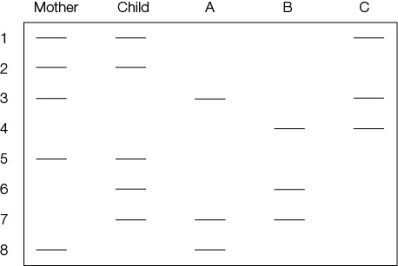 The figure shows a series of STRs (just for one locus) for a mother, a child, and three men who are all being considered as the possible biological father (A, B, and C).Which of the individuals could be the father?
 (Short Answer)
4.8/5 (71)
(71) Inborn errors of metabolism are more frequently encountered in highly consanguineous populations.To identify all mutations in the known genes responsible for a group of metabolic disorders that were common in such a population, researchers first established a pedigree of afflicted families, _______ the genes involved, then sequenced the products.
(Multiple Choice)
4.8/5 (75)
(75) One individual has the base A at position 768 of a DNA sequence, while another has a G.This is an example of a(n) _______.
(Short Answer)
4.7/5 (89)
(89) Treating a disease by restricting the substrate is an example of modifying the _______; using a metabolic inhibitor is an example of modifying _______.
(Multiple Choice)
4.8/5 (77)
(77) 
Filters
- Essay(0)
- Multiple Choice(0)
- Short Answer(0)
- True False(0)
- Matching(0)