



 Chat with AI
Exam 15: Gene Mutation and Molecular Medicine

Exam 1: Studying Life246 Questions
Exam 2: Small Molecules and the Chemistry of Life246 Questions
Exam 3: Proteins, Carbohydrates, and Lipids246 Questions
Exam 4: Nucleic Acids and the Origin of Life246 Questions
Exam 5: Cells: the Working Units of Life248 Questions
Exam 6: Cell Membranes246 Questions
Exam 7: Cell Communication and Multicellularity246 Questions
Exam 8: Energy, Enzymes, and Metabolism246 Questions
Exam 9: Pathways That Harvest Chemical Energy246 Questions
Exam 10: Photosynthesis: Energy From Sunlight242 Questions
Exam 11: The Cell Cycle and Cell Division260 Questions
Exam 12: Inheritance, Genes, and Chromosomes250 Questions
Exam 13: Dna and Its Role in Heredity257 Questions
Exam 14: From Dna to Protein: Gene Expression252 Questions
Exam 15: Gene Mutation and Molecular Medicine251 Questions
Exam 16: Regulation of Gene Expression245 Questions
Exam 17: Genomes249 Questions
Exam 18: Recombinant Dna and Biotechnology243 Questions
Exam 20: Mechanisms of Evolution243 Questions
Exam 21: Reconstructing and Using Phylogenies246 Questions
Exam 22: Speciation247 Questions
Exam 23: Evolution of Genes and Genomes252 Questions
Exam 24: The History of Life on Earth246 Questions
Exam 25: Bacteria, Archaea, and Viruses262 Questions
Exam 26: The Origin and Diversification of Eukaryotes252 Questions
Exam 27: Plants Without Seeds: From Water to Land251 Questions
Exam 28: The Evolution of Seed Plants259 Questions
Exam 29: The Evolution and Diversity of Fungi261 Questions
Exam 30: Animal Origins and the Evolution of Body Plans248 Questions
Exam 31: Protostome Animals244 Questions
Exam 32: Deuterostome Animals246 Questions
Exam 33: The Plant Body243 Questions
Exam 34: Transport in Plants248 Questions
Exam 35: Plant Nutrition247 Questions
Exam 36: Regulation of Plant Growth246 Questions
Exam 37: Reproduction in Flowering Plants247 Questions
Exam 38: Plant Responses to Environmental Challenges246 Questions
Exam 39: Physiology, Homeostasis, and Temperature Regulation258 Questions
Exam 40: Animal Hormones249 Questions
Exam 41: Immunology: Animal Defense Systems265 Questions
Exam 42: Animal Reproduction261 Questions
Exam 43: Animal Development261 Questions
Exam 44: Neurons, Glia, and Nervous Systems250 Questions
Exam 45: Sensory Systems249 Questions
Exam 46: The Mammalian Nervous System: Structure and Higher Functions254 Questions
Exam 47: Musculoskeletal Systems259 Questions
Exam 48: Gas Exchange247 Questions
Exam 49: Circulatory Systems252 Questions
Exam 50: Nutrition, Digestion, and Absorption259 Questions
Exam 51: Salt and Water Balance and Nitrogen Excretion251 Questions
Exam 52: Animal Behavior249 Questions
Exam 53: The Physical Environment and Biogeography of Life248 Questions
Exam 54: Populations259 Questions
Exam 55: Species Interactions254 Questions
Exam 56: Communities247 Questions
Exam 57: Ecosystems238 Questions
Exam 58: A Changing Biosphere222 Questions
Select questions type


A disease that manifests itself in symptoms of neurodegeneration is passed down from generation to generation in a manner consistent with an autosomal dominant mutation.The symptoms tend to get worse in subsequent generations, with individuals showing symptoms at progressively earlier ages than their afflicted parents.What is the most reasonable hypothesis consistent with all of these facts?
(Multiple Choice)
4.9/5  (69)
(69) Suppose you run gel electrophoresis using the standard voltage, but the spaces between the polymers of the gel are smaller than usual because of an error in making the gel.The samples are commonly run, so you neglect to include a lane with standards that would indicate the sizes of the bands.What is the most likely result?
(Multiple Choice)
4.7/5 (70)
(70) During replication a DNA polymerase slips backward then resumes replication.Which replication error is likely to occur as a result?
(Multiple Choice)
4.7/5 (71)
(71) The products of tumor suppressor genes _______ cell division; the products of oncogenes _______ cell division.
(Multiple Choice)
4.7/5 (69)
(69) A couple hopes to be parents but are concerned that their child could end up with cystic fibrosis, as both of them have family histories of cystic fibrosis (CF).Neither exhibits symptoms of CF, but CF is a recessive disease, so they get the CF test done.This scenario presents an example of
(Multiple Choice)
4.8/5 (63)
(63) Methylated _______ is particularly prone to mutation from deamination.
(Multiple Choice)
5.0/5 (82)
(82) Suppose restriction enzyme A makes two cuts in a linear DNA fragment and restriction enzyme B makes one cut in that same DNA.The cuts are not in the same place, and no two of the cut fragments is exactly the same size.The digested samples are run in an electrophoresis gel.How many bands should the gel pick up if both enzymes A and B are used in the restriction digest?
(Multiple Choice)
4.8/5 (65)
(65) If a mutation has a visible effect at 26°C, but no visible effect at 20°C, then 20°C is the _______ temperature and 26°C is the _______ temperature.
(Multiple Choice)
4.9/5 (80)
(80) People are often more concerned about germ line mutations than somatic ones because germ line mutations
(Multiple Choice)
4.9/5 (69)
(69) Refer to the table. 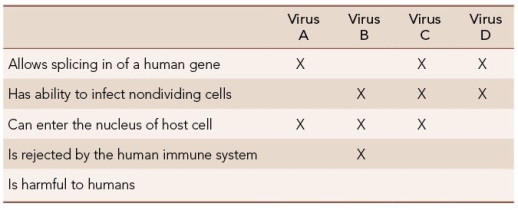 A researcher is considering several new carrier viruses, listed in the table, to use in a gene therapy trial to treat Alzheimer's disease.Which type of virus would be the most successful for carrying the gene into the patients' brains?
 (Multiple Choice)
4.9/5 (83)
(83) A child born of parents heterozygous for sickle-cell disease is screened at birth for the disease and is diagnosed as heterozygous by allele-specific oligonucleotide screening based on the genotypes of the parents.Thus, it is an unpleasant surprise when the child exhibits the symptoms of a homozygous individual.The doctor concludes that the screening test failed to pick up the second abnormal HBB allele due to a _______ mutation.DNA sequencing later reveals a de novo loss-of-function mutation elsewhere in the HBB gene.
(Multiple Choice)
4.7/5 (74)
(74) The standard test for PKU examines the _______ in the blood of newborns.
(Multiple Choice)
4.9/5 (80)
(80) Refer to the figure. 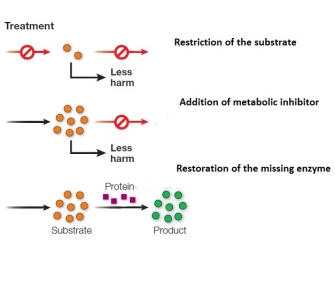 A child is born with a metabolic disorder in which there is a failure to produce an essential protein in brain development.This phenotype is the result of a single nonfunctional enzyme.The substrate for this enzyme does not build up in the brain, as it is essential for other metabolic pathways.Which is the best treatment strategy for this genetic disease?
 (Multiple Choice)
4.8/5 (83)
(83) A woman whose mother has Huntington's disease is concerned that she may also have the disease, even though she is currently asymptomatic.She can get this information from
(Multiple Choice)
4.8/5 (62)
(62) In allele-specific oligonucleotide hybridization for genetic screening, the probes are
(Multiple Choice)
4.9/5 (85)
(85) A neonate is diagnosed with phenylketonuria (PKU).Is PKU an autosomal recessive or dominant disease? What is the genetic abnormality associated with this disorder?
(Essay)
4.9/5 (78)
(78) DNA testing by allele-specific oligonucleotide hybridization
(Multiple Choice)
4.7/5 (81)
(81) Certain kinds of breast cancer are treated with a drug that inhibits estrogen production in fatty tissue.What kind of therapeutic approach is this?
(Multiple Choice)
4.8/5 (77)
(77) 
Filters
- Essay(0)
- Multiple Choice(0)
- Short Answer(0)
- True False(0)
- Matching(0)