



 Chat with AI
Exam 15: Gene Mutation and Molecular Medicine

Exam 1: Studying Life246 Questions
Exam 2: Small Molecules and the Chemistry of Life246 Questions
Exam 3: Proteins, Carbohydrates, and Lipids246 Questions
Exam 4: Nucleic Acids and the Origin of Life246 Questions
Exam 5: Cells: the Working Units of Life248 Questions
Exam 6: Cell Membranes246 Questions
Exam 7: Cell Communication and Multicellularity246 Questions
Exam 8: Energy, Enzymes, and Metabolism246 Questions
Exam 9: Pathways That Harvest Chemical Energy246 Questions
Exam 10: Photosynthesis: Energy From Sunlight242 Questions
Exam 11: The Cell Cycle and Cell Division260 Questions
Exam 12: Inheritance, Genes, and Chromosomes250 Questions
Exam 13: Dna and Its Role in Heredity257 Questions
Exam 14: From Dna to Protein: Gene Expression252 Questions
Exam 15: Gene Mutation and Molecular Medicine251 Questions
Exam 16: Regulation of Gene Expression245 Questions
Exam 17: Genomes249 Questions
Exam 18: Recombinant Dna and Biotechnology243 Questions
Exam 20: Mechanisms of Evolution243 Questions
Exam 21: Reconstructing and Using Phylogenies246 Questions
Exam 22: Speciation247 Questions
Exam 23: Evolution of Genes and Genomes252 Questions
Exam 24: The History of Life on Earth246 Questions
Exam 25: Bacteria, Archaea, and Viruses262 Questions
Exam 26: The Origin and Diversification of Eukaryotes252 Questions
Exam 27: Plants Without Seeds: From Water to Land251 Questions
Exam 28: The Evolution of Seed Plants259 Questions
Exam 29: The Evolution and Diversity of Fungi261 Questions
Exam 30: Animal Origins and the Evolution of Body Plans248 Questions
Exam 31: Protostome Animals244 Questions
Exam 32: Deuterostome Animals246 Questions
Exam 33: The Plant Body243 Questions
Exam 34: Transport in Plants248 Questions
Exam 35: Plant Nutrition247 Questions
Exam 36: Regulation of Plant Growth246 Questions
Exam 37: Reproduction in Flowering Plants247 Questions
Exam 38: Plant Responses to Environmental Challenges246 Questions
Exam 39: Physiology, Homeostasis, and Temperature Regulation258 Questions
Exam 40: Animal Hormones249 Questions
Exam 41: Immunology: Animal Defense Systems265 Questions
Exam 42: Animal Reproduction261 Questions
Exam 43: Animal Development261 Questions
Exam 44: Neurons, Glia, and Nervous Systems250 Questions
Exam 45: Sensory Systems249 Questions
Exam 46: The Mammalian Nervous System: Structure and Higher Functions254 Questions
Exam 47: Musculoskeletal Systems259 Questions
Exam 48: Gas Exchange247 Questions
Exam 49: Circulatory Systems252 Questions
Exam 50: Nutrition, Digestion, and Absorption259 Questions
Exam 51: Salt and Water Balance and Nitrogen Excretion251 Questions
Exam 52: Animal Behavior249 Questions
Exam 53: The Physical Environment and Biogeography of Life248 Questions
Exam 54: Populations259 Questions
Exam 55: Species Interactions254 Questions
Exam 56: Communities247 Questions
Exam 57: Ecosystems238 Questions
Exam 58: A Changing Biosphere222 Questions
Select questions type


Some bacteria use _______ enzymes as a defense mechanism; these enzymes cut up foreign DNA.
(Short Answer)
5.0/5  (99)
(99) A medical researcher finds a high incidence of covalent bonds between thymine and other nucleotides in the DNA of skin cells of a patient.The most likely cause is
(Multiple Choice)
4.9/5 (84)
(84) Refer to the chart of the genetic code. 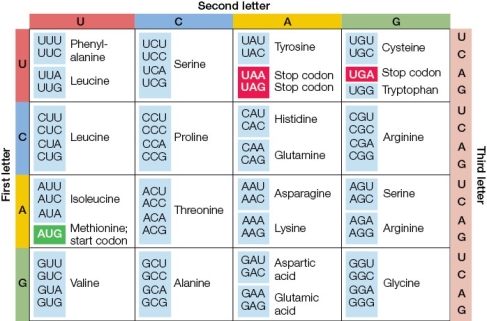 Given the codon CUU, would any mutations in the third position result in a missense mutation? Explain.If there would be any changes, name them.
 (Essay)
4.8/5 (73)
(73) People who are prediabetic and make too little insulin are often encouraged to limit their intake of sugar.This is an example of disease treatment that involves restricting the _______.
(Short Answer)
4.8/5 (69)
(69) In flies, Mariner is a stretch of DNA that is a few thousand base pairs long.Mariner contains genes that enable it to copy itself and then insert itself in various places in the genome.Mariner is thus a(n) _______.
(Short Answer)
4.9/5 (85)
(85) Incidences of most forms of cancer increase with age.Which of the following explanations is most plausible?
(Multiple Choice)
5.0/5 (78)
(78) During DNA replication, DNA polymerase inserts a T opposite a G, thereby introducing a(n) _______ mutation.
(Multiple Choice)
4.9/5 (78)
(78) Current treatments for human genetic diseases include all of the following except
(Multiple Choice)
4.8/5 (75)
(75) The disease PKU results from abnormalities in the enzyme _______.
(Short Answer)
4.8/5 (88)
(88) Suppose that for a certain gene, nearly 100 percent of the normal level of expression is required to produce the normal phenotype.Based on this requirement, one could predict that a _______ mutation would be _______.
(Multiple Choice)
4.9/5 (66)
(66) Chronic myelogenous leukemia (CML) is usually caused by the oncogene BCR/ABL.This abnormal gene is the product of the fusion of part of a BCR gene with part of an ABL gene.The resulting protein has unregulated tyrosine kinase activity.The BCR and ABL genes are normally found on two different chromosomes, respectively 22 and 9.What type of mutation is required to generate the BCR/ABL fusion gene?
(Multiple Choice)
4.9/5 (90)
(90) People with PKU often have too much of the amino acid _______ and too little of the amino acid _______.
(Multiple Choice)
4.8/5 (91)
(91) Genetic screening of a child with symptoms of developmental delays reveals an abnormal karyotype: all of the child's cells have an extra chromosome.Most likely the chromosomal mutation that lead to this error was _______ during the meiotic division that generated a gamete from one of the child's parents.
(Short Answer)
4.9/5 (77)
(77) Refer to the figure. 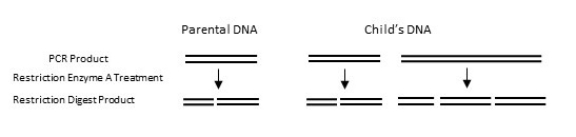 Through the use of linkage analysis, a researcher has identified a candidate gene responsible for a novel neurological disease.To obtain enough sample for DNA fingerprinting, the researcher uses PCR to amplify the gene.From the parent's DNA, PCR amplifies one band.From the child's DNA, the same size band plus a second larger band is amplified.Based on the published sequence of the gene, the researcher knows that restriction enzyme A will cut the wild-type allele into two fragments.The fragment sizes identified by DNA gel electrophoresis are shown in the figure.From this information one can infer that one of the child's alleles probably has one or more _______ mutation(s).
 (Multiple Choice)
4.9/5 (69)
(69) The gene order for one chromosome is A, B, C, D, E.A homologous chromosome has the gene order A, D, C, B, E.These chromosomes differ by a(n) _______.
(Short Answer)
4.7/5 (76)
(76) As commonly practiced in the developed world today, doctors screening for PKU infer the disease is present if the newborn has
(Multiple Choice)
5.0/5 (81)
(81) Changes in the tautomer state of nucleotides will most often lead to
(Multiple Choice)
5.0/5 (75)
(75) 
Filters
- Essay(0)
- Multiple Choice(0)
- Short Answer(0)
- True False(0)
- Matching(0)