



 Chat with AI
Exam 54: Populations

Exam 1: Studying Life246 Questions
Exam 2: Small Molecules and the Chemistry of Life246 Questions
Exam 3: Proteins, Carbohydrates, and Lipids246 Questions
Exam 4: Nucleic Acids and the Origin of Life246 Questions
Exam 5: Cells: the Working Units of Life248 Questions
Exam 6: Cell Membranes246 Questions
Exam 7: Cell Communication and Multicellularity246 Questions
Exam 8: Energy, Enzymes, and Metabolism246 Questions
Exam 9: Pathways That Harvest Chemical Energy246 Questions
Exam 10: Photosynthesis: Energy From Sunlight242 Questions
Exam 11: The Cell Cycle and Cell Division260 Questions
Exam 12: Inheritance, Genes, and Chromosomes250 Questions
Exam 13: Dna and Its Role in Heredity257 Questions
Exam 14: From Dna to Protein: Gene Expression252 Questions
Exam 15: Gene Mutation and Molecular Medicine251 Questions
Exam 16: Regulation of Gene Expression245 Questions
Exam 17: Genomes249 Questions
Exam 18: Recombinant Dna and Biotechnology243 Questions
Exam 20: Mechanisms of Evolution243 Questions
Exam 21: Reconstructing and Using Phylogenies246 Questions
Exam 22: Speciation247 Questions
Exam 23: Evolution of Genes and Genomes252 Questions
Exam 24: The History of Life on Earth246 Questions
Exam 25: Bacteria, Archaea, and Viruses262 Questions
Exam 26: The Origin and Diversification of Eukaryotes252 Questions
Exam 27: Plants Without Seeds: From Water to Land251 Questions
Exam 28: The Evolution of Seed Plants259 Questions
Exam 29: The Evolution and Diversity of Fungi261 Questions
Exam 30: Animal Origins and the Evolution of Body Plans248 Questions
Exam 31: Protostome Animals244 Questions
Exam 32: Deuterostome Animals246 Questions
Exam 33: The Plant Body243 Questions
Exam 34: Transport in Plants248 Questions
Exam 35: Plant Nutrition247 Questions
Exam 36: Regulation of Plant Growth246 Questions
Exam 37: Reproduction in Flowering Plants247 Questions
Exam 38: Plant Responses to Environmental Challenges246 Questions
Exam 39: Physiology, Homeostasis, and Temperature Regulation258 Questions
Exam 40: Animal Hormones249 Questions
Exam 41: Immunology: Animal Defense Systems265 Questions
Exam 42: Animal Reproduction261 Questions
Exam 43: Animal Development261 Questions
Exam 44: Neurons, Glia, and Nervous Systems250 Questions
Exam 45: Sensory Systems249 Questions
Exam 46: The Mammalian Nervous System: Structure and Higher Functions254 Questions
Exam 47: Musculoskeletal Systems259 Questions
Exam 48: Gas Exchange247 Questions
Exam 49: Circulatory Systems252 Questions
Exam 50: Nutrition, Digestion, and Absorption259 Questions
Exam 51: Salt and Water Balance and Nitrogen Excretion251 Questions
Exam 52: Animal Behavior249 Questions
Exam 53: The Physical Environment and Biogeography of Life248 Questions
Exam 54: Populations259 Questions
Exam 55: Species Interactions254 Questions
Exam 56: Communities247 Questions
Exam 57: Ecosystems238 Questions
Exam 58: A Changing Biosphere222 Questions
Select questions type


One population lives in an area with abundant food and allocates a large percentage of its available energy to reproduction.Another lives in an area where resources are scarce.Individuals spend more energy finding food and have fewer offspring.These populations are showing a difference in their _______ strategies.
(Short Answer)
4.9/5  (72)
(72) The Pacific salmon matures in the oceans but migrates to fresh water to breed.The Pacific salmon is semelparous.Other members of the salmon family live their entire lives in fresh water, and are typically iteroparous.What might explain the difference in life history patterns of these different species of salmon?
(Essay)
4.8/5 (81)
(81) Species fit along a continuum of r- and K-selection; not all species show purely r traits or purely K traits.For example, sparrows produce several young per year but only live a few years, while the wandering albatross first reproduces at age 10 and then produces a single egg every other year during its 40-year life span.Compared to the albatross, the sparrow is more
(Multiple Choice)
4.9/5 (92)
(92) In the life table below, survivorship is greatest during which time interval? 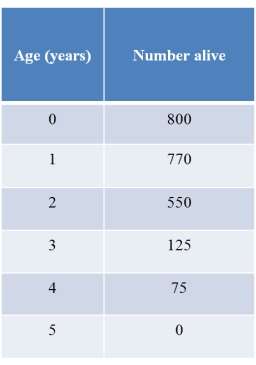
(Multiple Choice)
4.8/5 (81)
(81) A conservationist trying to manage a population of deer within a national forest looks at past life tables of the deer population.To predict future trends in the deer population, the conservationist would likely be most interested in which aspect of the life table?
(Multiple Choice)
4.8/5 (72)
(72) A group of scientists is studying a population, or pod, of dolphins.They gather information about individual dolphins to determine population characteristics, migration patterns, and other factors.They identify each dolphin by photographing its dorsal fins, providing a photo-ID similar to a fingerprint.Scientists in this study are using which method of studying populations?
(Multiple Choice)
4.8/5 (75)
(75) Depending on the species, a clumped distribution pattern might be adaptive for a population for all of the following except
(Multiple Choice)
4.9/5 (78)
(78) Which organism is not correctly matched with its dispersion pattern?
(Multiple Choice)
4.9/5 (81)
(81) The most likely way that a species' population numbers would be controlled when resources are limiting is by
(Multiple Choice)
4.8/5 (89)
(89) Ruby-throated hummingbirds migrate as far north as northern Canada in the summer but return to Central America each winter.Migration is extremely energy intensive, and ruby-throats nearly double their body weight (from 3.25 to 6 grams) before migrating.When they reach the Gulf Coast they weigh only about 2.25 grams.What adaptive advantage do these tiny birds receive by making this stressful, hazardous journey every year?
(Multiple Choice)
4.9/5 (74)
(74) In the population growth equation, the main parameters that contribute directly to increases, decreases, or stability in population size are
(Multiple Choice)
4.8/5 (85)
(85) Geographically distant events would likely have the most impact on populations of
(Multiple Choice)
4.8/5 (81)
(81) The European gypsy moth was introduced into the eastern United States in the 1860s and spread rapidly.Its caterpillars feed on the leaves of oaks and other trees, and high numbers can defoliate large areas of forest.Recently, a virus specific to gypsy moths has become widespread and has killed large numbers of caterpillars.Before planning a management strategy, foresters want to understand the life history strategies of the species involved in the interaction.What should they conclude about the gypsy moth-oak tree interaction, and about the gypsy moth-virus interaction?
(Multiple Choice)
4.7/5 (98)
(98) A cohort life table allows population ecologists to do all of the following except
(Multiple Choice)
4.8/5 (84)
(84) At the beginning of May, 259 butterflies are found in a certain locality.During the month, 45 butterflies emigrate, 10 die, and 67 immigrate into the area.No butterflies hatch.What is the population size at the end of the month?
(Multiple Choice)
4.8/5 (77)
(77) The black rockfish has indeterminate growth, and female fecundity is directly proportional to size and age.Larvae produced by older females have better nutrition and grow faster.How does the fact that fishermen prefer to catch larger fish affect the management of the rockfish population?
(Multiple Choice)
4.8/5 (77)
(77) A study population shows more immigration than emigration.However, researchers studying this population have assumed that these factors are equal.If the per capita growth rate is estimated according to the equation r = b − d, the calculation of r may be
(Multiple Choice)
4.9/5 (77)
(77) Which situation would most likely result in a temporary life history trade-off in which a rabbit population allocates more of its available energy to obtaining nutrients for survival and less to reproduction?
(Multiple Choice)
4.7/5 (88)
(88) Which pattern of survivorship is most likely for an organism such as the sea urchin, which produces large numbers of very small offspring and provides no parental care?
(Multiple Choice)
4.8/5 (91)
(91) A metapopulation would be most likely to develop in a situation where
(Multiple Choice)
4.8/5 (75)
(75) 
Filters
- Essay(0)
- Multiple Choice(0)
- Short Answer(0)
- True False(0)
- Matching(0)