



 Chat with AI
Exam 13: Dna and Its Role in Heredity

Exam 1: Studying Life246 Questions
Exam 2: Small Molecules and the Chemistry of Life246 Questions
Exam 3: Proteins, Carbohydrates, and Lipids246 Questions
Exam 4: Nucleic Acids and the Origin of Life246 Questions
Exam 5: Cells: the Working Units of Life248 Questions
Exam 6: Cell Membranes246 Questions
Exam 7: Cell Communication and Multicellularity246 Questions
Exam 8: Energy, Enzymes, and Metabolism246 Questions
Exam 9: Pathways That Harvest Chemical Energy246 Questions
Exam 10: Photosynthesis: Energy From Sunlight242 Questions
Exam 11: The Cell Cycle and Cell Division260 Questions
Exam 12: Inheritance, Genes, and Chromosomes250 Questions
Exam 13: Dna and Its Role in Heredity257 Questions
Exam 14: From Dna to Protein: Gene Expression252 Questions
Exam 15: Gene Mutation and Molecular Medicine251 Questions
Exam 16: Regulation of Gene Expression245 Questions
Exam 17: Genomes249 Questions
Exam 18: Recombinant Dna and Biotechnology243 Questions
Exam 20: Mechanisms of Evolution243 Questions
Exam 21: Reconstructing and Using Phylogenies246 Questions
Exam 22: Speciation247 Questions
Exam 23: Evolution of Genes and Genomes252 Questions
Exam 24: The History of Life on Earth246 Questions
Exam 25: Bacteria, Archaea, and Viruses262 Questions
Exam 26: The Origin and Diversification of Eukaryotes252 Questions
Exam 27: Plants Without Seeds: From Water to Land251 Questions
Exam 28: The Evolution of Seed Plants259 Questions
Exam 29: The Evolution and Diversity of Fungi261 Questions
Exam 30: Animal Origins and the Evolution of Body Plans248 Questions
Exam 31: Protostome Animals244 Questions
Exam 32: Deuterostome Animals246 Questions
Exam 33: The Plant Body243 Questions
Exam 34: Transport in Plants248 Questions
Exam 35: Plant Nutrition247 Questions
Exam 36: Regulation of Plant Growth246 Questions
Exam 37: Reproduction in Flowering Plants247 Questions
Exam 38: Plant Responses to Environmental Challenges246 Questions
Exam 39: Physiology, Homeostasis, and Temperature Regulation258 Questions
Exam 40: Animal Hormones249 Questions
Exam 41: Immunology: Animal Defense Systems265 Questions
Exam 42: Animal Reproduction261 Questions
Exam 43: Animal Development261 Questions
Exam 44: Neurons, Glia, and Nervous Systems250 Questions
Exam 45: Sensory Systems249 Questions
Exam 46: The Mammalian Nervous System: Structure and Higher Functions254 Questions
Exam 47: Musculoskeletal Systems259 Questions
Exam 48: Gas Exchange247 Questions
Exam 49: Circulatory Systems252 Questions
Exam 50: Nutrition, Digestion, and Absorption259 Questions
Exam 51: Salt and Water Balance and Nitrogen Excretion251 Questions
Exam 52: Animal Behavior249 Questions
Exam 53: The Physical Environment and Biogeography of Life248 Questions
Exam 54: Populations259 Questions
Exam 55: Species Interactions254 Questions
Exam 56: Communities247 Questions
Exam 57: Ecosystems238 Questions
Exam 58: A Changing Biosphere222 Questions
Select questions type


If one strand of DNA has a C attached to a sugar with a free 5 phosphate group, the other strand will have a _______ attached to a sugar with a free _______ group.
(Multiple Choice)
4.7/5  (79)
(79) In many eukaryotes, there are repetitive sequences called telomeres at the ends of chromosomes.After successive rounds of DNA replication, the _______ strand becomes shorter.In some cells, an enzyme called _______ repairs the shortened strand.
a. lagging; telomerase
b. leading; DNA polymerase I
c. leading; replicase
d. lagging; DNA polymerase I
e. leading; telomerase
(Essay)
5.0/5 (72)
(72) If 28 percent of the bases in a sample of DNA are T, _______ percent must be G.
(Multiple Choice)
4.8/5 (71)
(71) Refer to the figure, which shows DNA replication. 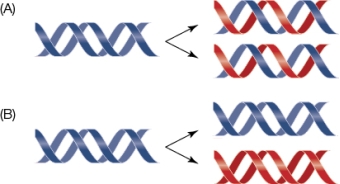 Which diagram (A or B) shows semiconservative replication?
 (Short Answer)
4.8/5 (79)
(79) If Hershey and Chase had found 32P in both the pellet and the supernatant of the phage-infected bacteria, what would have been their likely conclusion about the nature of genetic material?
(Multiple Choice)
4.9/5 (69)
(69) Refer to the figure of a DNA molecule. 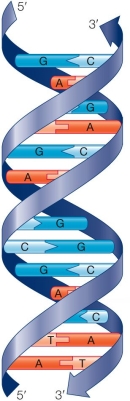 One can deduce all of the following information from this image except
 (Multiple Choice)
5.0/5 (71)
(71) If a sequence in one strand of DNA is 5ʹ-AGCTGCTGA-3ʹ, what is the sequence in the complementary strand?
(Multiple Choice)
4.8/5 (77)
(77) If the Meselson-Stahl density gradient experiment had resulted in two bands of DNA molecules after only one round of replication, one containing only 15N and the second only 14N, this result would have indicated that replication was
a. conservative.
b. dispersive.
c. bidirectional.
d. semiconservative
e. unidirectional.
(Essay)
4.9/5 (91)
(91) A researcher would like to separate viral DNA from the viral coat proteins using a density gradient.Which material would she use to set the density gradient?
(Multiple Choice)
4.8/5 (75)
(75) What prevents the DNA repair system from "repairing" telomeres?
(Multiple Choice)
4.8/5 (72)
(72) If a single cycle of PCR takes 5 minutes, how long should it take to amplify one double-stranded molecule into 64?
(Multiple Choice)
4.8/5 (72)
(72) The nucleotides that make up a DNA molecule each contain _______ phosphate group(s).Before they are added to the DNA, the precursors to nucleotides each contain _______ phosphate group(s).
(Multiple Choice)
4.8/5 (73)
(73) Bacteria from hot springs greatly helped the development of PCR by
(Multiple Choice)
4.7/5 (74)
(74) Which feature of DNA replication is a consequence of semiconservative replication?
(Multiple Choice)
4.9/5 (66)
(66) You are a biologist working with a cell culture.You notice that the chromosomes are decreasing in size with each cell division.Other than that, the cells seem healthy.What is the most likely explanation?
(Multiple Choice)
4.8/5 (89)
(89) Refer to the figure, which shows DNA complementary base pairing. 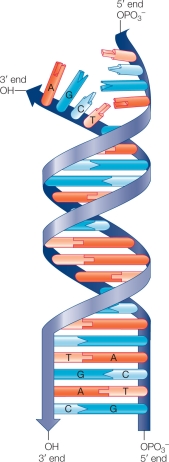 Explain the difference between conservative and semiconservative models of DNA replication.What were the experimental results that supported the semiconservative model? What would the results have looked like if the conservative model of DNA replication had been accurate? Are there any other potential hypotheses?
 (Essay)
4.8/5 (91)
(91) Researchers have determined the chemical composition of a molecule that interacts with DNA.To understand how it binds to a DNA molecule, the researchers can utilize _______ to deduce the physical structure of the molecule.
(Short Answer)
4.8/5 (76)
(76) If the enzyme _______ were nonfunctional, the double helix would not be able to unwind and separate into single strands.
(Short Answer)
4.8/5 (81)
(81) 
Filters
- Essay(0)
- Multiple Choice(0)
- Short Answer(0)
- True False(0)
- Matching(0)