



 Chat with AI
Exam 13: Dna and Its Role in Heredity

Exam 1: Studying Life246 Questions
Exam 2: Small Molecules and the Chemistry of Life246 Questions
Exam 3: Proteins, Carbohydrates, and Lipids246 Questions
Exam 4: Nucleic Acids and the Origin of Life246 Questions
Exam 5: Cells: the Working Units of Life248 Questions
Exam 6: Cell Membranes246 Questions
Exam 7: Cell Communication and Multicellularity246 Questions
Exam 8: Energy, Enzymes, and Metabolism246 Questions
Exam 9: Pathways That Harvest Chemical Energy246 Questions
Exam 10: Photosynthesis: Energy From Sunlight242 Questions
Exam 11: The Cell Cycle and Cell Division260 Questions
Exam 12: Inheritance, Genes, and Chromosomes250 Questions
Exam 13: Dna and Its Role in Heredity257 Questions
Exam 14: From Dna to Protein: Gene Expression252 Questions
Exam 15: Gene Mutation and Molecular Medicine251 Questions
Exam 16: Regulation of Gene Expression245 Questions
Exam 17: Genomes249 Questions
Exam 18: Recombinant Dna and Biotechnology243 Questions
Exam 20: Mechanisms of Evolution243 Questions
Exam 21: Reconstructing and Using Phylogenies246 Questions
Exam 22: Speciation247 Questions
Exam 23: Evolution of Genes and Genomes252 Questions
Exam 24: The History of Life on Earth246 Questions
Exam 25: Bacteria, Archaea, and Viruses262 Questions
Exam 26: The Origin and Diversification of Eukaryotes252 Questions
Exam 27: Plants Without Seeds: From Water to Land251 Questions
Exam 28: The Evolution of Seed Plants259 Questions
Exam 29: The Evolution and Diversity of Fungi261 Questions
Exam 30: Animal Origins and the Evolution of Body Plans248 Questions
Exam 31: Protostome Animals244 Questions
Exam 32: Deuterostome Animals246 Questions
Exam 33: The Plant Body243 Questions
Exam 34: Transport in Plants248 Questions
Exam 35: Plant Nutrition247 Questions
Exam 36: Regulation of Plant Growth246 Questions
Exam 37: Reproduction in Flowering Plants247 Questions
Exam 38: Plant Responses to Environmental Challenges246 Questions
Exam 39: Physiology, Homeostasis, and Temperature Regulation258 Questions
Exam 40: Animal Hormones249 Questions
Exam 41: Immunology: Animal Defense Systems265 Questions
Exam 42: Animal Reproduction261 Questions
Exam 43: Animal Development261 Questions
Exam 44: Neurons, Glia, and Nervous Systems250 Questions
Exam 45: Sensory Systems249 Questions
Exam 46: The Mammalian Nervous System: Structure and Higher Functions254 Questions
Exam 47: Musculoskeletal Systems259 Questions
Exam 48: Gas Exchange247 Questions
Exam 49: Circulatory Systems252 Questions
Exam 50: Nutrition, Digestion, and Absorption259 Questions
Exam 51: Salt and Water Balance and Nitrogen Excretion251 Questions
Exam 52: Animal Behavior249 Questions
Exam 53: The Physical Environment and Biogeography of Life248 Questions
Exam 54: Populations259 Questions
Exam 55: Species Interactions254 Questions
Exam 56: Communities247 Questions
Exam 57: Ecosystems238 Questions
Exam 58: A Changing Biosphere222 Questions
Select questions type


The enzyme DNA ligase is required continuously during DNA replication in order for
(Multiple Choice)
4.8/5  (87)
(87) Mismatch repair differs from the other types of DNA repair in that it
(Multiple Choice)
4.7/5 (85)
(85) PCR is commonly used in research, forensics, and for the diagnosis of pathogens and genetic diseases.A commercial standardized diagnostic PCR test has been developed that uses one set of primers to amplify a short DNA template.For which of the following scenarios would such a standardized PCR test be most appropriate:
(Multiple Choice)
4.8/5 (74)
(74) Researchers can use PCR to introduce mutations in a gene.To do so, they can use a DNA primer that has one or more incorrect nucleotides.A low annealing temperature will allow the primer to anneal with the DNA and, if there are complementary base pairings at the 3ʹ end of the primer, initiate DNA polymerase activity.Why are these errors not corrected during PCR?
(Essay)
4.9/5 (74)
(74) The "antiparallel relationship" of the two strands of DNA refers to
(Multiple Choice)
4.8/5 (75)
(75) How many strands are used as a template in semiconservative replication?
(Multiple Choice)
4.8/5 (77)
(77) The short "starter" strand used in DNA replication is called the _______; in most organisms it is made up of _______.
(Multiple Choice)
4.8/5 (62)
(62) Starting with a single double-stranded DNA molecule, _______ double-stranded DNA molecules will be created after five rounds of PCR (assuming that the PCR works perfectly).
(Multiple Choice)
4.8/5 (78)
(78) The region of DNA where replication begins is called the _______.
(Short Answer)
4.8/5 (82)
(82) If DNA polymerase III introduces an incorrect nucleotide, what is the first corrective action made by the DNA repair system?
a. The mismatch repair system scans for base-pairing mismatches.
b. The excision repair proteins remove the incorrect nucleotide.
c. DNA ligase connects the correct nucleotide.
d. The replication complex excises the incorrect nucleotide.
e. There is no correction, because nucleotide errors by DNA polymerases are not repaired.
(Essay)
4.8/5 (94)
(94) Explain how the experiment of Avery and colleagues ruled out protein and RNA as the transforming substance and suggested that DNA was the genetic material.
(Essay)
4.8/5 (74)
(74) The DNA binding dye that was developed about 100 years ago (and is now called Feulgen stain) binds to DNA and stains nuclei a bright purple in direct proportion to the amount of DNA present in cells.As a consequence of this property, the dye revealed that gametes have _______ DNA as somatic cells have.
(Multiple Choice)
4.9/5 (83)
(83) The strand of DNA that grows continuously as the replication fork opens up is known as the _______ strand.
(Multiple Choice)
4.9/5 (78)
(78) To replicate their DNA in a timely manner, most eukaryotic chromosomes
a. contain linear molecules of single-stranded DNA.
b. normally have uncoiled DNA.
c. have multiple origins of replication.
d. have two replication forks that move in the same direction.
e. are composed entirely of DNA.
(Essay)
4.8/5 (94)
(94) Information sources used by Watson and Crick to determine the structure of DNA included
(Multiple Choice)
4.9/5 (77)
(77) Refer to the figure, which illustrates the chemical structure of DNA. 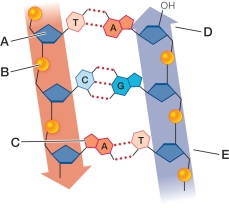 Which label corresponds to a 3ʹ end?
 (Multiple Choice)
5.0/5 (74)
(74) DNA production during PCR can be calculated by the rule of 2n, where n equals the number of rounds of amplification.About how many rounds of PCR are required to produce a billion DNA molecules from a single molecule, assuming that the PCR works perfectly?
(Multiple Choice)
4.9/5 (76)
(76) Which three major properties of genes can be attributed to the structure of DNA?
(Multiple Choice)
4.9/5 (89)
(89) Ideally, PCR _______ increases the amount of DNA during additional cycles.
(Multiple Choice)
4.7/5 (78)
(78) In Griffith's experiment, some substance from heat-killed S-type cells resulted in _______ of R-type cells.
(Short Answer)
4.9/5 (77)
(77) 
Filters
- Essay(0)
- Multiple Choice(0)
- Short Answer(0)
- True False(0)
- Matching(0)