



 Chat with AI
Exam 48: Gas Exchange

Exam 1: Studying Life246 Questions
Exam 2: Small Molecules and the Chemistry of Life246 Questions
Exam 3: Proteins, Carbohydrates, and Lipids246 Questions
Exam 4: Nucleic Acids and the Origin of Life246 Questions
Exam 5: Cells: the Working Units of Life248 Questions
Exam 6: Cell Membranes246 Questions
Exam 7: Cell Communication and Multicellularity246 Questions
Exam 8: Energy, Enzymes, and Metabolism246 Questions
Exam 9: Pathways That Harvest Chemical Energy246 Questions
Exam 10: Photosynthesis: Energy From Sunlight242 Questions
Exam 11: The Cell Cycle and Cell Division260 Questions
Exam 12: Inheritance, Genes, and Chromosomes250 Questions
Exam 13: Dna and Its Role in Heredity257 Questions
Exam 14: From Dna to Protein: Gene Expression252 Questions
Exam 15: Gene Mutation and Molecular Medicine251 Questions
Exam 16: Regulation of Gene Expression245 Questions
Exam 17: Genomes249 Questions
Exam 18: Recombinant Dna and Biotechnology243 Questions
Exam 20: Mechanisms of Evolution243 Questions
Exam 21: Reconstructing and Using Phylogenies246 Questions
Exam 22: Speciation247 Questions
Exam 23: Evolution of Genes and Genomes252 Questions
Exam 24: The History of Life on Earth246 Questions
Exam 25: Bacteria, Archaea, and Viruses262 Questions
Exam 26: The Origin and Diversification of Eukaryotes252 Questions
Exam 27: Plants Without Seeds: From Water to Land251 Questions
Exam 28: The Evolution of Seed Plants259 Questions
Exam 29: The Evolution and Diversity of Fungi261 Questions
Exam 30: Animal Origins and the Evolution of Body Plans248 Questions
Exam 31: Protostome Animals244 Questions
Exam 32: Deuterostome Animals246 Questions
Exam 33: The Plant Body243 Questions
Exam 34: Transport in Plants248 Questions
Exam 35: Plant Nutrition247 Questions
Exam 36: Regulation of Plant Growth246 Questions
Exam 37: Reproduction in Flowering Plants247 Questions
Exam 38: Plant Responses to Environmental Challenges246 Questions
Exam 39: Physiology, Homeostasis, and Temperature Regulation258 Questions
Exam 40: Animal Hormones249 Questions
Exam 41: Immunology: Animal Defense Systems265 Questions
Exam 42: Animal Reproduction261 Questions
Exam 43: Animal Development261 Questions
Exam 44: Neurons, Glia, and Nervous Systems250 Questions
Exam 45: Sensory Systems249 Questions
Exam 46: The Mammalian Nervous System: Structure and Higher Functions254 Questions
Exam 47: Musculoskeletal Systems259 Questions
Exam 48: Gas Exchange247 Questions
Exam 49: Circulatory Systems252 Questions
Exam 50: Nutrition, Digestion, and Absorption259 Questions
Exam 51: Salt and Water Balance and Nitrogen Excretion251 Questions
Exam 52: Animal Behavior249 Questions
Exam 53: The Physical Environment and Biogeography of Life248 Questions
Exam 54: Populations259 Questions
Exam 55: Species Interactions254 Questions
Exam 56: Communities247 Questions
Exam 57: Ecosystems238 Questions
Exam 58: A Changing Biosphere222 Questions
Select questions type


Which is the correct pairing of phase of respiration and description in humans?
(Multiple Choice)
4.9/5  (75)
(75) A patient who has smoked her entire adult life is diagnosed with severe emphysema.In measuring her lung ventilation, it was determined that the tidal volume of her lungs is 0.6 liter, her inspiratory reserve volume is 0.5 liter, her vital capacity is 1.5 liters, and her residual volume is 4.5 liters.What is her total lung capacity? Which of these volumes is larger than what you would find in a healthy person?
(Multiple Choice)
4.8/5 (83)
(83) Which statement on perfusion or ventilation in humans is true?
(Multiple Choice)
4.9/5 (83)
(83) To maximize exchange of respiratory gases, an animal's adaptations should minimize the
(Multiple Choice)
4.8/5 (93)
(93) Each molecule of hemoglobin, when fully saturated, carries _______ molecule(s) of oxygen.
(Multiple Choice)
4.7/5 (77)
(77) If the thoracic wall is punctured, air leaking in will cause the lung to collapse.Thus in the normal, intact thoracic cavity,
(Multiple Choice)
4.9/5 (86)
(86) Hemoglobin consists of _______ polypeptide subunits linked together.
(Short Answer)
4.8/5 (84)
(84) Oxygen exchange in water is limited by _______ diffusion rate and _______ oxygen content, especially in _______ water temperatures.
(Multiple Choice)
4.8/5 (75)
(75) Refer to the figure showing oxygen consumption of an organism relative to water temperature. 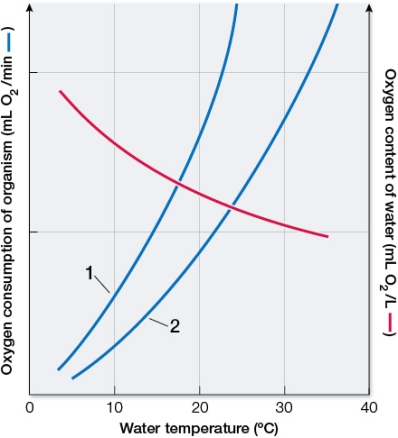 The organism represented by blue line 1 could be a(n) _______, and the organism represented by blue line 2 could be a(n) _______.
 (Multiple Choice)
5.0/5 (83)
(83) By being aquatic, _______ are in a double bind, because their demand for oxygen increases as the temperature of their water environment increases, but the oxygen content of water declines with increasing water temperatures.
(Multiple Choice)
4.9/5 (88)
(88) Refer to the figure. 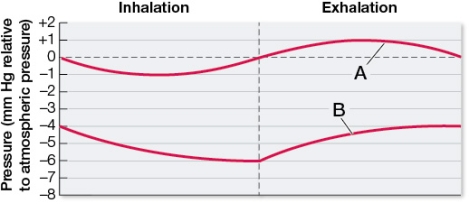 Which curve represents alveolar pressure and which represents pleural cavity pressure? At what point in the breathing cycle is the pleural cavity pressure decreasing while the alveolar pressure is increasing?
 (Essay)
4.9/5 (69)
(69) Mammalian lungs have two adaptive features: the production of mucus and _______, a substance that reduces the surface tension of the liquid lining the insides of the alveoli.
(Short Answer)
4.8/5 (83)
(83) What is the correct pairing of measurement and definition?
(Multiple Choice)
4.9/5 (91)
(91) Refer to the figure showing a variety of animals. 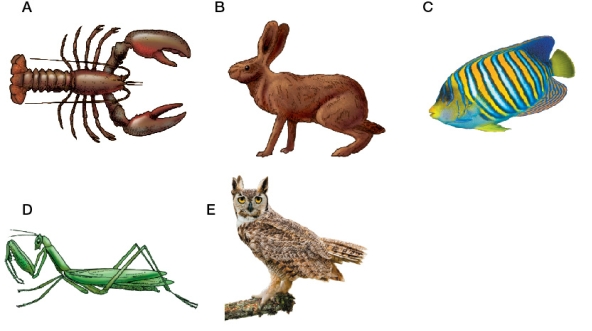 Which organism requires ventilation of its respiratory surfaces with a medium containing O2, but does not require perfusion of its respiratory surfaces with blood?
 (Multiple Choice)
4.9/5 (79)
(79) Refer to the figure showing the respiratory system in birds. 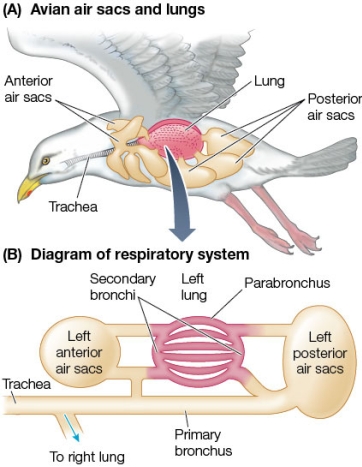 Based on the figure, which statement about the air sacs of birds is true?
 (Multiple Choice)
4.9/5 (80)
(80) Atmospheric pressure at sea level is 760 mm Hg, and oxygen makes up 20.9% of this air when the air is dry.Scientists at a Mount Everest base camp measured the atmospheric pressure there as 400 mm Hg.When the air is dry, the partial pressure of oxygen at this base camp is approximately _______ mm Hg.
(Multiple Choice)
4.7/5 (70)
(70) An unusual feature of the lungs of _______ is that they expand and contract relatively little during a breathing cycle.They also contract during inhalation and expand during exhalation.
(Short Answer)
4.7/5 (74)
(74) For air-breathing animals, there is always a _______ concentration gradient for diffusion of CO2 from the _______ to the _______.
(Multiple Choice)
4.8/5 (76)
(76) 
Filters
- Essay(0)
- Multiple Choice(0)
- Short Answer(0)
- True False(0)
- Matching(0)