



 Chat with AI
Exam 23: Evolution of Genes and Genomes

Exam 1: Studying Life246 Questions
Exam 2: Small Molecules and the Chemistry of Life246 Questions
Exam 3: Proteins, Carbohydrates, and Lipids246 Questions
Exam 4: Nucleic Acids and the Origin of Life246 Questions
Exam 5: Cells: the Working Units of Life248 Questions
Exam 6: Cell Membranes246 Questions
Exam 7: Cell Communication and Multicellularity246 Questions
Exam 8: Energy, Enzymes, and Metabolism246 Questions
Exam 9: Pathways That Harvest Chemical Energy246 Questions
Exam 10: Photosynthesis: Energy From Sunlight242 Questions
Exam 11: The Cell Cycle and Cell Division260 Questions
Exam 12: Inheritance, Genes, and Chromosomes250 Questions
Exam 13: Dna and Its Role in Heredity257 Questions
Exam 14: From Dna to Protein: Gene Expression252 Questions
Exam 15: Gene Mutation and Molecular Medicine251 Questions
Exam 16: Regulation of Gene Expression245 Questions
Exam 17: Genomes249 Questions
Exam 18: Recombinant Dna and Biotechnology243 Questions
Exam 20: Mechanisms of Evolution243 Questions
Exam 21: Reconstructing and Using Phylogenies246 Questions
Exam 22: Speciation247 Questions
Exam 23: Evolution of Genes and Genomes252 Questions
Exam 24: The History of Life on Earth246 Questions
Exam 25: Bacteria, Archaea, and Viruses262 Questions
Exam 26: The Origin and Diversification of Eukaryotes252 Questions
Exam 27: Plants Without Seeds: From Water to Land251 Questions
Exam 28: The Evolution of Seed Plants259 Questions
Exam 29: The Evolution and Diversity of Fungi261 Questions
Exam 30: Animal Origins and the Evolution of Body Plans248 Questions
Exam 31: Protostome Animals244 Questions
Exam 32: Deuterostome Animals246 Questions
Exam 33: The Plant Body243 Questions
Exam 34: Transport in Plants248 Questions
Exam 35: Plant Nutrition247 Questions
Exam 36: Regulation of Plant Growth246 Questions
Exam 37: Reproduction in Flowering Plants247 Questions
Exam 38: Plant Responses to Environmental Challenges246 Questions
Exam 39: Physiology, Homeostasis, and Temperature Regulation258 Questions
Exam 40: Animal Hormones249 Questions
Exam 41: Immunology: Animal Defense Systems265 Questions
Exam 42: Animal Reproduction261 Questions
Exam 43: Animal Development261 Questions
Exam 44: Neurons, Glia, and Nervous Systems250 Questions
Exam 45: Sensory Systems249 Questions
Exam 46: The Mammalian Nervous System: Structure and Higher Functions254 Questions
Exam 47: Musculoskeletal Systems259 Questions
Exam 48: Gas Exchange247 Questions
Exam 49: Circulatory Systems252 Questions
Exam 50: Nutrition, Digestion, and Absorption259 Questions
Exam 51: Salt and Water Balance and Nitrogen Excretion251 Questions
Exam 52: Animal Behavior249 Questions
Exam 53: The Physical Environment and Biogeography of Life248 Questions
Exam 54: Populations259 Questions
Exam 55: Species Interactions254 Questions
Exam 56: Communities247 Questions
Exam 57: Ecosystems238 Questions
Exam 58: A Changing Biosphere222 Questions
Select questions type


Which event is likely to affect the length of arrays of repetitive sequences?
(Multiple Choice)
4.9/5  (81)
(81) Though they look quite different, because of evolved modifications, the limbs of whales, bats, and humans are all derived from the same structure present in the common ancestor of these mammals.Thus, these limbs are _______ structures.
(Multiple Choice)
4.9/5 (91)
(91) When comparing the amino acid sequences of homologous proteins, molecular evolutionists can construct a _______ by summing the numbers of the same or different amino acids in each pair of compared sequences.
(Short Answer)
4.9/5 (69)
(69) The following sequences have been obtained from a hypothetical gene in three species of Drosophila:
D.melanogaster: GGCTTGTAGCTGTGCTCGCCGCTAGTCGG
D.simulans: AGGCTTGTAGCTGTGCTCGCCGCTAGTAGG
D.erecta: AGGGTAGCTGTGCTCACCGCTCGTCGG
If we assume that each observed nucleotide change is equivalent to two nucleotide substitutions, a total of _______ substitution(s) has/have occurred between D.melanogaster and D.simulans.
(Short Answer)
4.8/5 (79)
(79) The hypothesis for genome size presented in the textbook proposes that _______ selection is _______ effective in large populations, and thus species with large populations should have _______ genomes than those with smaller populations.
(Multiple Choice)
4.9/5 (76)
(76) Paralogous genes are genes that trace back to a common _______ event.
(Short Answer)
5.0/5 (91)
(91) The natural substitution rate for the RNA virus HIV-1 is 1 substitution per 1,000 nucleotides per generation.Consequently, this virus can be used as a model system to directly study molecular _______.
(Short Answer)
4.8/5 (74)
(74) Molecular evolutionists study relationships between the _______ of genes and proteins and their functions in organisms.
(Short Answer)
4.8/5 (87)
(87) The following sequences have been obtained from a hypothetical gene in three species of Drosophila:
D.melanogaster: GGCTTGTAGCTGTGCTCGCCGCTAGTCGG
D.simulans: AGGCTTGTAGCTGTGCTCGCCGCTAGTAGG
D.erecta: AGGGTAGCTGTGCTCACCGCTCGTCGG
To properly align the three sequences so they can be used to make comparisons, a gap representing _______ nucleotides should be added to sequence D.erecta starting at position 4.
(Short Answer)
4.9/5 (75)
(75) As discussed in the text, the molecular evolution studies of sodium channels in puffer fish are primarily used
(Multiple Choice)
4.8/5 (68)
(68) Refer to the figure. 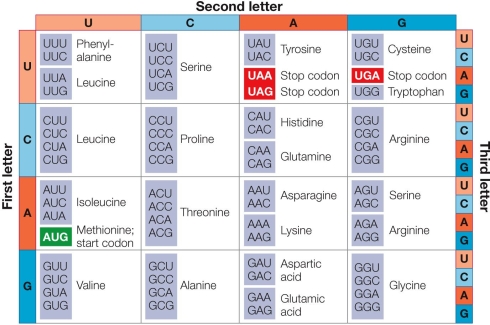 Which of the nucleotide substitutions in an mRNA strand would have the most harmful effect on the activity of the protein that it encodes?
 (Multiple Choice)
4.9/5 (73)
(73) Suppose the common ancestor of cows and whales had A at one nucleotide site.At this site, whales have G and cows have T.This would be an example of a _______ substitution.
(Short Answer)
4.8/5 (82)
(82) Suppose the size of a population of marmots is 300.Assuming that the neutral mutation rate for a particular gene is µ (mu), the number of new mutations at each gene in this population is _______ × µ.
(Multiple Choice)
4.9/5 (68)
(68) Scientists use sequence alignment to identify _______ nucleotides or amino acids when studying the evolution of genes shared by two or more species with a common ancestor.
(Short Answer)
4.8/5 (83)
(83) 
Filters
- Essay(0)
- Multiple Choice(0)
- Short Answer(0)
- True False(0)
- Matching(0)