



 Chat with AI
Exam 23: Evolution of Genes and Genomes

Exam 1: Studying Life246 Questions
Exam 2: Small Molecules and the Chemistry of Life246 Questions
Exam 3: Proteins, Carbohydrates, and Lipids246 Questions
Exam 4: Nucleic Acids and the Origin of Life246 Questions
Exam 5: Cells: the Working Units of Life248 Questions
Exam 6: Cell Membranes246 Questions
Exam 7: Cell Communication and Multicellularity246 Questions
Exam 8: Energy, Enzymes, and Metabolism246 Questions
Exam 9: Pathways That Harvest Chemical Energy246 Questions
Exam 10: Photosynthesis: Energy From Sunlight242 Questions
Exam 11: The Cell Cycle and Cell Division260 Questions
Exam 12: Inheritance, Genes, and Chromosomes250 Questions
Exam 13: Dna and Its Role in Heredity257 Questions
Exam 14: From Dna to Protein: Gene Expression252 Questions
Exam 15: Gene Mutation and Molecular Medicine251 Questions
Exam 16: Regulation of Gene Expression245 Questions
Exam 17: Genomes249 Questions
Exam 18: Recombinant Dna and Biotechnology243 Questions
Exam 20: Mechanisms of Evolution243 Questions
Exam 21: Reconstructing and Using Phylogenies246 Questions
Exam 22: Speciation247 Questions
Exam 23: Evolution of Genes and Genomes252 Questions
Exam 24: The History of Life on Earth246 Questions
Exam 25: Bacteria, Archaea, and Viruses262 Questions
Exam 26: The Origin and Diversification of Eukaryotes252 Questions
Exam 27: Plants Without Seeds: From Water to Land251 Questions
Exam 28: The Evolution of Seed Plants259 Questions
Exam 29: The Evolution and Diversity of Fungi261 Questions
Exam 30: Animal Origins and the Evolution of Body Plans248 Questions
Exam 31: Protostome Animals244 Questions
Exam 32: Deuterostome Animals246 Questions
Exam 33: The Plant Body243 Questions
Exam 34: Transport in Plants248 Questions
Exam 35: Plant Nutrition247 Questions
Exam 36: Regulation of Plant Growth246 Questions
Exam 37: Reproduction in Flowering Plants247 Questions
Exam 38: Plant Responses to Environmental Challenges246 Questions
Exam 39: Physiology, Homeostasis, and Temperature Regulation258 Questions
Exam 40: Animal Hormones249 Questions
Exam 41: Immunology: Animal Defense Systems265 Questions
Exam 42: Animal Reproduction261 Questions
Exam 43: Animal Development261 Questions
Exam 44: Neurons, Glia, and Nervous Systems250 Questions
Exam 45: Sensory Systems249 Questions
Exam 46: The Mammalian Nervous System: Structure and Higher Functions254 Questions
Exam 47: Musculoskeletal Systems259 Questions
Exam 48: Gas Exchange247 Questions
Exam 49: Circulatory Systems252 Questions
Exam 50: Nutrition, Digestion, and Absorption259 Questions
Exam 51: Salt and Water Balance and Nitrogen Excretion251 Questions
Exam 52: Animal Behavior249 Questions
Exam 53: The Physical Environment and Biogeography of Life248 Questions
Exam 54: Populations259 Questions
Exam 55: Species Interactions254 Questions
Exam 56: Communities247 Questions
Exam 57: Ecosystems238 Questions
Exam 58: A Changing Biosphere222 Questions
Select questions type


Two species of rodents that diverged 15 million years ago have accumulated an estimated 20 nucleotide differences in a gene.Both of these rodents have one generation per year.Suppose sequence analysis of offspring and parents shows that the actual total mutation rate is 1.5 per million generations.Given this information and assuming that all mutations are either deleterious or neutral, approximately _______ of mutations are neutral.
(Multiple Choice)
4.9/5  (68)
(68) Which is the best representation of a nucleotide substitution?
(Multiple Choice)
4.9/5 (87)
(87) After obtaining DNA sequences from a variety of species, the most logical next step in a molecular evolutionary study is to
(Multiple Choice)
4.7/5 (73)
(73) The human and chimpanzee sequences for a particular DNA segment are being aligned.Both happen to be the same length, but you know that there is a three-nucleotide insertion in the chimpanzee sequence, relative to the human sequence.The most likely explanation is that there was a
(Multiple Choice)
4.8/5 (72)
(72) Consider a hypothetical enzyme-coding gene and sequences of the gene from several species of rodents.The figure shows the rates of nonsynonymous and synonymous substitutions for each of four regions of the gene. 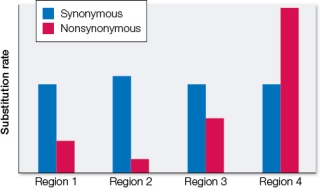 Which region appears to be under positive selection?
 (Short Answer)
4.9/5 (80)
(80) A gene family has been accumulating nucleotide substitutions at a rate of 0.25 per million years.On average, there have been 80 substitutions between the common ancestor of this gene family and each of the various living forms of this gene.Based on these numbers, this gene family likely originated _______ million years ago.
(Multiple Choice)
4.8/5 (71)
(71) Neutral substitutions accumulate between lineages primarily via
(Multiple Choice)
4.8/5 (90)
(90) Refer to the table. 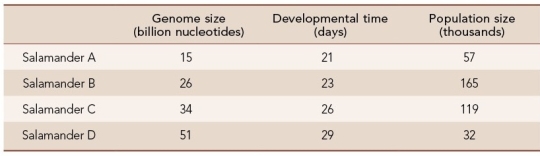 We can infer that the salamander data are consistent with the hypothesis that
 (Multiple Choice)
4.8/5 (79)
(79) Which genetic event is most like lateral gene transfer in its effects?
(Multiple Choice)
4.9/5 (85)
(85) Refer to the figure. 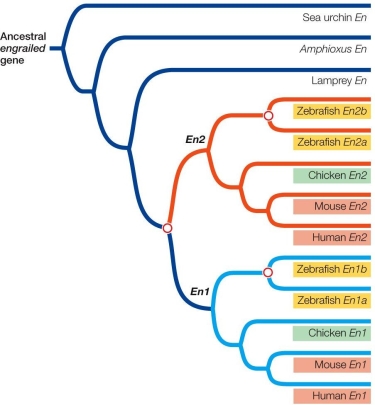 Which statement about the figure is false?
 (Multiple Choice)
4.9/5 (82)
(82) A gene involved in immunity duplicates within an organism, and these duplicate genes begin to diverge in their function.These different genes are considered
(Multiple Choice)
4.9/5 (76)
(76) Two species of beetles carry a single copy of a gene that codes for an enzyme.This gene has started to diverge.The copies of this gene found in the two species of beetles are
(Multiple Choice)
4.8/5 (80)
(80) Concerted evolution can occur through either unequal crossing over or _______.
(Short Answer)
4.8/5 (78)
(78) The most likely way for proteins to acquire new functions is via
(Multiple Choice)
4.7/5 (71)
(71) Which ranking of organisms is correct in terms of the proportion of coding DNA to noncoding DNA in their genomes, from smallest proportion to largest proportion?
(Multiple Choice)
4.9/5 (69)
(69) The table shows the amino acid sequences for an eight-residue section of a small protein for five different species (1-5). 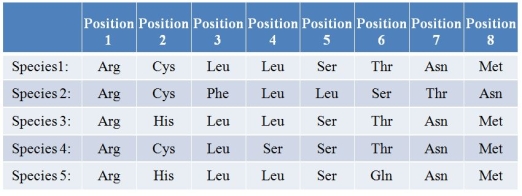 Complete the similarity matrix below using these sequences.
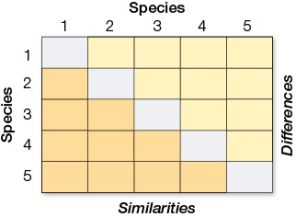
Complete the similarity matrix below using these sequences. (Essay)
4.8/5 (72)
(72) In a hypothetical experiment, researchers sequence a gene from a colony of bacteria at various times in the history of the colony.In the common ancestor, the nucleotide at site 998 is A.After 1,500 generations, it changes to G.After 5,000 generations, it changes back to A.We can infer that a total of _______ substitution(s) have occurred.Without knowledge of the sample taken at 1,500 generations, we would have inferred that _______ substitution(s) had occurred.
(Multiple Choice)
4.8/5 (79)
(79) 
Filters
- Essay(0)
- Multiple Choice(0)
- Short Answer(0)
- True False(0)
- Matching(0)