



 Chat with AI
Exam 8: Energy, Enzymes, and Metabolism

Exam 1: Studying Life246 Questions
Exam 2: Small Molecules and the Chemistry of Life246 Questions
Exam 3: Proteins, Carbohydrates, and Lipids246 Questions
Exam 4: Nucleic Acids and the Origin of Life246 Questions
Exam 5: Cells: the Working Units of Life248 Questions
Exam 6: Cell Membranes246 Questions
Exam 7: Cell Communication and Multicellularity246 Questions
Exam 8: Energy, Enzymes, and Metabolism246 Questions
Exam 9: Pathways That Harvest Chemical Energy246 Questions
Exam 10: Photosynthesis: Energy From Sunlight242 Questions
Exam 11: The Cell Cycle and Cell Division260 Questions
Exam 12: Inheritance, Genes, and Chromosomes250 Questions
Exam 13: Dna and Its Role in Heredity257 Questions
Exam 14: From Dna to Protein: Gene Expression252 Questions
Exam 15: Gene Mutation and Molecular Medicine251 Questions
Exam 16: Regulation of Gene Expression245 Questions
Exam 17: Genomes249 Questions
Exam 18: Recombinant Dna and Biotechnology243 Questions
Exam 20: Mechanisms of Evolution243 Questions
Exam 21: Reconstructing and Using Phylogenies246 Questions
Exam 22: Speciation247 Questions
Exam 23: Evolution of Genes and Genomes252 Questions
Exam 24: The History of Life on Earth246 Questions
Exam 25: Bacteria, Archaea, and Viruses262 Questions
Exam 26: The Origin and Diversification of Eukaryotes252 Questions
Exam 27: Plants Without Seeds: From Water to Land251 Questions
Exam 28: The Evolution of Seed Plants259 Questions
Exam 29: The Evolution and Diversity of Fungi261 Questions
Exam 30: Animal Origins and the Evolution of Body Plans248 Questions
Exam 31: Protostome Animals244 Questions
Exam 32: Deuterostome Animals246 Questions
Exam 33: The Plant Body243 Questions
Exam 34: Transport in Plants248 Questions
Exam 35: Plant Nutrition247 Questions
Exam 36: Regulation of Plant Growth246 Questions
Exam 37: Reproduction in Flowering Plants247 Questions
Exam 38: Plant Responses to Environmental Challenges246 Questions
Exam 39: Physiology, Homeostasis, and Temperature Regulation258 Questions
Exam 40: Animal Hormones249 Questions
Exam 41: Immunology: Animal Defense Systems265 Questions
Exam 42: Animal Reproduction261 Questions
Exam 43: Animal Development261 Questions
Exam 44: Neurons, Glia, and Nervous Systems250 Questions
Exam 45: Sensory Systems249 Questions
Exam 46: The Mammalian Nervous System: Structure and Higher Functions254 Questions
Exam 47: Musculoskeletal Systems259 Questions
Exam 48: Gas Exchange247 Questions
Exam 49: Circulatory Systems252 Questions
Exam 50: Nutrition, Digestion, and Absorption259 Questions
Exam 51: Salt and Water Balance and Nitrogen Excretion251 Questions
Exam 52: Animal Behavior249 Questions
Exam 53: The Physical Environment and Biogeography of Life248 Questions
Exam 54: Populations259 Questions
Exam 55: Species Interactions254 Questions
Exam 56: Communities247 Questions
Exam 57: Ecosystems238 Questions
Exam 58: A Changing Biosphere222 Questions
Select questions type


If the temperature of a reaction with a G of ‒7.1 kJ/mol increases, what will happen to the G of the reaction?
(Multiple Choice)
4.9/5  (76)
(76) What explains the sharp drop-off in enzyme activity as the temperature is raised?
(Multiple Choice)
5.0/5 (67)
(67) Which statement can be used to explain how the first law of thermodynamics relates to biological systems?
(Multiple Choice)
4.8/5 (85)
(85) The amount of energy needed to start a reaction is known as its _______ energy.
(Short Answer)
4.9/5 (74)
(74) The term referring to a reactant in an enzyme-catalyzed reaction is
(Multiple Choice)
4.8/5 (85)
(85) Refer to the graph below. 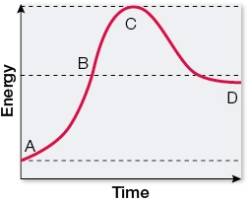 The letter _______ labels the transition state, and the free energy change for this reaction has a _______ value.
 (Multiple Choice)
4.8/5 (77)
(77) A particular enzyme is used to convert substrate A into product B.If you wished to use this enzyme in another reaction with a different substrate, which of the following substrates could theoretically be acted on by the same enzyme?
(Multiple Choice)
4.8/5 (75)
(75) A chemical cross-linking reagent has two reactive ends that can be used to covalently link two different amino acid groups in proteins.The links that result are similar to a disulfide bridge that forms between two cysteine groups.Biochemists use chemical cross-linking reagents to test for conformational changes in proteins because the cross-links often freeze proteins in a single conformation.Which method of increasing reaction rates would be most adversely affected by chemical cross-linking?
(Multiple Choice)
4.9/5 (67)
(67) The phosphorylation of glucose to glucose 6-phosphate is a reaction with a G of +4.0 kcal/mol.What is required for this reaction to take place?
(Multiple Choice)
4.8/5 (77)
(77) Refer to the figure below. 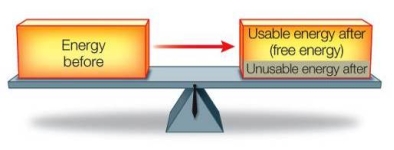 Does this figure illustrate both the first and second laws of thermodynamics?
 (Multiple Choice)
4.8/5 (75)
(75) Refer to the figure below. 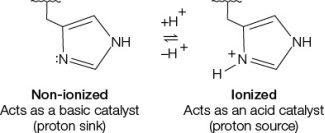 The figure shows how a histidine group at the active site of an enzyme could function either as a base (left) or as an acid (right).The pKa of histidine is 6.0, which means that at pH 6.0, there are equal numbers of ionized and nonionized histidine groups since a pKa is an acid dissociation constant.With this in mind, what would you expect about the pH sensitivity of enzyme X that uses histidine as a base catalyst compared with enzyme Y that uses histidine as an acid catalyst?
 (Multiple Choice)
4.8/5 (85)
(85) Refer to the graphs below. 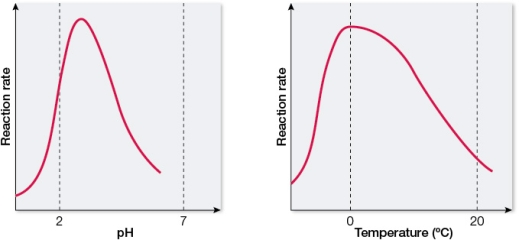 The graphs show data collected during the characterization of an enzyme.Which is the most likely source of the enzyme?
 (Multiple Choice)
4.9/5 (82)
(82) Refer to the table below. 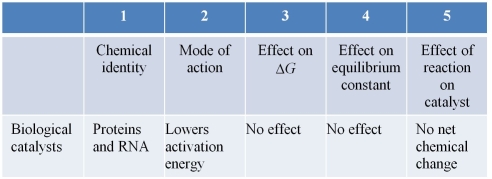 A student prepared the table to summarize information she had learned about biological catalysts.Which statement best evaluates the accuracy of the information in the table?
 (Multiple Choice)
4.9/5 (69)
(69) Which of the following can participate in an enzymatic reaction as an electron donor or acceptor?
(Multiple Choice)
4.7/5 (86)
(86) Two amino acids shown to be essential in the catalytic mechanism of phosphohexose isomerase are a histidine and a lysine.These two side chains work together in a reversible series of protonation and deprotonation steps to break one bond in the substrate and form a new one.This is an example of a(n) _______ mechanism of catalysis.
(Short Answer)
4.8/5 (73)
(73) Refer to the figure below. 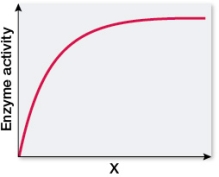 A purified enzyme was subjected to changes in a variable (X) as its ability to catalyze its chemical reaction was measured.Based on the shape of the curve, which variable could X be?
 (Multiple Choice)
4.8/5 (74)
(74) Hexokinase is the enzyme that catalyzes the reaction shown below.  To which class of enzymes does hexokinase belong?
 (Multiple Choice)
4.8/5 (65)
(65) Suppose the reaction A B has a large negative G.The reaction would proceed _______, at equilibrium _______ would be present, and _______.
(Multiple Choice)
4.9/5 (101)
(101) 
Filters
- Essay(0)
- Multiple Choice(0)
- Short Answer(0)
- True False(0)
- Matching(0)