



 Chat with AI
Exam 22: Speciation

Exam 1: Studying Life246 Questions
Exam 2: Small Molecules and the Chemistry of Life246 Questions
Exam 3: Proteins, Carbohydrates, and Lipids246 Questions
Exam 4: Nucleic Acids and the Origin of Life246 Questions
Exam 5: Cells: the Working Units of Life248 Questions
Exam 6: Cell Membranes246 Questions
Exam 7: Cell Communication and Multicellularity246 Questions
Exam 8: Energy, Enzymes, and Metabolism246 Questions
Exam 9: Pathways That Harvest Chemical Energy246 Questions
Exam 10: Photosynthesis: Energy From Sunlight242 Questions
Exam 11: The Cell Cycle and Cell Division260 Questions
Exam 12: Inheritance, Genes, and Chromosomes250 Questions
Exam 13: Dna and Its Role in Heredity257 Questions
Exam 14: From Dna to Protein: Gene Expression252 Questions
Exam 15: Gene Mutation and Molecular Medicine251 Questions
Exam 16: Regulation of Gene Expression245 Questions
Exam 17: Genomes249 Questions
Exam 18: Recombinant Dna and Biotechnology243 Questions
Exam 20: Mechanisms of Evolution243 Questions
Exam 21: Reconstructing and Using Phylogenies246 Questions
Exam 22: Speciation247 Questions
Exam 23: Evolution of Genes and Genomes252 Questions
Exam 24: The History of Life on Earth246 Questions
Exam 25: Bacteria, Archaea, and Viruses262 Questions
Exam 26: The Origin and Diversification of Eukaryotes252 Questions
Exam 27: Plants Without Seeds: From Water to Land251 Questions
Exam 28: The Evolution of Seed Plants259 Questions
Exam 29: The Evolution and Diversity of Fungi261 Questions
Exam 30: Animal Origins and the Evolution of Body Plans248 Questions
Exam 31: Protostome Animals244 Questions
Exam 32: Deuterostome Animals246 Questions
Exam 33: The Plant Body243 Questions
Exam 34: Transport in Plants248 Questions
Exam 35: Plant Nutrition247 Questions
Exam 36: Regulation of Plant Growth246 Questions
Exam 37: Reproduction in Flowering Plants247 Questions
Exam 38: Plant Responses to Environmental Challenges246 Questions
Exam 39: Physiology, Homeostasis, and Temperature Regulation258 Questions
Exam 40: Animal Hormones249 Questions
Exam 41: Immunology: Animal Defense Systems265 Questions
Exam 42: Animal Reproduction261 Questions
Exam 43: Animal Development261 Questions
Exam 44: Neurons, Glia, and Nervous Systems250 Questions
Exam 45: Sensory Systems249 Questions
Exam 46: The Mammalian Nervous System: Structure and Higher Functions254 Questions
Exam 47: Musculoskeletal Systems259 Questions
Exam 48: Gas Exchange247 Questions
Exam 49: Circulatory Systems252 Questions
Exam 50: Nutrition, Digestion, and Absorption259 Questions
Exam 51: Salt and Water Balance and Nitrogen Excretion251 Questions
Exam 52: Animal Behavior249 Questions
Exam 53: The Physical Environment and Biogeography of Life248 Questions
Exam 54: Populations259 Questions
Exam 55: Species Interactions254 Questions
Exam 56: Communities247 Questions
Exam 57: Ecosystems238 Questions
Exam 58: A Changing Biosphere222 Questions
Select questions type


The genes F and G act in accordance with the Dobzhansky-Muller model leading to sterility in hybrids between two species of monkeyflowers.Any combination of the F2 and the G1 alleles causes hybrids to be sterile.Based on the Dobzhansky-Muller model, which genotype should have low fitness?
(Multiple Choice)
4.9/5  (77)
(77) Before transferring sperm to the female during mating, the males of some species of beetles use their copulatory organs to remove the sperm of other males.In cases in which a female mated first with a male of a different species, the male of her own species is particularly adept at removing the other male's sperm.This is an example of _______ isolation.
(Multiple Choice)
4.8/5 (78)
(78) Which of the following does not appear to result in increased speciation rates?
(Multiple Choice)
4.8/5 (78)
(78) The morphology and natural history of a common and widely distributed butterfly was observed over a 25-year period in Costa Rica.Recent DNA barcoding (DNA sequence analysis) showed that what was once thought to be a single species is actually a complex of at least 10 species.Though caterpillars of these species eat different food plants and have somewhat different habitat preferences than their adult forms, their morphological differences are subtle.There are no differences in reproductive organs.Based on observation alone, there is no obvious reproductive isolation.Which statement best characterizes how different species concepts would consider this group of butterflies?
(Multiple Choice)
4.8/5 (90)
(90) The species concept that is best for long-term evolutionary view is the _______ species concept.
(Multiple Choice)
4.9/5 (76)
(76) In the eastern United States, populations of the white-footed mouse, Peromyscus leucopus, can be found almost continuously from Maine to Georgia.Suppose the mice were indeed one single species under the biological species concept.Individuals are collected from across the range and are crossed in the lab.Graph the relationship between viability of hybrids and geographic distance.
(Essay)
4.7/5 (85)
(85) Two species of narrowmouth frogs in the United States have mating calls that differ more in their region of sympatry than in those parts of their ranges that do not overlap.If this difference in their vocalizations has the function of preventing hybridization between the two species, it is an example of
(Multiple Choice)
4.8/5 (82)
(82) Some species of wheat have four sets of chromosomes.This makes them
(Multiple Choice)
4.9/5 (76)
(76) Refer to the figure. 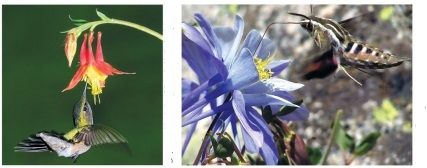 In each of the species of columbine shown, the orientation of the flowers and the length of flower spurs are associated with a particular type of pollinator (hummingbirds or hawkmoths).Columbine flowers vary in other ways as well; for example, they differ in color, and probably in odor.What experiments could you design to determine the traits that various pollinators use to distinguish among the flowers of different columbine species?
 (Essay)
4.9/5 (86)
(86) A field contains two related species of flowering plants.Species A has a diploid chromosome number of 22, and species B has a diploid chromosome number of 26.If a third species arises as a result of hybridization between A and B, how many chromosomes will it have?
(Multiple Choice)
4.8/5 (86)
(86) Which scenario is least likely to lead to allopatric isolation?
(Multiple Choice)
4.8/5 (92)
(92) An evolutionary biologist makes decisions about whether to consider different populations of lacewings as separate species, based on observations of the individuals with which these lacewings will mate.This biologist is most likely employing Mayr's _______ species concept, which asserts that reproductive isolation is the most important criterion for identifying species.
(Short Answer)
4.8/5 (79)
(79) Which conclusion is best supported by results of the studies of apple maggot flies?
(Multiple Choice)
4.7/5 (86)
(86) Which statement about the Dobzhansky-Muller model of speciation is true?
(Multiple Choice)
4.9/5 (81)
(81) A hypothetical ancestral population (AABB) splits into two independent lineages.Mutations produce different new alleles fixed at each loci in each population (AAbb in one population, aaBb in the other).According to the Dobzhansky-Muller model, which genotype would not be viable if the F1 individuals were inviable?
(Multiple Choice)
4.7/5 (75)
(75) Suppose that the natural ranges of horses and donkeys were to overlap.Which statement best describes what is likely to happen to the populations over time?
(Multiple Choice)
5.0/5 (79)
(79) 
Filters
- Essay(0)
- Multiple Choice(0)
- Short Answer(0)
- True False(0)
- Matching(0)