



 Chat with AI
Exam 2: Small Molecules and the Chemistry of Life

Exam 1: Studying Life246 Questions
Exam 2: Small Molecules and the Chemistry of Life246 Questions
Exam 3: Proteins, Carbohydrates, and Lipids246 Questions
Exam 4: Nucleic Acids and the Origin of Life246 Questions
Exam 5: Cells: the Working Units of Life248 Questions
Exam 6: Cell Membranes246 Questions
Exam 7: Cell Communication and Multicellularity246 Questions
Exam 8: Energy, Enzymes, and Metabolism246 Questions
Exam 9: Pathways That Harvest Chemical Energy246 Questions
Exam 10: Photosynthesis: Energy From Sunlight242 Questions
Exam 11: The Cell Cycle and Cell Division260 Questions
Exam 12: Inheritance, Genes, and Chromosomes250 Questions
Exam 13: Dna and Its Role in Heredity257 Questions
Exam 14: From Dna to Protein: Gene Expression252 Questions
Exam 15: Gene Mutation and Molecular Medicine251 Questions
Exam 16: Regulation of Gene Expression245 Questions
Exam 17: Genomes249 Questions
Exam 18: Recombinant Dna and Biotechnology243 Questions
Exam 20: Mechanisms of Evolution243 Questions
Exam 21: Reconstructing and Using Phylogenies246 Questions
Exam 22: Speciation247 Questions
Exam 23: Evolution of Genes and Genomes252 Questions
Exam 24: The History of Life on Earth246 Questions
Exam 25: Bacteria, Archaea, and Viruses262 Questions
Exam 26: The Origin and Diversification of Eukaryotes252 Questions
Exam 27: Plants Without Seeds: From Water to Land251 Questions
Exam 28: The Evolution of Seed Plants259 Questions
Exam 29: The Evolution and Diversity of Fungi261 Questions
Exam 30: Animal Origins and the Evolution of Body Plans248 Questions
Exam 31: Protostome Animals244 Questions
Exam 32: Deuterostome Animals246 Questions
Exam 33: The Plant Body243 Questions
Exam 34: Transport in Plants248 Questions
Exam 35: Plant Nutrition247 Questions
Exam 36: Regulation of Plant Growth246 Questions
Exam 37: Reproduction in Flowering Plants247 Questions
Exam 38: Plant Responses to Environmental Challenges246 Questions
Exam 39: Physiology, Homeostasis, and Temperature Regulation258 Questions
Exam 40: Animal Hormones249 Questions
Exam 41: Immunology: Animal Defense Systems265 Questions
Exam 42: Animal Reproduction261 Questions
Exam 43: Animal Development261 Questions
Exam 44: Neurons, Glia, and Nervous Systems250 Questions
Exam 45: Sensory Systems249 Questions
Exam 46: The Mammalian Nervous System: Structure and Higher Functions254 Questions
Exam 47: Musculoskeletal Systems259 Questions
Exam 48: Gas Exchange247 Questions
Exam 49: Circulatory Systems252 Questions
Exam 50: Nutrition, Digestion, and Absorption259 Questions
Exam 51: Salt and Water Balance and Nitrogen Excretion251 Questions
Exam 52: Animal Behavior249 Questions
Exam 53: The Physical Environment and Biogeography of Life248 Questions
Exam 54: Populations259 Questions
Exam 55: Species Interactions254 Questions
Exam 56: Communities247 Questions
Exam 57: Ecosystems238 Questions
Exam 58: A Changing Biosphere222 Questions
Select questions type


Refer to the table below. 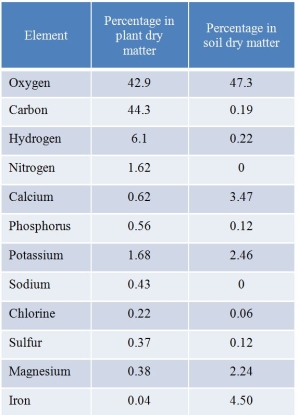 The table shows results from elemental analyses performed on a plant sample and a soil sample.These samples were dried prior to the analysis to remove all water.A scientist wants to use this information as the basis for identifying samples of unknown origin as either plant or soil material.Because running so many chemical tests can be time-consuming and expensive, she wants to limit future tests to one element.She would have the best chance of distinguishing between soil and plant material if she chose the element _______ for analysis.
 (Short Answer)
4.9/5  (79)
(79) In the history of the discovery of the parts of an atom, the neutron was discovered after the proton and electron.What property of a neutron made it more difficult than the proton or electron to discover?
(Multiple Choice)
4.9/5 (73)
(73) In the periodic table, when elements are in the same vertical column, they share a similar
(Multiple Choice)
4.9/5 (92)
(92) According to the periodic table, which element has the same number of outer shell (valence) electrons as oxygen?
(Multiple Choice)
4.9/5 (79)
(79) The chemical properties of an element are determined by the number of _______ in the atom's valence shell.
(Short Answer)
4.9/5 (71)
(71) An atom with 20 protons and 25 neutrons has an atomic number 20 and a mass number _______.
(Short Answer)
4.7/5 (87)
(87) Every atom except _______ has one or more neutrons in its nucleus.
(Short Answer)
5.0/5 (81)
(81) Refer to the figure below. 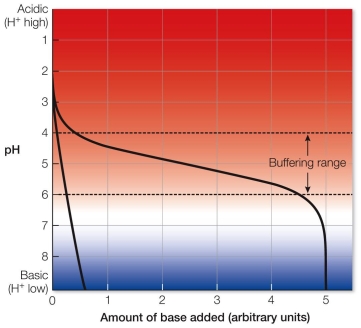 For the solution containing a buffer, the pH range with greatest buffering capacity is
 (Multiple Choice)
4.9/5 (74)
(74) The water strider can skate along the surface of water because of a property of liquids called _______.
(Short Answer)
4.9/5 (84)
(84) Refer to the figure below. 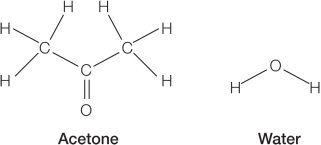 Two molecules are shown.Where is it most likely that a hydrogen bond would form?
 (Multiple Choice)
4.9/5 (89)
(89) An ionic compound has the formula XCl2, where X is a cation bonded through ionic attractions to two Cl− anions.Sketch Bohr models to show how the ions interact to form such a compound.
(Essay)
4.9/5 (70)
(70) Refer to the table below. 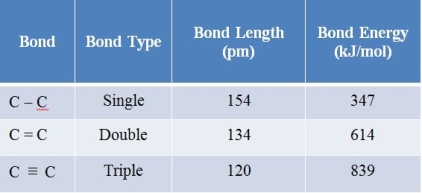 The data support the claim that the strength of a covalent bond increases with the number of _______ that are shared between two atoms.
 (Short Answer)
4.9/5 (79)
(79) Refer to the figures below. 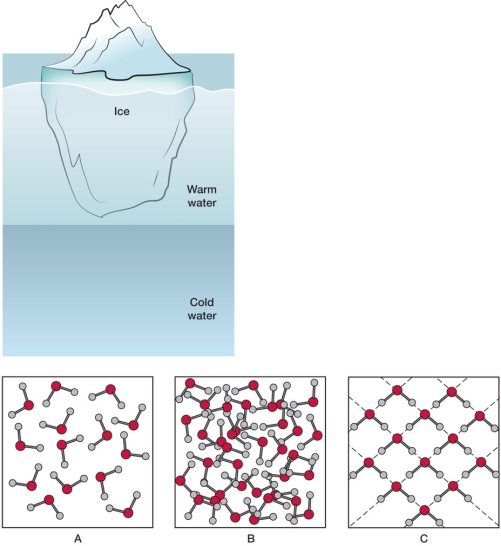 A student is creating a diagram to illustrate the structure of water in an Arctic lake.The student has identified three zones of the lake to label.How should the smaller images be attached to the larger one?
 (Multiple Choice)
4.9/5 (77)
(77) 
Filters
- Essay(0)
- Multiple Choice(0)
- Short Answer(0)
- True False(0)
- Matching(0)