



 Chat with AI
Exam 2: Small Molecules and the Chemistry of Life

Exam 1: Studying Life246 Questions
Exam 2: Small Molecules and the Chemistry of Life246 Questions
Exam 3: Proteins, Carbohydrates, and Lipids246 Questions
Exam 4: Nucleic Acids and the Origin of Life246 Questions
Exam 5: Cells: the Working Units of Life248 Questions
Exam 6: Cell Membranes246 Questions
Exam 7: Cell Communication and Multicellularity246 Questions
Exam 8: Energy, Enzymes, and Metabolism246 Questions
Exam 9: Pathways That Harvest Chemical Energy246 Questions
Exam 10: Photosynthesis: Energy From Sunlight242 Questions
Exam 11: The Cell Cycle and Cell Division260 Questions
Exam 12: Inheritance, Genes, and Chromosomes250 Questions
Exam 13: Dna and Its Role in Heredity257 Questions
Exam 14: From Dna to Protein: Gene Expression252 Questions
Exam 15: Gene Mutation and Molecular Medicine251 Questions
Exam 16: Regulation of Gene Expression245 Questions
Exam 17: Genomes249 Questions
Exam 18: Recombinant Dna and Biotechnology243 Questions
Exam 20: Mechanisms of Evolution243 Questions
Exam 21: Reconstructing and Using Phylogenies246 Questions
Exam 22: Speciation247 Questions
Exam 23: Evolution of Genes and Genomes252 Questions
Exam 24: The History of Life on Earth246 Questions
Exam 25: Bacteria, Archaea, and Viruses262 Questions
Exam 26: The Origin and Diversification of Eukaryotes252 Questions
Exam 27: Plants Without Seeds: From Water to Land251 Questions
Exam 28: The Evolution of Seed Plants259 Questions
Exam 29: The Evolution and Diversity of Fungi261 Questions
Exam 30: Animal Origins and the Evolution of Body Plans248 Questions
Exam 31: Protostome Animals244 Questions
Exam 32: Deuterostome Animals246 Questions
Exam 33: The Plant Body243 Questions
Exam 34: Transport in Plants248 Questions
Exam 35: Plant Nutrition247 Questions
Exam 36: Regulation of Plant Growth246 Questions
Exam 37: Reproduction in Flowering Plants247 Questions
Exam 38: Plant Responses to Environmental Challenges246 Questions
Exam 39: Physiology, Homeostasis, and Temperature Regulation258 Questions
Exam 40: Animal Hormones249 Questions
Exam 41: Immunology: Animal Defense Systems265 Questions
Exam 42: Animal Reproduction261 Questions
Exam 43: Animal Development261 Questions
Exam 44: Neurons, Glia, and Nervous Systems250 Questions
Exam 45: Sensory Systems249 Questions
Exam 46: The Mammalian Nervous System: Structure and Higher Functions254 Questions
Exam 47: Musculoskeletal Systems259 Questions
Exam 48: Gas Exchange247 Questions
Exam 49: Circulatory Systems252 Questions
Exam 50: Nutrition, Digestion, and Absorption259 Questions
Exam 51: Salt and Water Balance and Nitrogen Excretion251 Questions
Exam 52: Animal Behavior249 Questions
Exam 53: The Physical Environment and Biogeography of Life248 Questions
Exam 54: Populations259 Questions
Exam 55: Species Interactions254 Questions
Exam 56: Communities247 Questions
Exam 57: Ecosystems238 Questions
Exam 58: A Changing Biosphere222 Questions
Select questions type


Sketch Bohr models to show the three isotopes of hydrogen, then explain how the three structures are similar and how they differ.
(Essay)
4.9/5  (77)
(77) A lithium atom contains three protons.For this atom to remain inert in an electric field, it must also contain
(Multiple Choice)
4.8/5 (83)
(83) What part of the atom determines how the atom reacts chemically?
(Multiple Choice)
4.9/5 (82)
(82) What type of chemical bond connects the carbon and oxygen atoms in the molecule shown below? 
(Multiple Choice)
4.8/5 (81)
(81) Refer to the figure below. 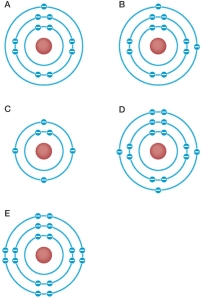 Which diagram represents a stable atom, and what element is it?
 (Short Answer)
4.9/5 (83)
(83) A neutral atom lost one or more particles.Before this loss, the atom had a mass of 15.99491 Da, and it was not influenced by an electric field.After this loss, the atom had a mass of 15.99440 Da, and its movement was diverted by an electric field.What particle(s) did the atom lose?
(Multiple Choice)
4.9/5 (89)
(89) Which general chemical principles can be applied to all chemical reactions?
(Multiple Choice)
4.8/5 (78)
(78) _______ capacity is a term used to describe the ability of a solution to prevent large changes in pH with the addition of a base or acid.
(Multiple Choice)
4.8/5 (94)
(94) In the periodic table, why are hydrogen, lithium, and sodium in the same column?
(Multiple Choice)
4.8/5 (90)
(90) Surface tension and cohesion occur in pure water because water
(Multiple Choice)
4.8/5 (75)
(75) Carbon-12 is the most abundant isotope of carbon on Earth.Carbon-13 makes up about 1 percent of Earth's carbon atoms and is useful for radio imaging.Which of the following is true?
(Multiple Choice)
4.8/5 (67)
(67) Refer to the figure below.  The figure shows a molecule found in biological samples.What interactions will occur if 1 part of this compound is mixed with 20 parts of water, and why?
 (Multiple Choice)
4.9/5 (83)
(83) If the pH of an acid rain sample is 2.5 pH units more acidic than water, the acid rain sample has a pH of _______.
(Short Answer)
4.8/5 (74)
(74) When 0.1 mole of sodium hydroxide (NaOH) is added to 1 liter of water, it ionizes, releasing OH- and Na+ ions.The resulting solution is
(Multiple Choice)
4.9/5 (76)
(76) What features of the water molecule are responsible for its high heat of vaporization, and what other compound shares these features?
(Multiple Choice)
4.9/5 (68)
(68) How would you make 100 mL of an aqueous solution with a 0.25 M concentration of a compound that has a molecular weight of 200 Da?
(Multiple Choice)
4.8/5 (81)
(81) Refer to the oxidation-reduction reaction below.
Fe + Cu2+ Cu + Fe2+
This reaction occurs spontaneously when a strip of iron metal is placed into a solution of copper sulfate dissolved in water.During the reaction, iron metal is oxidized to form a cation, and copper ion is reduced to form copper metal.Which statement describes the change taking place?
(Multiple Choice)
4.9/5 (71)
(71) 
Filters
- Essay(0)
- Multiple Choice(0)
- Short Answer(0)
- True False(0)
- Matching(0)