



 Chat with AI
Exam 17: Genomes

Exam 1: Studying Life246 Questions
Exam 2: Small Molecules and the Chemistry of Life246 Questions
Exam 3: Proteins, Carbohydrates, and Lipids246 Questions
Exam 4: Nucleic Acids and the Origin of Life246 Questions
Exam 5: Cells: the Working Units of Life248 Questions
Exam 6: Cell Membranes246 Questions
Exam 7: Cell Communication and Multicellularity246 Questions
Exam 8: Energy, Enzymes, and Metabolism246 Questions
Exam 9: Pathways That Harvest Chemical Energy246 Questions
Exam 10: Photosynthesis: Energy From Sunlight242 Questions
Exam 11: The Cell Cycle and Cell Division260 Questions
Exam 12: Inheritance, Genes, and Chromosomes250 Questions
Exam 13: Dna and Its Role in Heredity257 Questions
Exam 14: From Dna to Protein: Gene Expression252 Questions
Exam 15: Gene Mutation and Molecular Medicine251 Questions
Exam 16: Regulation of Gene Expression245 Questions
Exam 17: Genomes249 Questions
Exam 18: Recombinant Dna and Biotechnology243 Questions
Exam 20: Mechanisms of Evolution243 Questions
Exam 21: Reconstructing and Using Phylogenies246 Questions
Exam 22: Speciation247 Questions
Exam 23: Evolution of Genes and Genomes252 Questions
Exam 24: The History of Life on Earth246 Questions
Exam 25: Bacteria, Archaea, and Viruses262 Questions
Exam 26: The Origin and Diversification of Eukaryotes252 Questions
Exam 27: Plants Without Seeds: From Water to Land251 Questions
Exam 28: The Evolution of Seed Plants259 Questions
Exam 29: The Evolution and Diversity of Fungi261 Questions
Exam 30: Animal Origins and the Evolution of Body Plans248 Questions
Exam 31: Protostome Animals244 Questions
Exam 32: Deuterostome Animals246 Questions
Exam 33: The Plant Body243 Questions
Exam 34: Transport in Plants248 Questions
Exam 35: Plant Nutrition247 Questions
Exam 36: Regulation of Plant Growth246 Questions
Exam 37: Reproduction in Flowering Plants247 Questions
Exam 38: Plant Responses to Environmental Challenges246 Questions
Exam 39: Physiology, Homeostasis, and Temperature Regulation258 Questions
Exam 40: Animal Hormones249 Questions
Exam 41: Immunology: Animal Defense Systems265 Questions
Exam 42: Animal Reproduction261 Questions
Exam 43: Animal Development261 Questions
Exam 44: Neurons, Glia, and Nervous Systems250 Questions
Exam 45: Sensory Systems249 Questions
Exam 46: The Mammalian Nervous System: Structure and Higher Functions254 Questions
Exam 47: Musculoskeletal Systems259 Questions
Exam 48: Gas Exchange247 Questions
Exam 49: Circulatory Systems252 Questions
Exam 50: Nutrition, Digestion, and Absorption259 Questions
Exam 51: Salt and Water Balance and Nitrogen Excretion251 Questions
Exam 52: Animal Behavior249 Questions
Exam 53: The Physical Environment and Biogeography of Life248 Questions
Exam 54: Populations259 Questions
Exam 55: Species Interactions254 Questions
Exam 56: Communities247 Questions
Exam 57: Ecosystems238 Questions
Exam 58: A Changing Biosphere222 Questions
Select questions type


A group of biologists is examining changes in the proteins in monkeys as they change in social status.This activity is best characterized as
(Multiple Choice)
4.9/5  (84)
(84) Suppose a particular human chromosome is 50 million bp long (as haploid).If it is cut into fragments that are the same size as those typically used in high-throughput sequencing, about _______ fragments would be generated.
(Multiple Choice)
4.9/5 (75)
(75) The most likely way that transposons disrupt the expression of other genes is by
(Multiple Choice)
4.8/5 (83)
(83) Two overlapping DNA sequences arise from cutting a longer sequence: 5′-TGTAATGCTAAAGTAGTCATAGGC-3′ and 5′-AGGTATCTGTCAGTGTAATGCT-3′.The longer sequence is _______.
(Essay)
4.8/5 (84)
(84) Studies investigating the genetic diversity of organisms within a sample of marsh soil, rather than the genomes of individual organisms, would be considered part of the burgeoning field of _______.
(Short Answer)
4.9/5 (74)
(74) Which statement comparing the human and Neanderthal genomes is true?
(Multiple Choice)
4.8/5 (88)
(88) The genomes of rice, wheat, and corn are similar to one another and to that of Arabidopsis in many ways.Discuss how these plants might nevertheless have very different proteins.
(Essay)
4.8/5 (85)
(85) Refer to the figure showing microbial DNA being sequenced and analyzed. 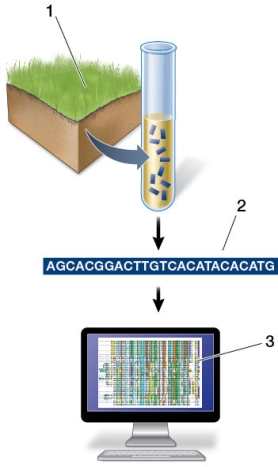 Studies like these would be most useful for questions related to
 (Multiple Choice)
4.8/5 (80)
(80) Which feature ensures that in the human placenta, oxygen will be transferred from the mother's blood to the developing fetus's blood?
(Multiple Choice)
4.8/5 (65)
(65) Suppose a long sequence of DNA is cut with three different restriction enzymes: one that cuts at CTCG, one that cuts at TGCATC, and one that cuts at TCATGCTC.The restriction enzyme that cuts at _______ should produce the greatest number of fragments.
(Short Answer)
4.8/5 (74)
(74) Highly repetitive sequences are often found in the transcriptionally inactive and densely packed region of a chromosome called _______.
(Short Answer)
4.8/5 (77)
(77) Refer to the table showing several prokaryote (bacterial) species (labeled A-E) that have been sequenced, along with the findings of the genes they contain.(Note: "x" marks the species possessing a functional copy of the gene.) Gene 1 is essential for the synthesis of several amino acids.Gene 2 encodes a protein involved in strengthening the cell wall.Gene 3 produces an enzyme that breaks down methane.The functions of the other five genes are currently unknown. 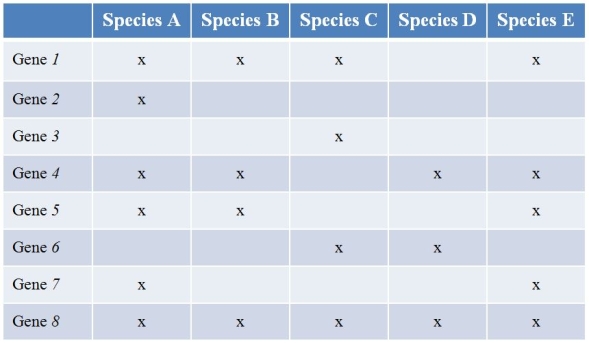 Which species has the most potential to be useful regarding studies of how global warming can be slowed?
 (Multiple Choice)
4.9/5 (66)
(66) It is the year 2025.You are taking care of a patient who is concerned about having an early stage of kidney cancer.His mother died from this disease.Assume that the SNPs linked to genes involved in the development of this type of cancer have been identified.How would you determine whether this man has a genetic predisposition for developing kidney cancer? Explain how you would do the analysis.
(Essay)
4.8/5 (77)
(77) Following are four overlapping reads from sequencing.(Note: All reads are in a 5′-to-3′ direction.) Read 1: AGCGCTAAAGACGGCTCGAGTCAGCTAGTAGAA
Read 2: TGCGTAGCTATCGCATACGCAAGCGCTAAA
Read 3: GCTAGTAGAATCGATATCGAGGATCGATTAG
Read 4: GGATCGATTAGAGCTATAGTAGGCTGATGAC
Which reads share the sequence GCTAGTAGAA?
(Multiple Choice)
4.9/5 (83)
(83) Refer to the table showing the number of genes in three bacteria (E.coli, Haemophilus influenzae, and Mycoplasma genitalium) for different functions. 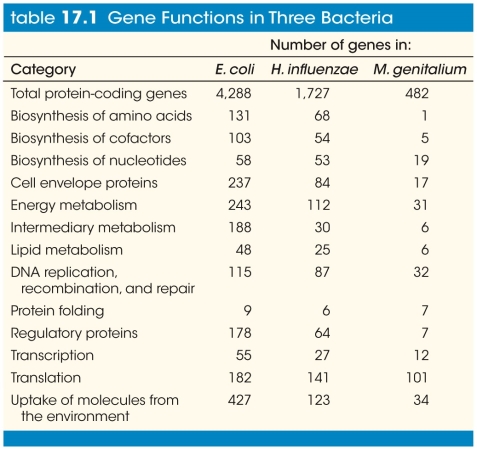 For which class of genes does M.genitalium devote a larger percentage of its genome than the other two bacteria do?
 (Multiple Choice)
4.8/5 (70)
(70) In the high-throughput sequencing method, _______ are labeled with colored fluorescent dyes.
(Multiple Choice)
4.7/5 (82)
(82) In the process of high-throughput sequencing of DNA of an aphid, a researcher uses computer programs to determine the correct order of the reads, thus using a technique developed in the field of
(Multiple Choice)
4.8/5 (65)
(65) In some species of moths, the genes that make the protein-rich chorion for the eggshell are found in multiple copies in order to maximize the production of chorion at specific times.In this regard, these chorion genes are most like
(Multiple Choice)
4.9/5 (87)
(87) A hypothetical drug has a side effect of increasing blood pressure.Individuals who are homozygous for G at SNP 1 break down this drug faster than average.Individuals who are homozygous for A at SNP 2 break down this drug slower than average.The effects of these two SNPs roughly cancel each other out, such that homozygotes at both SNPs generally have average rates of breakdown of the enzyme.Which combination of genotypes is most likely to require an individual to take a larger than average dose of the drug to get the desired effect? (Note: The genotype of SNP 1 is listed first, followed by that of SNP 2.)
(Multiple Choice)
4.7/5 (71)
(71) Two sequences both contain the same protein-coding gene.They differ only in that one has an enhancer and the other does not.We can thus say that the sequences differ
(Multiple Choice)
4.8/5 (88)
(88) 
Filters
- Essay(0)
- Multiple Choice(0)
- Short Answer(0)
- True False(0)
- Matching(0)