



 Chat with AI
Exam 17: Genomes

Exam 1: Studying Life246 Questions
Exam 2: Small Molecules and the Chemistry of Life246 Questions
Exam 3: Proteins, Carbohydrates, and Lipids246 Questions
Exam 4: Nucleic Acids and the Origin of Life246 Questions
Exam 5: Cells: the Working Units of Life248 Questions
Exam 6: Cell Membranes246 Questions
Exam 7: Cell Communication and Multicellularity246 Questions
Exam 8: Energy, Enzymes, and Metabolism246 Questions
Exam 9: Pathways That Harvest Chemical Energy246 Questions
Exam 10: Photosynthesis: Energy From Sunlight242 Questions
Exam 11: The Cell Cycle and Cell Division260 Questions
Exam 12: Inheritance, Genes, and Chromosomes250 Questions
Exam 13: Dna and Its Role in Heredity257 Questions
Exam 14: From Dna to Protein: Gene Expression252 Questions
Exam 15: Gene Mutation and Molecular Medicine251 Questions
Exam 16: Regulation of Gene Expression245 Questions
Exam 17: Genomes249 Questions
Exam 18: Recombinant Dna and Biotechnology243 Questions
Exam 20: Mechanisms of Evolution243 Questions
Exam 21: Reconstructing and Using Phylogenies246 Questions
Exam 22: Speciation247 Questions
Exam 23: Evolution of Genes and Genomes252 Questions
Exam 24: The History of Life on Earth246 Questions
Exam 25: Bacteria, Archaea, and Viruses262 Questions
Exam 26: The Origin and Diversification of Eukaryotes252 Questions
Exam 27: Plants Without Seeds: From Water to Land251 Questions
Exam 28: The Evolution of Seed Plants259 Questions
Exam 29: The Evolution and Diversity of Fungi261 Questions
Exam 30: Animal Origins and the Evolution of Body Plans248 Questions
Exam 31: Protostome Animals244 Questions
Exam 32: Deuterostome Animals246 Questions
Exam 33: The Plant Body243 Questions
Exam 34: Transport in Plants248 Questions
Exam 35: Plant Nutrition247 Questions
Exam 36: Regulation of Plant Growth246 Questions
Exam 37: Reproduction in Flowering Plants247 Questions
Exam 38: Plant Responses to Environmental Challenges246 Questions
Exam 39: Physiology, Homeostasis, and Temperature Regulation258 Questions
Exam 40: Animal Hormones249 Questions
Exam 41: Immunology: Animal Defense Systems265 Questions
Exam 42: Animal Reproduction261 Questions
Exam 43: Animal Development261 Questions
Exam 44: Neurons, Glia, and Nervous Systems250 Questions
Exam 45: Sensory Systems249 Questions
Exam 46: The Mammalian Nervous System: Structure and Higher Functions254 Questions
Exam 47: Musculoskeletal Systems259 Questions
Exam 48: Gas Exchange247 Questions
Exam 49: Circulatory Systems252 Questions
Exam 50: Nutrition, Digestion, and Absorption259 Questions
Exam 51: Salt and Water Balance and Nitrogen Excretion251 Questions
Exam 52: Animal Behavior249 Questions
Exam 53: The Physical Environment and Biogeography of Life248 Questions
Exam 54: Populations259 Questions
Exam 55: Species Interactions254 Questions
Exam 56: Communities247 Questions
Exam 57: Ecosystems238 Questions
Exam 58: A Changing Biosphere222 Questions
Select questions type


Biologists are attempting to develop a small wasp called Nasonia vitripennis into a model system.Which characteristic would most likely limit this wasp's use as a model system for genomic studies?
(Multiple Choice)
4.8/5  (67)
(67) In the context of metabolomics, glucose, as a substrate for glycolysis, would be considered a(n)
(Multiple Choice)
4.8/5 (93)
(93) Succinate is a chemical involved in the Krebs cycle in the generation of energy.It is thus a(n)
(Multiple Choice)
4.8/5 (87)
(87) What is the most likely explanation for the abundance of transposons in eukaryotic genomes?
(Multiple Choice)
4.8/5 (81)
(81) Refer to the table showing the properties of five different genomes. 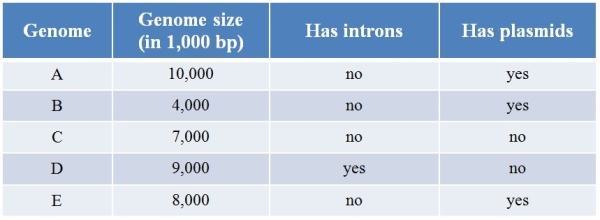 Which genome is most likely eukaryotic?
 (Multiple Choice)
4.9/5 (86)
(86) Which sequence type will not be included in an open reading frame?
(Multiple Choice)
4.8/5 (73)
(73) Which type of sequence is likely to be found in a eukaryotic genome but not in a prokaryotic genome?
(Multiple Choice)
4.8/5 (76)
(76) Refer to the table showing a hypothetical data set comparing the gene content of strains of Salmonella and Shigella (which are all pathogenic) and pathogenic and nonpathogenic strains of E.coli.(Note: "x" denotes presence of the gene.) 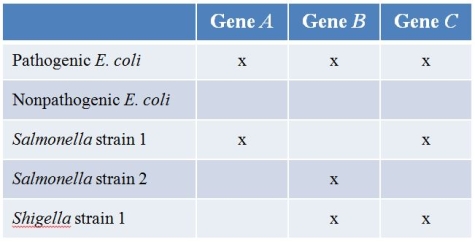 What is the most likely conclusion about gene A?
 (Multiple Choice)
4.8/5 (75)
(75) Refer to the figure showing the use of transposons as mutagens in Mycoplasma genitalium. 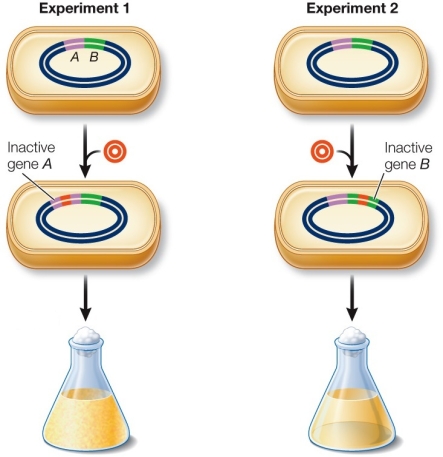 Which statement is true?
 (Multiple Choice)
5.0/5 (88)
(88) Comparing prokaryotic and eukaryotic genomes, which statement is generally correct?
(Multiple Choice)
4.8/5 (86)
(86) If someone wanted to reduce the need for nitrogen fertilizer for legume production, which bacterium would be the best one to apply?
(Multiple Choice)
5.0/5 (92)
(92) A universal adapter used in a sequencing run starts 5′-TCATAGT.What would be the sequence of the corresponding universal primer? (Note: "…" represents many nucleotides.)
(Multiple Choice)
4.8/5 (80)
(80) An organism has a genome that is 4.7 million bp long, with only 12 percent noncoding sequence.It lacks introns completely, even in the tRNA genes.This organism is most likely a
(Multiple Choice)
4.8/5 (67)
(67) High-performance liquid chromatography is most closely associated with
(Multiple Choice)
4.7/5 (75)
(75) If the universal adapter used in DNA synthesis is 5′-GTCAAGT… GTATC-3′, with "..." representing many nucleotides, the universal primer is _______.
(Short Answer)
4.7/5 (85)
(85) Which case best fits the description of functional genomics?
(Multiple Choice)
4.8/5 (78)
(78) You are told that a genome is about 10 million bp long, has 5,000 genes, has introns, and that 65 percent of its sequence is coding sequence.This genome most likely belongs to a(n)
(Multiple Choice)
4.8/5 (89)
(89) It is the year 2025.You are taking care of a patient who is concerned about having an early stage of kidney cancer.His mother died from this disease.If the patient was diagnosed with cancer using SNP analysis and metabolomics, how would you use pharmacogenomics to choose the right medications to treat the tumor in this patient?
(Essay)
4.9/5 (88)
(88) 
Filters
- Essay(0)
- Multiple Choice(0)
- Short Answer(0)
- True False(0)
- Matching(0)