



 Chat with AI
Exam 17: Genomes

Exam 1: Studying Life246 Questions
Exam 2: Small Molecules and the Chemistry of Life246 Questions
Exam 3: Proteins, Carbohydrates, and Lipids246 Questions
Exam 4: Nucleic Acids and the Origin of Life246 Questions
Exam 5: Cells: the Working Units of Life248 Questions
Exam 6: Cell Membranes246 Questions
Exam 7: Cell Communication and Multicellularity246 Questions
Exam 8: Energy, Enzymes, and Metabolism246 Questions
Exam 9: Pathways That Harvest Chemical Energy246 Questions
Exam 10: Photosynthesis: Energy From Sunlight242 Questions
Exam 11: The Cell Cycle and Cell Division260 Questions
Exam 12: Inheritance, Genes, and Chromosomes250 Questions
Exam 13: Dna and Its Role in Heredity257 Questions
Exam 14: From Dna to Protein: Gene Expression252 Questions
Exam 15: Gene Mutation and Molecular Medicine251 Questions
Exam 16: Regulation of Gene Expression245 Questions
Exam 17: Genomes249 Questions
Exam 18: Recombinant Dna and Biotechnology243 Questions
Exam 20: Mechanisms of Evolution243 Questions
Exam 21: Reconstructing and Using Phylogenies246 Questions
Exam 22: Speciation247 Questions
Exam 23: Evolution of Genes and Genomes252 Questions
Exam 24: The History of Life on Earth246 Questions
Exam 25: Bacteria, Archaea, and Viruses262 Questions
Exam 26: The Origin and Diversification of Eukaryotes252 Questions
Exam 27: Plants Without Seeds: From Water to Land251 Questions
Exam 28: The Evolution of Seed Plants259 Questions
Exam 29: The Evolution and Diversity of Fungi261 Questions
Exam 30: Animal Origins and the Evolution of Body Plans248 Questions
Exam 31: Protostome Animals244 Questions
Exam 32: Deuterostome Animals246 Questions
Exam 33: The Plant Body243 Questions
Exam 34: Transport in Plants248 Questions
Exam 35: Plant Nutrition247 Questions
Exam 36: Regulation of Plant Growth246 Questions
Exam 37: Reproduction in Flowering Plants247 Questions
Exam 38: Plant Responses to Environmental Challenges246 Questions
Exam 39: Physiology, Homeostasis, and Temperature Regulation258 Questions
Exam 40: Animal Hormones249 Questions
Exam 41: Immunology: Animal Defense Systems265 Questions
Exam 42: Animal Reproduction261 Questions
Exam 43: Animal Development261 Questions
Exam 44: Neurons, Glia, and Nervous Systems250 Questions
Exam 45: Sensory Systems249 Questions
Exam 46: The Mammalian Nervous System: Structure and Higher Functions254 Questions
Exam 47: Musculoskeletal Systems259 Questions
Exam 48: Gas Exchange247 Questions
Exam 49: Circulatory Systems252 Questions
Exam 50: Nutrition, Digestion, and Absorption259 Questions
Exam 51: Salt and Water Balance and Nitrogen Excretion251 Questions
Exam 52: Animal Behavior249 Questions
Exam 53: The Physical Environment and Biogeography of Life248 Questions
Exam 54: Populations259 Questions
Exam 55: Species Interactions254 Questions
Exam 56: Communities247 Questions
Exam 57: Ecosystems238 Questions
Exam 58: A Changing Biosphere222 Questions
Select questions type


Two graduate students are working in the same lab.Jane is investigating the mariner transposon, a DNA transposon.Sam is studying Alu, a SINE.What property is shared by Jane's and Sam's elements?
(Multiple Choice)
4.9/5  (87)
(87) What is the major distinction between primary and secondary metabolites?
(Multiple Choice)
4.8/5 (75)
(75) You are a researcher wanting to study cellular movement during animal development.An organism that had a transparent body would be ideal.What would be the best model organism to study?
(Multiple Choice)
4.7/5 (69)
(69) Under which circumstance will a researcher most likely use Sanger sequencing instead of high-throughput sequencing?
(Multiple Choice)
4.9/5 (60)
(60) A DNA sequence has been cut into the following three overlapping sequence fragments:
(1) CCGCGCGTAGCGAGTCAG
(2) GGCTAGTTAGCTCCGCGCG
(3) AGTCAGTCAAAAT
What is the correct assembled sequence of these fragments?
(Multiple Choice)
4.9/5 (93)
(93) Refer to the table showing the properties of five different genomes. 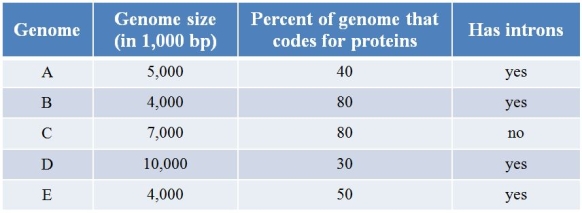 Which genome is most likely prokaryotic?
 (Multiple Choice)
4.7/5 (94)
(94) Refer to the table showing transposable elements that have been inserted into various genes (labeled A-E).(Note: "x" indicates the genes that have been knocked out in each experiment, "+" indicates that the bacteria can grow, and "-" indicates that the bacteria cannot grow.) 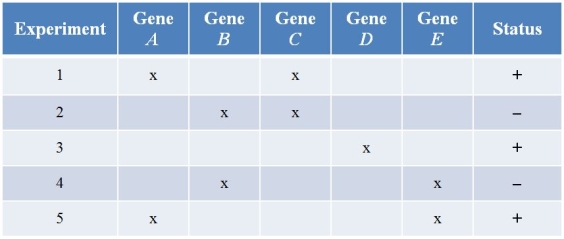 What are the minimal genomes?
 (Multiple Choice)
4.9/5 (83)
(83) A DNA sequence is cut by two different restriction enzymes (1 and 2).
Digestion from enzyme 1 yields the following fragments (read in the 5ʹ-to-3ʹ direction): CGATAC, GTCGTCGCC, and GTTATCGCGAC.Digestion from enzyme 2 yields the following fragments (read in the 5ʹ-to-3ʹ direction): CGACGTCGTCGCC and CGATACGTTATCG.
Which sequence does enzyme 1 recognize as a site at which to cut?
(Note that the enzyme cuts in the middle of its recognition sequence.)
(Multiple Choice)
4.8/5 (73)
(73) A hypothetical drug has a side effect of increasing blood pressure.Individuals who are homozygous T at SNP 1 break down this drug faster than average.Individuals who are homozygous A at SNP 2 break down this drug slower than average.The effects of these two SNPs roughly cancel each other out, such that homozygotes at both SNPs generally have average rates of breakdown of the enzyme.Which individual is most likely to be at risk for having the side effect? (Note: The genotype of SNP 1 is presented first, followed by that of SNP 2.)
(Multiple Choice)
4.8/5 (86)
(86) Refer to the table showing several prokaryote (bacterial) species (labeled A-E) that have been sequenced, along with the findings of the genes they contain.(Note: "x" marks the species possessing a functional copy of the gene.) Gene 1 is essential for the synthesis of several amino acids.Gene 2 encodes a protein involved in strengthening the cell wall.Gene 3 produces an enzyme that breaks down methane.The functions of the other five genes are currently unknown. 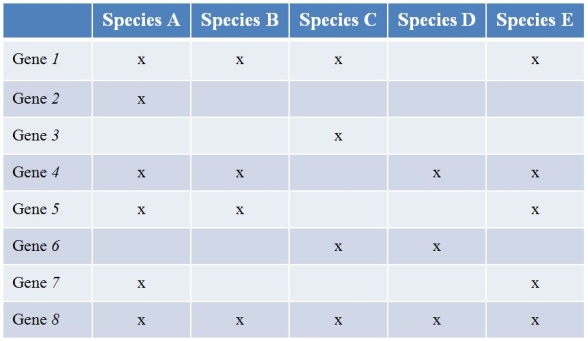 What type of study best characterizes what the researchers did?
 (Multiple Choice)
4.9/5 (71)
(71) Which genome is most likely to be that of a free-living prokaryote?
(Multiple Choice)
4.9/5 (78)
(78) The Denisovans are an extinct species of human that lived in Siberia several tens of thousands of years ago.We now have sequence information from these Denisovans.What evidence would best support Denisovans having had red hair?
(Multiple Choice)
4.8/5 (82)
(82) Which observation would best contradict the notion of genetic determinism?
(Multiple Choice)
4.7/5 (80)
(80) The presence of _______ proteins that attach to the respiratory tract is a key determinant of whether Haemophilus influenzae strains will be infectious.
(Short Answer)
4.8/5 (81)
(81) A gene involved in fatty acid metabolism duplicates.Via mutation and selection, these genes diverge in function.There is subsequent duplication and divergence.The resulting genes are all part of the same _______.
(Short Answer)
4.8/5 (80)
(80) Refer to the table showing several prokaryote species (labeled F-J) that have been sequenced, and the genes they contain.(Note: "x" marks the species possessing a functional copy of the gene.) 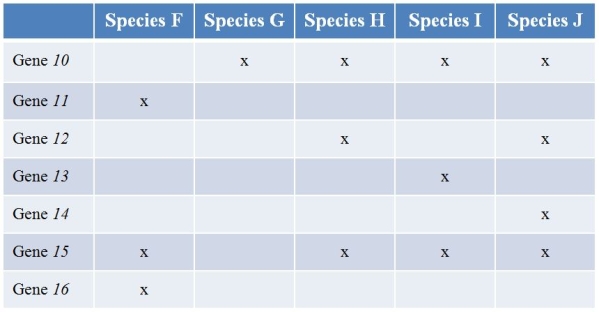 None of these species is closely related.Which two species are most likely exchanging genes? Explain your answer.
 (Essay)
4.7/5 (70)
(70) Refer to the table showing several prokaryote (bacterial) species (labeled A-E) that have been sequenced, along with the findings of the genes they contain.(Note: "x" marks the species possessing a functional copy of the gene.) Gene 1 is essential for the synthesis of several amino acids.Gene 2 encodes a protein involved in strengthening the cell wall.Gene 3 produces an enzyme that breaks down methane.The functions of the other five genes are currently unknown. 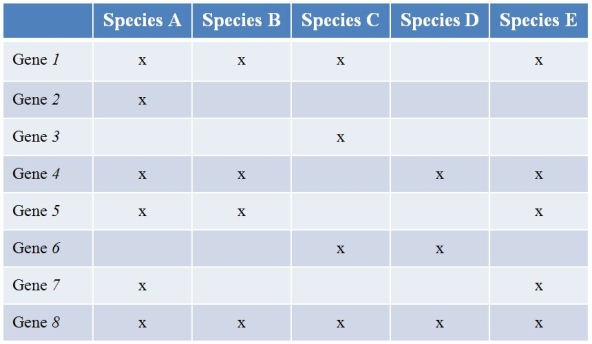 Which species would be most likely to withstand extreme conditions?
 (Multiple Choice)
4.8/5 (73)
(73) In comparison with Sanger sequencing, in high-throughput DNA sequencing,
(Multiple Choice)
4.8/5 (72)
(72) 
Filters
- Essay(0)
- Multiple Choice(0)
- Short Answer(0)
- True False(0)
- Matching(0)