



 Chat with AI
Exam 17: Genomes

Exam 1: Studying Life246 Questions
Exam 2: Small Molecules and the Chemistry of Life246 Questions
Exam 3: Proteins, Carbohydrates, and Lipids246 Questions
Exam 4: Nucleic Acids and the Origin of Life246 Questions
Exam 5: Cells: the Working Units of Life248 Questions
Exam 6: Cell Membranes246 Questions
Exam 7: Cell Communication and Multicellularity246 Questions
Exam 8: Energy, Enzymes, and Metabolism246 Questions
Exam 9: Pathways That Harvest Chemical Energy246 Questions
Exam 10: Photosynthesis: Energy From Sunlight242 Questions
Exam 11: The Cell Cycle and Cell Division260 Questions
Exam 12: Inheritance, Genes, and Chromosomes250 Questions
Exam 13: Dna and Its Role in Heredity257 Questions
Exam 14: From Dna to Protein: Gene Expression252 Questions
Exam 15: Gene Mutation and Molecular Medicine251 Questions
Exam 16: Regulation of Gene Expression245 Questions
Exam 17: Genomes249 Questions
Exam 18: Recombinant Dna and Biotechnology243 Questions
Exam 20: Mechanisms of Evolution243 Questions
Exam 21: Reconstructing and Using Phylogenies246 Questions
Exam 22: Speciation247 Questions
Exam 23: Evolution of Genes and Genomes252 Questions
Exam 24: The History of Life on Earth246 Questions
Exam 25: Bacteria, Archaea, and Viruses262 Questions
Exam 26: The Origin and Diversification of Eukaryotes252 Questions
Exam 27: Plants Without Seeds: From Water to Land251 Questions
Exam 28: The Evolution of Seed Plants259 Questions
Exam 29: The Evolution and Diversity of Fungi261 Questions
Exam 30: Animal Origins and the Evolution of Body Plans248 Questions
Exam 31: Protostome Animals244 Questions
Exam 32: Deuterostome Animals246 Questions
Exam 33: The Plant Body243 Questions
Exam 34: Transport in Plants248 Questions
Exam 35: Plant Nutrition247 Questions
Exam 36: Regulation of Plant Growth246 Questions
Exam 37: Reproduction in Flowering Plants247 Questions
Exam 38: Plant Responses to Environmental Challenges246 Questions
Exam 39: Physiology, Homeostasis, and Temperature Regulation258 Questions
Exam 40: Animal Hormones249 Questions
Exam 41: Immunology: Animal Defense Systems265 Questions
Exam 42: Animal Reproduction261 Questions
Exam 43: Animal Development261 Questions
Exam 44: Neurons, Glia, and Nervous Systems250 Questions
Exam 45: Sensory Systems249 Questions
Exam 46: The Mammalian Nervous System: Structure and Higher Functions254 Questions
Exam 47: Musculoskeletal Systems259 Questions
Exam 48: Gas Exchange247 Questions
Exam 49: Circulatory Systems252 Questions
Exam 50: Nutrition, Digestion, and Absorption259 Questions
Exam 51: Salt and Water Balance and Nitrogen Excretion251 Questions
Exam 52: Animal Behavior249 Questions
Exam 53: The Physical Environment and Biogeography of Life248 Questions
Exam 54: Populations259 Questions
Exam 55: Species Interactions254 Questions
Exam 56: Communities247 Questions
Exam 57: Ecosystems238 Questions
Exam 58: A Changing Biosphere222 Questions
Select questions type


Refer to the table showing various sequenced genomes. 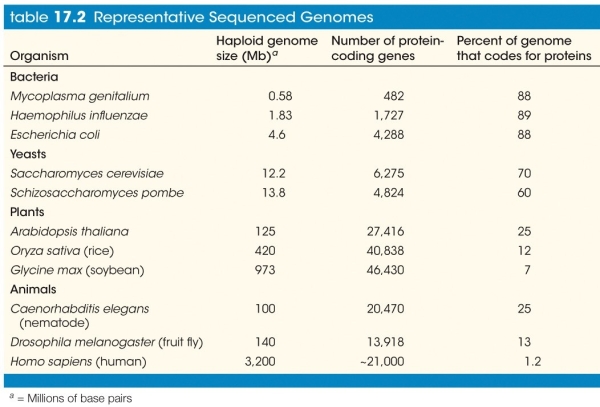 Of the nematode, the fruit fly, and the human, which devotes more than one-fifth of its genomes to protein-coding genes?
 (Multiple Choice)
4.7/5  (85)
(85) Comparisons of yeast and bacterial cell genomes have revealed that
(Multiple Choice)
4.8/5 (68)
(68) Caenorhabditis elegans is a roundworm, or nematode, that scientists have used as a model eukaryotic organism in the study of genomics and developmental biology in multicellular organisms.The _______ of its body makes it useful to study cell movement.
(Short Answer)
4.9/5 (72)
(72) Suppose a long sequence of DNA is cut with four different restriction enzymes.Which restriction enzyme should produce the fewest fragments?
(Multiple Choice)
4.8/5 (86)
(86) When eukaryotic genomes and prokaryotic genomes are compared,
(Multiple Choice)
4.9/5 (66)
(66) If a plant were to acquire mobility, such that it could more easily escape adverse conditions and enemies, some genes would be lost over evolutionary time.Which function category would most likely lose genes?
(Multiple Choice)
5.0/5 (73)
(73) Refer to the figure showing high-throughput sequencing. 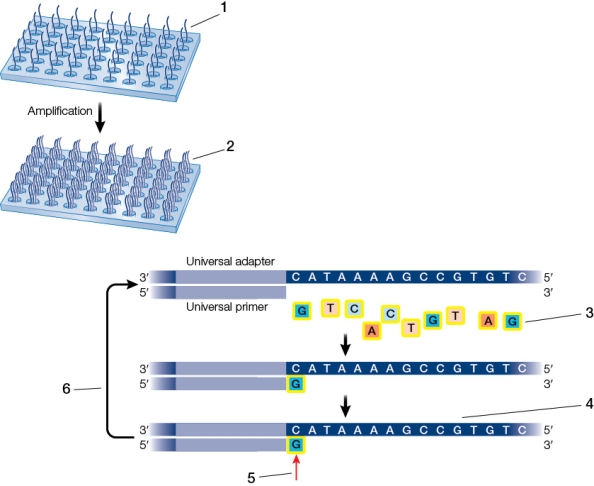 At which step is DNA synthesis halted by the incorporation of a fluorescently tagged nucleoside triphosphate?
 (Short Answer)
4.9/5 (71)
(71) In functional genomics, biologists use sequence information to identify the functions of various regions of genomes.Which kinds of information could not be obtained from a genome sequence?
(Multiple Choice)
4.7/5 (77)
(77) Refer to the table showing transposable elements that have been inserted into various genes (labeled A-E).(Note: "x" indicates the genes that have been knocked out in each experiment, "+" indicates that the bacteria can grow, and "-" indicates that the bacteria cannot grow.) 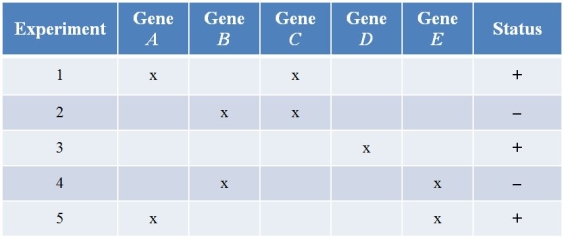 Which gene is an essential gene?
 (Multiple Choice)
4.9/5 (81)
(81) Which statement would be considered an expression of genetic determinism?
(Multiple Choice)
5.0/5 (86)
(86) In comparison to Mycoplasma genitalium, the yeast Saccharomyces cerevisiae has
(Multiple Choice)
4.8/5 (84)
(84) Two transposable elements located near one another (within a few thousand base pairs) will transpose together and carry the intervening DNA sequence with them.These are known as _______ transposable elements.
(Multiple Choice)
4.9/5 (73)
(73) Refer to the table showing several prokaryote (bacterial) species (labeled A-E) that have been sequenced, along with the findings of the genes they contain.(Note: "x" marks the species possessing a functional copy of the gene.) Gene 1 is essential for the synthesis of several amino acids.Gene 2 encodes a protein involved in strengthening the cell wall.Gene 3 produces an enzyme that breaks down methane.The functions of the other five genes are currently unknown. 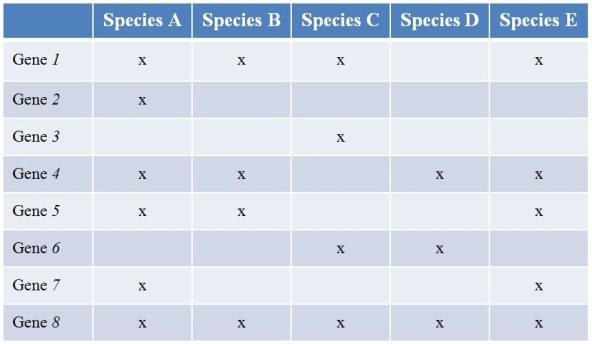 Which gene is most likely to be part of the prokaryotic minimal genome?
 (Multiple Choice)
4.8/5 (81)
(81) Which techniques, tools, or activities would be most directly useful in identifying the genetic variants associated with a complex human disease such as schizophrenia?
(Multiple Choice)
4.9/5 (81)
(81) A DNA sequence is cut by two different restriction enzymes (1 and 2).
Digestion from enzyme 1 yields the following fragments (read in the 5ʹ-to-3ʹ direction): CGATAC, GTCGTCGCC, and GTTATCGCGAC.Digestion from enzyme 2 yields the following fragments (read in the 5ʹ-to-3ʹ direction): CGACGTCGTCGCC and CGATACGTTATCG.
What was the original sequence?
(Multiple Choice)
4.8/5 (77)
(77) Five prokaryote species (labeled A-E) have been sequenced.Below are the findings of the genes they contain.(Note: "x" denotes the species possessing a functional copy of the gene.) Gene 1 is essential for the synthesis of several amino acids.Gene 2 encodes a protein involved in strengthening the cell wall.Gene 3 produces an enzyme that breaks down methane.The functions of the other three genes are currently unknown. 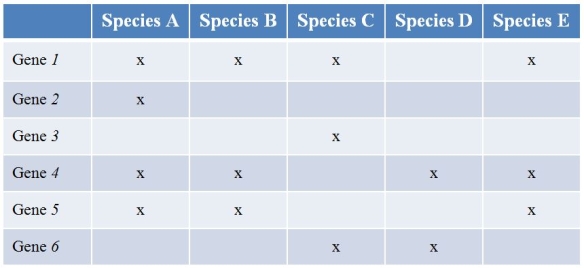 Which of these genes is/are likely to be included in the minimal genome?
 (Multiple Choice)
5.0/5 (72)
(72) The success or failure of current treatments for hepatitis C is determined to a large extent by genetic variants of the IL28B gene.This important finding is an example of the discoveries coming from the field of _______.
(Short Answer)
4.7/5 (68)
(68) 
Filters
- Essay(0)
- Multiple Choice(0)
- Short Answer(0)
- True False(0)
- Matching(0)