



 Chat with AI
Exam 17: Genomes

Exam 1: Studying Life246 Questions
Exam 2: Small Molecules and the Chemistry of Life246 Questions
Exam 3: Proteins, Carbohydrates, and Lipids246 Questions
Exam 4: Nucleic Acids and the Origin of Life246 Questions
Exam 5: Cells: the Working Units of Life248 Questions
Exam 6: Cell Membranes246 Questions
Exam 7: Cell Communication and Multicellularity246 Questions
Exam 8: Energy, Enzymes, and Metabolism246 Questions
Exam 9: Pathways That Harvest Chemical Energy246 Questions
Exam 10: Photosynthesis: Energy From Sunlight242 Questions
Exam 11: The Cell Cycle and Cell Division260 Questions
Exam 12: Inheritance, Genes, and Chromosomes250 Questions
Exam 13: Dna and Its Role in Heredity257 Questions
Exam 14: From Dna to Protein: Gene Expression252 Questions
Exam 15: Gene Mutation and Molecular Medicine251 Questions
Exam 16: Regulation of Gene Expression245 Questions
Exam 17: Genomes249 Questions
Exam 18: Recombinant Dna and Biotechnology243 Questions
Exam 20: Mechanisms of Evolution243 Questions
Exam 21: Reconstructing and Using Phylogenies246 Questions
Exam 22: Speciation247 Questions
Exam 23: Evolution of Genes and Genomes252 Questions
Exam 24: The History of Life on Earth246 Questions
Exam 25: Bacteria, Archaea, and Viruses262 Questions
Exam 26: The Origin and Diversification of Eukaryotes252 Questions
Exam 27: Plants Without Seeds: From Water to Land251 Questions
Exam 28: The Evolution of Seed Plants259 Questions
Exam 29: The Evolution and Diversity of Fungi261 Questions
Exam 30: Animal Origins and the Evolution of Body Plans248 Questions
Exam 31: Protostome Animals244 Questions
Exam 32: Deuterostome Animals246 Questions
Exam 33: The Plant Body243 Questions
Exam 34: Transport in Plants248 Questions
Exam 35: Plant Nutrition247 Questions
Exam 36: Regulation of Plant Growth246 Questions
Exam 37: Reproduction in Flowering Plants247 Questions
Exam 38: Plant Responses to Environmental Challenges246 Questions
Exam 39: Physiology, Homeostasis, and Temperature Regulation258 Questions
Exam 40: Animal Hormones249 Questions
Exam 41: Immunology: Animal Defense Systems265 Questions
Exam 42: Animal Reproduction261 Questions
Exam 43: Animal Development261 Questions
Exam 44: Neurons, Glia, and Nervous Systems250 Questions
Exam 45: Sensory Systems249 Questions
Exam 46: The Mammalian Nervous System: Structure and Higher Functions254 Questions
Exam 47: Musculoskeletal Systems259 Questions
Exam 48: Gas Exchange247 Questions
Exam 49: Circulatory Systems252 Questions
Exam 50: Nutrition, Digestion, and Absorption259 Questions
Exam 51: Salt and Water Balance and Nitrogen Excretion251 Questions
Exam 52: Animal Behavior249 Questions
Exam 53: The Physical Environment and Biogeography of Life248 Questions
Exam 54: Populations259 Questions
Exam 55: Species Interactions254 Questions
Exam 56: Communities247 Questions
Exam 57: Ecosystems238 Questions
Exam 58: A Changing Biosphere222 Questions
Select questions type


Five prokaryote species (labeled A-E) have been sequenced.Below are the findings of the genes they contain.(Note: "x" denotes the species possessing a functional copy of the gene.) Gene 1 is essential for the synthesis of several amino acids.Gene 2 encodes a protein involved in strengthening the cell wall.The functions of the other genes are currently unknown. 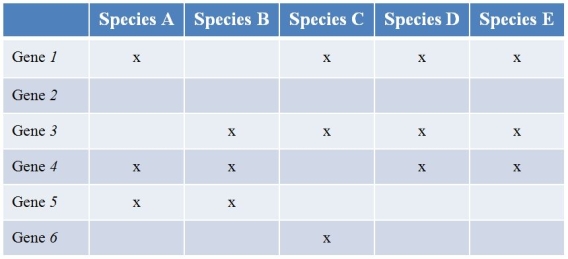 Which species would most likely have difficulty growing on a growth medium composed simply of a sugar as a carbon source?
 (Multiple Choice)
4.9/5  (75)
(75) The genes that encode estrogen receptors and those that encode adrenal steroid receptors evolved from an ancestral gene hundreds of millions of years ago.These genes are an example of a gene _______.
(Short Answer)
4.8/5 (60)
(60) A biologist is interested in the genomics of organisms that undergo complex transitions during development.She wants an animal with a genome that is smaller than 500 million nucleotides._______ would be a useful model organism.
(Short Answer)
4.9/5 (68)
(68) Which procedure is not used in high-throughput DNA sequencing?
(Multiple Choice)
4.9/5 (73)
(73) A universal adapter used in a DNA sequencing run starts 5′-TGCAGTA….What would be the sequence of the corresponding universal primer? (Note: "…" represents many nucleotides.)
(Multiple Choice)
4.9/5 (96)
(96) Refer to the table showing a hypothetical data set comparing the gene content of strains of Salmonella and Shigella (which are all pathogenic) and pathogenic and nonpathogenic strains of E.coli.(Note: "x" denotes presence of the gene.) 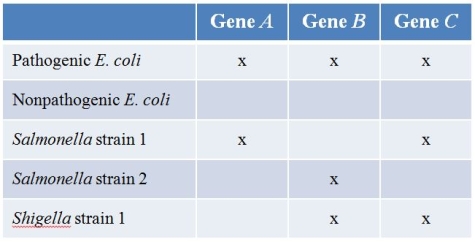 What is the most likely conclusion about gene C?
 (Multiple Choice)
4.8/5 (80)
(80) A highly repetitive sequence is found in a eukaryotic genome.Its repeat length is short, and the repeats are found next to one another.It is also not transcribed.This is most likely composed of _______.
(Short Answer)
4.8/5 (71)
(71) Nonfunctional copies of genes, known as _______, arise when mutations knock out the function of a gene.
(Short Answer)
4.8/5 (87)
(87) An organism has a genome that is 2.7 million bp long, with only 12 percent noncoding sequence.It lacks introns, except in its tRNA and rRNA.This organism is most likely a prokaryotic organism and is a(n) _______.
(Short Answer)
4.7/5 (78)
(78) A group of biologists is studying the link between genetic variation and variation in response to statin drugs in a group of people with heart disease.This activity is best described as
(Multiple Choice)
4.9/5 (80)
(80) Overlapping reads in high-throughput sequencing are possible because
(Multiple Choice)
4.9/5 (70)
(70) Which statement comparing the human genome to those of invertebrates such as Caenorhabditis elegans and Drosophila melanogaster is true?
(Multiple Choice)
4.8/5 (74)
(74) Craig Venter's team determined essential genes in bacteria by
(Multiple Choice)
4.9/5 (87)
(87) The most likely reason why the plant Arabidopsis thaliana has more protein-coding genes than flies or nematodes have is that
(Multiple Choice)
4.8/5 (78)
(78) The transposable element bandit, which was discovered in the dog hookworm, appears able to move to the hookworm's mammalian hosts.Because it does not use an RNA intermediate, the bandit element has been classified as a(n) _______.
(Short Answer)
4.8/5 (93)
(93) Five prokaryote species (labeled A-E) have been sequenced.Refer to the table with the findings of the genes they contain.(Note: "x" denotes the species possessing a functional copy of the gene.) Gene 1 is essential for the synthesis of several amino acids.Gene 2 encodes a protein involved in strengthening the cell wall.Gene 3 appears to encode an enzyme, but its function is unknown. 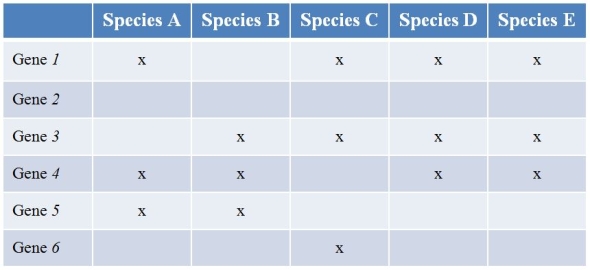 One way to obtain clues about the function of gene 3 would be to see what substances species _______ cannot grow on, in contrast with the other species.
 (Short Answer)
4.7/5 (94)
(94) It is the year 2025.You are taking care of a patient who is concerned about having an early stage of kidney cancer.His mother died from this disease.How might you develop a metabolomic profile for kidney cancer and then use it to determine whether your patient has kidney cancer?
(Essay)
5.0/5 (75)
(75) Below are four overlapping reads from sequencing.(Note: All reads are in a 5′-to-3′ direction.) Read 1: AGCGCTAAAGACGGCTCGAGTCAGCTAGTAGAA
Read 2: TGCGTAGCTATCGCATACGCAAGCGCTAAA
Read 3: GCTAGTAGAATCGATATCGAGGATCGATTAG
Read 4: GGATCGATTAGAGCTATAGTAGGCTGATGAC
Which is the most likely order of these reads?
(Multiple Choice)
4.9/5 (78)
(78) Refer to the figure showing the use of transposons as mutagens in Mycoplasma genitalium. 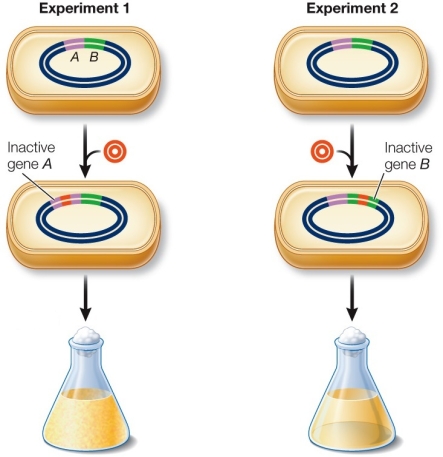 The transposon mutagenesis procedure shown in the figure
 (Multiple Choice)
4.8/5 (84)
(84) 
Filters
- Essay(0)
- Multiple Choice(0)
- Short Answer(0)
- True False(0)
- Matching(0)