



 Chat with AI
Exam 17: Genomes

Exam 1: Studying Life246 Questions
Exam 2: Small Molecules and the Chemistry of Life246 Questions
Exam 3: Proteins, Carbohydrates, and Lipids246 Questions
Exam 4: Nucleic Acids and the Origin of Life246 Questions
Exam 5: Cells: the Working Units of Life248 Questions
Exam 6: Cell Membranes246 Questions
Exam 7: Cell Communication and Multicellularity246 Questions
Exam 8: Energy, Enzymes, and Metabolism246 Questions
Exam 9: Pathways That Harvest Chemical Energy246 Questions
Exam 10: Photosynthesis: Energy From Sunlight242 Questions
Exam 11: The Cell Cycle and Cell Division260 Questions
Exam 12: Inheritance, Genes, and Chromosomes250 Questions
Exam 13: Dna and Its Role in Heredity257 Questions
Exam 14: From Dna to Protein: Gene Expression252 Questions
Exam 15: Gene Mutation and Molecular Medicine251 Questions
Exam 16: Regulation of Gene Expression245 Questions
Exam 17: Genomes249 Questions
Exam 18: Recombinant Dna and Biotechnology243 Questions
Exam 20: Mechanisms of Evolution243 Questions
Exam 21: Reconstructing and Using Phylogenies246 Questions
Exam 22: Speciation247 Questions
Exam 23: Evolution of Genes and Genomes252 Questions
Exam 24: The History of Life on Earth246 Questions
Exam 25: Bacteria, Archaea, and Viruses262 Questions
Exam 26: The Origin and Diversification of Eukaryotes252 Questions
Exam 27: Plants Without Seeds: From Water to Land251 Questions
Exam 28: The Evolution of Seed Plants259 Questions
Exam 29: The Evolution and Diversity of Fungi261 Questions
Exam 30: Animal Origins and the Evolution of Body Plans248 Questions
Exam 31: Protostome Animals244 Questions
Exam 32: Deuterostome Animals246 Questions
Exam 33: The Plant Body243 Questions
Exam 34: Transport in Plants248 Questions
Exam 35: Plant Nutrition247 Questions
Exam 36: Regulation of Plant Growth246 Questions
Exam 37: Reproduction in Flowering Plants247 Questions
Exam 38: Plant Responses to Environmental Challenges246 Questions
Exam 39: Physiology, Homeostasis, and Temperature Regulation258 Questions
Exam 40: Animal Hormones249 Questions
Exam 41: Immunology: Animal Defense Systems265 Questions
Exam 42: Animal Reproduction261 Questions
Exam 43: Animal Development261 Questions
Exam 44: Neurons, Glia, and Nervous Systems250 Questions
Exam 45: Sensory Systems249 Questions
Exam 46: The Mammalian Nervous System: Structure and Higher Functions254 Questions
Exam 47: Musculoskeletal Systems259 Questions
Exam 48: Gas Exchange247 Questions
Exam 49: Circulatory Systems252 Questions
Exam 50: Nutrition, Digestion, and Absorption259 Questions
Exam 51: Salt and Water Balance and Nitrogen Excretion251 Questions
Exam 52: Animal Behavior249 Questions
Exam 53: The Physical Environment and Biogeography of Life248 Questions
Exam 54: Populations259 Questions
Exam 55: Species Interactions254 Questions
Exam 56: Communities247 Questions
Exam 57: Ecosystems238 Questions
Exam 58: A Changing Biosphere222 Questions
Select questions type


Which study is best characterized as one of comparative genomics?
(Multiple Choice)
4.9/5  (78)
(78) Five prokaryote species (labeled A-E) have been sequenced.Refer to the table with the findings of the genes they contain.(Note: "x" denotes the species possessing a functional copy of the gene.) Gene 1 is essential for the synthesis of several amino acids.Gene 2 encodes a protein involved in strengthening the cell wall.Gene 3 produces an enzyme that breaks down methane.The functions of the other four genes are currently unknown. 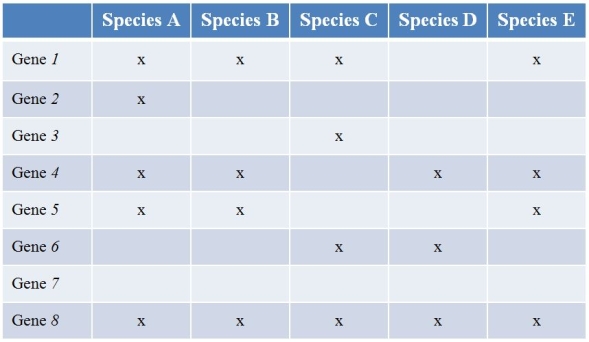 Based on these data, gene _______ is most likely to be included in the minimal genome.
 (Short Answer)
4.9/5 (80)
(80) Which ranking correctly orders the concepts, from the one most closely related to phenotypic characteristics to the one most distantly related to phenotypic characteristics?
(Multiple Choice)
4.7/5 (83)
(83) For the DNA sequence that begins 5′-GTCATAG…, the complement is _______.(Label the polarity accordingly.)
(Short Answer)
4.8/5 (70)
(70) Which technique is least likely to be associated with metagenomics?
(Multiple Choice)
4.7/5 (79)
(79) An enzyme is required to convert the inactive form of a drug into the active form.A completely dominant change from the G to the C allele increases activity of the enzyme.Too much of the active form of the drug can lead to tremors.Too little of the active form of the drug renders it ineffective.Which scenario is most likely?
(Multiple Choice)
4.9/5 (81)
(81) A genome is about 1.83 million bp long, it has 1,738 genes, and 99 percent of its sequence is coding sequence.This genome most likely belongs to a(n)
(Multiple Choice)
4.9/5 (85)
(85) Because they are usually more sedentary than animals, plants generally require more
(Multiple Choice)
4.7/5 (79)
(79) Which chemical or substance is an example of a secondary metabolite?
(Multiple Choice)
4.9/5 (81)
(81) The Denisovans are an extinct species of human that lived in Siberia several tens of thousands of years ago.We now have sequence information from these Denisovans.One could make the inference that Denisovans had red hair if their variant of the MC1R protein had _______ (higher/lower) activity than that of the typical human.
(Short Answer)
4.8/5 (84)
(84) Refer to the table showing various sequenced genomes 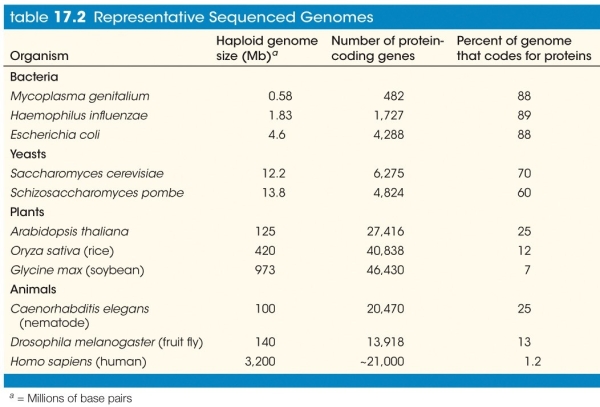 With respect to just the part of the genome that codes for proteins, the human coding genome is about _______ times larger than the Drosophila coding genome.
 (Multiple Choice)
4.9/5 (68)
(68) When studying Haemophilus influenzae, which of its properties would be most useful to know in determining whether a strain is infectious or not?
(Multiple Choice)
4.9/5 (68)
(68) Refer to the table showing several prokaryote (bacterial) species (labeled A-E) that have been sequenced, along with the findings of the genes they contain.(Note: "x" marks the species possessing a functional copy of the gene.) Gene 1 is essential for the synthesis of several amino acids.Gene 2 encodes a protein involved in strengthening the cell wall.Gene 3 produces an enzyme that breaks down methane.The functions of the other five genes are currently unknown. 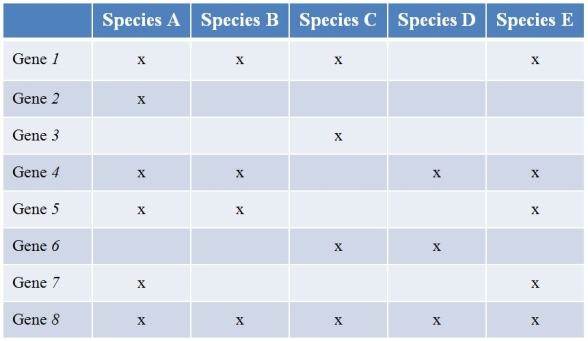 Which species would most likely have difficulty growing on a growth medium composed simply of a sugar as a carbon source?
 (Multiple Choice)
4.9/5 (93)
(93) A strand of DNA reads 5′-GTCT…ATGC-3′, with "…" representing many nucleotides.What is its complement?
(Multiple Choice)
4.9/5 (80)
(80) A DNA sequence motif is often found near open reading frames and contains consensus sequences for binding sites of transcription factors.Most likely, this sequence is
(Multiple Choice)
4.8/5 (91)
(91) A stretch of one strand of a DNA fragment is 5′-GTCATCGTACT-3′.What is the complementary strand?
(Multiple Choice)
4.8/5 (74)
(74) What is the most likely difference between the genomes of Drosophila and Caenorhabditis?
(Multiple Choice)
4.7/5 (79)
(79) 
Filters
- Essay(0)
- Multiple Choice(0)
- Short Answer(0)
- True False(0)
- Matching(0)