



 Chat with AI
Exam 56: Communities

Exam 1: Studying Life246 Questions
Exam 2: Small Molecules and the Chemistry of Life246 Questions
Exam 3: Proteins, Carbohydrates, and Lipids246 Questions
Exam 4: Nucleic Acids and the Origin of Life246 Questions
Exam 5: Cells: the Working Units of Life248 Questions
Exam 6: Cell Membranes246 Questions
Exam 7: Cell Communication and Multicellularity246 Questions
Exam 8: Energy, Enzymes, and Metabolism246 Questions
Exam 9: Pathways That Harvest Chemical Energy246 Questions
Exam 10: Photosynthesis: Energy From Sunlight242 Questions
Exam 11: The Cell Cycle and Cell Division260 Questions
Exam 12: Inheritance, Genes, and Chromosomes250 Questions
Exam 13: Dna and Its Role in Heredity257 Questions
Exam 14: From Dna to Protein: Gene Expression252 Questions
Exam 15: Gene Mutation and Molecular Medicine251 Questions
Exam 16: Regulation of Gene Expression245 Questions
Exam 17: Genomes249 Questions
Exam 18: Recombinant Dna and Biotechnology243 Questions
Exam 20: Mechanisms of Evolution243 Questions
Exam 21: Reconstructing and Using Phylogenies246 Questions
Exam 22: Speciation247 Questions
Exam 23: Evolution of Genes and Genomes252 Questions
Exam 24: The History of Life on Earth246 Questions
Exam 25: Bacteria, Archaea, and Viruses262 Questions
Exam 26: The Origin and Diversification of Eukaryotes252 Questions
Exam 27: Plants Without Seeds: From Water to Land251 Questions
Exam 28: The Evolution of Seed Plants259 Questions
Exam 29: The Evolution and Diversity of Fungi261 Questions
Exam 30: Animal Origins and the Evolution of Body Plans248 Questions
Exam 31: Protostome Animals244 Questions
Exam 32: Deuterostome Animals246 Questions
Exam 33: The Plant Body243 Questions
Exam 34: Transport in Plants248 Questions
Exam 35: Plant Nutrition247 Questions
Exam 36: Regulation of Plant Growth246 Questions
Exam 37: Reproduction in Flowering Plants247 Questions
Exam 38: Plant Responses to Environmental Challenges246 Questions
Exam 39: Physiology, Homeostasis, and Temperature Regulation258 Questions
Exam 40: Animal Hormones249 Questions
Exam 41: Immunology: Animal Defense Systems265 Questions
Exam 42: Animal Reproduction261 Questions
Exam 43: Animal Development261 Questions
Exam 44: Neurons, Glia, and Nervous Systems250 Questions
Exam 45: Sensory Systems249 Questions
Exam 46: The Mammalian Nervous System: Structure and Higher Functions254 Questions
Exam 47: Musculoskeletal Systems259 Questions
Exam 48: Gas Exchange247 Questions
Exam 49: Circulatory Systems252 Questions
Exam 50: Nutrition, Digestion, and Absorption259 Questions
Exam 51: Salt and Water Balance and Nitrogen Excretion251 Questions
Exam 52: Animal Behavior249 Questions
Exam 53: The Physical Environment and Biogeography of Life248 Questions
Exam 54: Populations259 Questions
Exam 55: Species Interactions254 Questions
Exam 56: Communities247 Questions
Exam 57: Ecosystems238 Questions
Exam 58: A Changing Biosphere222 Questions
Select questions type


If someone attempted to introduce a tropical species, such as an orangutan, into a polar region such as northern Alaska, it would probably not survive.What factor would likely be most effective in preventing its survival?
(Multiple Choice)
4.9/5  (96)
(96) The graphs illustrate elk and aspen numbers over several decades in Yellowstone National Park.They show major human management actions (removal and return of wolves; hunting of elk).Given this information, describe how biotic factors affected the community structure of Yellowstone National Park during this century.List each biotic factor and its effect. 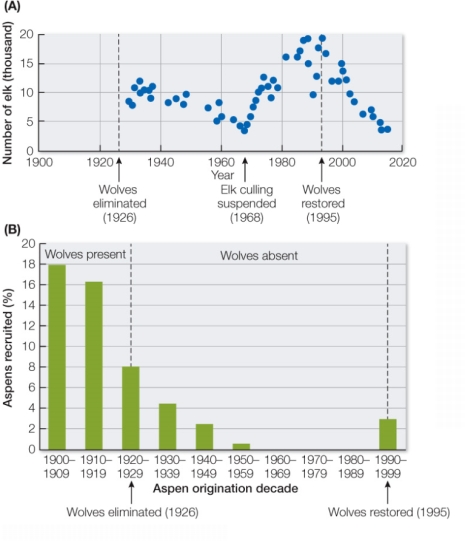
(Essay)
4.8/5 (69)
(69) At one time, giant African land snails were sold as pets, for teaching purposes, and for food.However, this snail has become a serious pest in habitats around the world.It carries plant pathogens, competes with native snails, eats 500 different species of plants, and even spreads human disease.The least likely way this invasive snail could have entered ecosystems in the United States is by
(Multiple Choice)
4.7/5 (86)
(86) In the northern Pacific Ocean, sea otters feed on sea urchins and sea stars.Sea urchins feed on kelp, and sea stars feed on mussels.Beginning in the 1700s, sea otters were hunted for their fur and driven nearly to extinction in some areas, resulting in trophic cascades in their communities.When the fur trade ended, sea otter numbers increased and their communities began to recover.One would expect this recovery to lead to increased numbers of _______ and decreased numbers of _______.
(Multiple Choice)
4.9/5 (84)
(84) Ecologists are not sure whether diversity in a community causes stability or whether diversity and stability are simply correlated.Explain the difference in these two concepts, and explain why the distinction is important.
(Essay)
4.8/5 (80)
(80) Does an established community always maintain the same species composition? Give examples of how changing environmental conditions might impact species composition.
(Essay)
4.8/5 (69)
(69) An ecologist studying interaction strength in a pond set up laboratory experiments using aquaria.He set up food webs in two aquaria that included these interactions:  After populations in the aquaria stabilized, the ecologist removed the small fish from one aquarium.The population of Daphnia there immediately increased rapidly.This indicates that the interactor species (fish) had what effect on the target species (Daphnia)?
 (Multiple Choice)
4.9/5 (80)
(80) The major process that occurred on the Pumice Plain on Mount St.Helens in the years after its eruption was
(Multiple Choice)
4.7/5 (88)
(88) Suppose succession occurred in a situation like the one at Glacier Bay, except that no nitrogen fixers such as Dryas or alders were available to begin colonization.How might this lack affect the process or outcome of succession?
(Multiple Choice)
4.8/5 (71)
(71) In their study of diversity and stability in grassland ecosystems, Tilman and his colleagues found that higher species richness in their plots had what effect on stability and productivity?
(Multiple Choice)
4.8/5 (71)
(71) During secondary succession following habitat destruction of a forest, settlement of new species is affected by both facilitation and inhibition.During which part of succession is each process most active, and how does the interaction of the two processes affect community structure?
(Essay)
4.9/5 (83)
(83) If secondary consumers are the highest trophic level in a specific community, how many trophic levels are in this community (not counting decomposers or omnivores)?
(Multiple Choice)
4.8/5 (83)
(83) The Shannon index of species diversity is calculated using this equation: 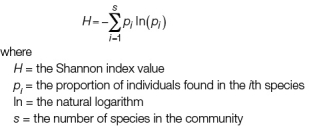 A laboratory community contains four species, with 10, 15, 25, and 50 individuals per species.Using the Shannon index, determine the species diversity of this community.
 (Multiple Choice)
4.8/5 (78)
(78) Sea otters in marine habitats along the west coast of North America were hunted to near extinction.This caused sea urchins to grow exponentially.They overgrazed and nearly destroyed kelp beds, which provided habitat and food for many fish and other species.After kelp was destroyed, many fish species also declined.This suggests that sea otters act as a _______ species and their loss set off a(n) _______.
(Multiple Choice)
4.8/5 (91)
(91) Refer to the figure, showing three aspects of biodiversity.Define each of these three aspects.Explain how they interact and how each is important for understanding community structure. 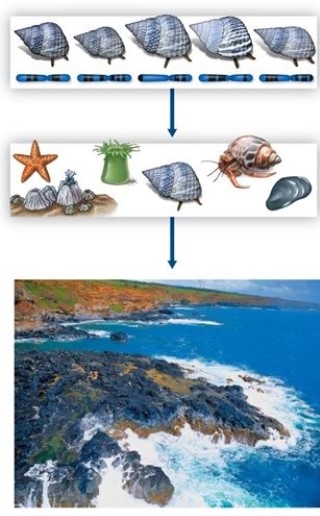
(Essay)
4.9/5 (79)
(79) A field of wildflowers has a diverse community of pollinators.A nearby farmer brings in hives of honey bees to pollinate his fields.The honey bees also feed on wildflower pollen, making them competitors of the wild pollinators.In response, some wild pollinator populations decline, but they build up again when the honey bees are removed.Assuming honey bees are the interactors and wild pollinator species are the targets, what is the most definite conclusion that can be made about interaction strength and direction?
(Multiple Choice)
4.8/5 (74)
(74) Which is the correct chronological order (from earliest to latest) for the succession of plant species in Glacier Bay?
(Multiple Choice)
4.8/5 (73)
(73) According to research by Joseph Connell, rock barnacles living at lower levels of the intertidal zone grow faster and, through competition, eliminate stellate barnacles from the area.This indicates that rock barnacles have a greater _______ than stellate barnacles.
(Short Answer)
4.7/5 (80)
(80) Competition is an important interaction in most communities.How would differences in interaction strength among competitors be likely to influence community structure?
(Essay)
4.8/5 (81)
(81) Human activities are causing many stresses in nearshore estuarine habitats, which are vital habitats for breeding and development of young marine fish and other animals.These stresses are occurring as a result of climate change, pollution, coastal construction, and a variety of other factors.Of the changes that occur in estuaries, which would not be considered a stress?
(Multiple Choice)
5.0/5 (82)
(82) 
Filters
- Essay(0)
- Multiple Choice(0)
- Short Answer(0)
- True False(0)
- Matching(0)