



 Chat with AI
Exam 56: Communities

Exam 1: Studying Life246 Questions
Exam 2: Small Molecules and the Chemistry of Life246 Questions
Exam 3: Proteins, Carbohydrates, and Lipids246 Questions
Exam 4: Nucleic Acids and the Origin of Life246 Questions
Exam 5: Cells: the Working Units of Life248 Questions
Exam 6: Cell Membranes246 Questions
Exam 7: Cell Communication and Multicellularity246 Questions
Exam 8: Energy, Enzymes, and Metabolism246 Questions
Exam 9: Pathways That Harvest Chemical Energy246 Questions
Exam 10: Photosynthesis: Energy From Sunlight242 Questions
Exam 11: The Cell Cycle and Cell Division260 Questions
Exam 12: Inheritance, Genes, and Chromosomes250 Questions
Exam 13: Dna and Its Role in Heredity257 Questions
Exam 14: From Dna to Protein: Gene Expression252 Questions
Exam 15: Gene Mutation and Molecular Medicine251 Questions
Exam 16: Regulation of Gene Expression245 Questions
Exam 17: Genomes249 Questions
Exam 18: Recombinant Dna and Biotechnology243 Questions
Exam 20: Mechanisms of Evolution243 Questions
Exam 21: Reconstructing and Using Phylogenies246 Questions
Exam 22: Speciation247 Questions
Exam 23: Evolution of Genes and Genomes252 Questions
Exam 24: The History of Life on Earth246 Questions
Exam 25: Bacteria, Archaea, and Viruses262 Questions
Exam 26: The Origin and Diversification of Eukaryotes252 Questions
Exam 27: Plants Without Seeds: From Water to Land251 Questions
Exam 28: The Evolution of Seed Plants259 Questions
Exam 29: The Evolution and Diversity of Fungi261 Questions
Exam 30: Animal Origins and the Evolution of Body Plans248 Questions
Exam 31: Protostome Animals244 Questions
Exam 32: Deuterostome Animals246 Questions
Exam 33: The Plant Body243 Questions
Exam 34: Transport in Plants248 Questions
Exam 35: Plant Nutrition247 Questions
Exam 36: Regulation of Plant Growth246 Questions
Exam 37: Reproduction in Flowering Plants247 Questions
Exam 38: Plant Responses to Environmental Challenges246 Questions
Exam 39: Physiology, Homeostasis, and Temperature Regulation258 Questions
Exam 40: Animal Hormones249 Questions
Exam 41: Immunology: Animal Defense Systems265 Questions
Exam 42: Animal Reproduction261 Questions
Exam 43: Animal Development261 Questions
Exam 44: Neurons, Glia, and Nervous Systems250 Questions
Exam 45: Sensory Systems249 Questions
Exam 46: The Mammalian Nervous System: Structure and Higher Functions254 Questions
Exam 47: Musculoskeletal Systems259 Questions
Exam 48: Gas Exchange247 Questions
Exam 49: Circulatory Systems252 Questions
Exam 50: Nutrition, Digestion, and Absorption259 Questions
Exam 51: Salt and Water Balance and Nitrogen Excretion251 Questions
Exam 52: Animal Behavior249 Questions
Exam 53: The Physical Environment and Biogeography of Life248 Questions
Exam 54: Populations259 Questions
Exam 55: Species Interactions254 Questions
Exam 56: Communities247 Questions
Exam 57: Ecosystems238 Questions
Exam 58: A Changing Biosphere222 Questions
Select questions type


Gopher tortoises are native to the southeastern United States.Which characteristic of gopher tortoises would best support the claim that they act as both keystone and ecosystem engineering species in their communities?
(Multiple Choice)
4.7/5  (76)
(76) In a desert food web, cacti are eaten by flies.Flies are eaten by scorpions, which are eaten by roadrunners.In this food web, the primary consumers are the _______.
(Short Answer)
4.8/5 (89)
(89) The regional species pool of a community defines the conditions for a species to
(Multiple Choice)
4.8/5 (76)
(76) The stomach contents of a mammal are examined and found to contain the remains of mice, birds, insects, worms, snails, berries, seeds, grass, and leaves.This organism is therefore a(n)
(Multiple Choice)
4.9/5 (74)
(74) What factor can best be used to distinguish a disturbance from a stress in a community?
(Multiple Choice)
5.0/5 (82)
(82) Refer to the figure. 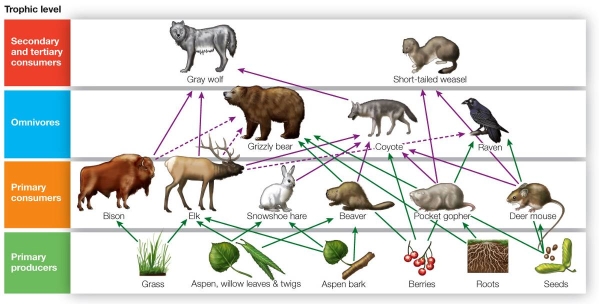 In which list are organisms ordered correctly from lowest to highest trophic level, according to the figure?
 (Multiple Choice)
4.8/5 (80)
(80) The golden toad of Central America is thought to be extinct in the wild.The mountaintop cloud forests in which it lived no longer exist, because of drought and other changes associated with climate change.In this case, it appears that changing environmental conditions affected the habitat of the golden toad by
(Multiple Choice)
4.7/5 (81)
(81) As a community develops, more species enter the community and become established.How will this affect the Shannon index (H) of the community?
(Multiple Choice)
5.0/5 (84)
(84) Following a severe ice storm, the composition of the trees changed in a community as it recovered from the disturbance.This is an example of _______ succession.
(Multiple Choice)
4.9/5 (81)
(81) In comparing the terms "species diversity" and "biodiversity," it would be most correct to say that
(Multiple Choice)
4.8/5 (79)
(79) Refer to the graph, showing the interaction between the elk population and the presence or absence of wolves in Yellowstone National Park. 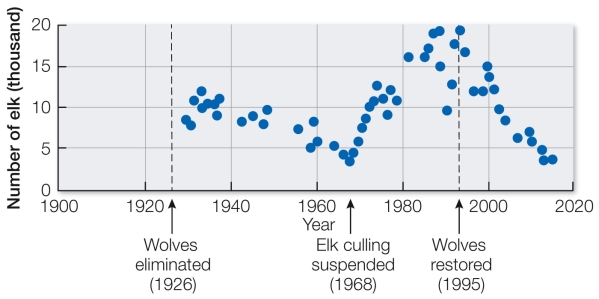 Elk culling (hunting by humans) occurred until 1968.Based on this information, what factor had the most influence on the population of elk between 1926 and 1968?
 (Multiple Choice)
4.9/5 (80)
(80) A tropical rainforest is home to hundreds of species of trees that overlap in their resource requirements.Assuming multiple tree species have similar rates of population growth and similar access to the space and resources available, rainforest trees can be said to work in accordance with a neutral, or _______, model in maintaining species diversity.
(Short Answer)
4.8/5 (85)
(85) Removal of a keystone species from a community will likely decrease species richness by interrupting
(Multiple Choice)
4.7/5 (95)
(95) Students comparing insect communities in two fields find that both fields have ten species of insects.However, field A has mostly grasshoppers of a single species; the other nine species are rarely seen.Field B, in contrast, has approximately equal numbers of all ten species.This finding shows a difference in species diversity in the fields, which is due to a difference in species _______.
(Short Answer)
4.9/5 (70)
(70) A gardener plants a bed that contains several blueberry bushes, several red clover and yarrow plants, and 100 strawberry plants.The strawberries provide a ground cover that conserves moisture and suppresses weeds.The red clover provides nitrogen, and the yarrow provides other nutrients for the blueberries.Because of its multiple species and their interactions, this bed can be considered a _______.
(Short Answer)
4.9/5 (84)
(84) Area A has 50 species.One species is very dominant, making up 90 percent of the total biomass, while the others are very rare.Area B has only 20 species, but they are distributed so that all are present in relatively equal numbers.Compared with area B, area A has a very high level of _______.
(Short Answer)
4.9/5 (84)
(84) Using examples, compare the stability of monocultures with that of polycultures, and explain why their stabilities are different.How have scientists learned about this difference in stability?
(Essay)
4.8/5 (78)
(78) Two fish species live and compete on a coral reef.Fish A is dominant and maintains a larger population than fish B.During a very hot summer, a temperature spike occurs on the reef, killing off most of fish A's population.The fish B population then begins to increase.This scenario describes the process of
(Multiple Choice)
4.9/5 (83)
(83) Zones created by the eruption of Mount St.Helens included the Pumice Plain nearest the lava dome, the Blowdown Zone along the mountain slopes, and beyond those, forests covered with debris and ash.Which, if any, of these zones would be the fastest to begin recovering living communities, and why?
(Multiple Choice)
4.9/5 (63)
(63) 
Filters
- Essay(0)
- Multiple Choice(0)
- Short Answer(0)
- True False(0)
- Matching(0)