



 Chat with AI
Exam 56: Communities

Exam 1: Studying Life246 Questions
Exam 2: Small Molecules and the Chemistry of Life246 Questions
Exam 3: Proteins, Carbohydrates, and Lipids246 Questions
Exam 4: Nucleic Acids and the Origin of Life246 Questions
Exam 5: Cells: the Working Units of Life248 Questions
Exam 6: Cell Membranes246 Questions
Exam 7: Cell Communication and Multicellularity246 Questions
Exam 8: Energy, Enzymes, and Metabolism246 Questions
Exam 9: Pathways That Harvest Chemical Energy246 Questions
Exam 10: Photosynthesis: Energy From Sunlight242 Questions
Exam 11: The Cell Cycle and Cell Division260 Questions
Exam 12: Inheritance, Genes, and Chromosomes250 Questions
Exam 13: Dna and Its Role in Heredity257 Questions
Exam 14: From Dna to Protein: Gene Expression252 Questions
Exam 15: Gene Mutation and Molecular Medicine251 Questions
Exam 16: Regulation of Gene Expression245 Questions
Exam 17: Genomes249 Questions
Exam 18: Recombinant Dna and Biotechnology243 Questions
Exam 20: Mechanisms of Evolution243 Questions
Exam 21: Reconstructing and Using Phylogenies246 Questions
Exam 22: Speciation247 Questions
Exam 23: Evolution of Genes and Genomes252 Questions
Exam 24: The History of Life on Earth246 Questions
Exam 25: Bacteria, Archaea, and Viruses262 Questions
Exam 26: The Origin and Diversification of Eukaryotes252 Questions
Exam 27: Plants Without Seeds: From Water to Land251 Questions
Exam 28: The Evolution of Seed Plants259 Questions
Exam 29: The Evolution and Diversity of Fungi261 Questions
Exam 30: Animal Origins and the Evolution of Body Plans248 Questions
Exam 31: Protostome Animals244 Questions
Exam 32: Deuterostome Animals246 Questions
Exam 33: The Plant Body243 Questions
Exam 34: Transport in Plants248 Questions
Exam 35: Plant Nutrition247 Questions
Exam 36: Regulation of Plant Growth246 Questions
Exam 37: Reproduction in Flowering Plants247 Questions
Exam 38: Plant Responses to Environmental Challenges246 Questions
Exam 39: Physiology, Homeostasis, and Temperature Regulation258 Questions
Exam 40: Animal Hormones249 Questions
Exam 41: Immunology: Animal Defense Systems265 Questions
Exam 42: Animal Reproduction261 Questions
Exam 43: Animal Development261 Questions
Exam 44: Neurons, Glia, and Nervous Systems250 Questions
Exam 45: Sensory Systems249 Questions
Exam 46: The Mammalian Nervous System: Structure and Higher Functions254 Questions
Exam 47: Musculoskeletal Systems259 Questions
Exam 48: Gas Exchange247 Questions
Exam 49: Circulatory Systems252 Questions
Exam 50: Nutrition, Digestion, and Absorption259 Questions
Exam 51: Salt and Water Balance and Nitrogen Excretion251 Questions
Exam 52: Animal Behavior249 Questions
Exam 53: The Physical Environment and Biogeography of Life248 Questions
Exam 54: Populations259 Questions
Exam 55: Species Interactions254 Questions
Exam 56: Communities247 Questions
Exam 57: Ecosystems238 Questions
Exam 58: A Changing Biosphere222 Questions
Select questions type


The figure shows 200 years of succession as glaciers recede in Glacier Bay, Alaska.In terms of succession, what is the significance of the climax (spruce forest) at the right of the top diagram? What can you infer about the nature of the climax forest, based on the graph? 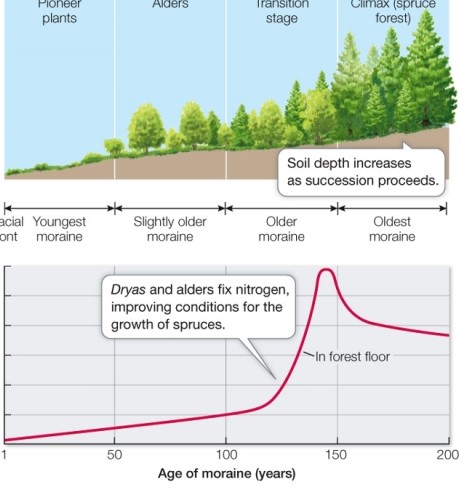
(Essay)
4.9/5  (85)
(85) As a community's species richness increases, its community function generally _______.
(Short Answer)
4.8/5 (70)
(70) Communities can be defined based on all of the following except
(Multiple Choice)
4.8/5 (95)
(95) Many species are introduced outside their normal ranges deliberately, for specific purposes.Some of these (such as the honey bee) integrate into natural communities; others (such as the gypsy moth) reproduce out of control, become pests, and are defined as "invasive." Which of the following could be a difference in the way these two categories of introduced species changed a community's structure?
(Multiple Choice)
4.9/5 (71)
(71) According to the intermediate disturbance hypothesis, species diversity might be low under conditions of low disturbance or stress because there may be high levels of
(Multiple Choice)
4.8/5 (87)
(87) A group of species in a community all feed on similar resources, and they are all approximately equal in their ability to obtain these resources.Species diversity in this group is likely maintained by
(Multiple Choice)
4.8/5 (87)
(87) What is the major distinction, if any, between a food web and an interaction web?
(Multiple Choice)
4.8/5 (81)
(81) Which trophic interaction in a community is an indirect interaction?
(Multiple Choice)
4.8/5 (67)
(67) In a coastal aquaculture operation, mussels and seaweed are introduced to use the nutrients contained in the waste produced by salmon.This reduces salmon waste in the system by up to 60 percent.This is an example of a _______ system that is most likely _______ stable compared with a traditional system, in which salmon are farmed alone.
(Multiple Choice)
4.7/5 (89)
(89) The succession occurring on the glacial moraines of Glacier Bay, Alaska, and behind other retreating glaciers is considered primary succession.What aspect of this process defines it as primary, rather than secondary, succession?
(Multiple Choice)
4.8/5 (94)
(94) Many biotic factors have the potential to affect community structure.Such biotic factors include all of the following except
(Multiple Choice)
4.8/5 (78)
(78) An ecologist studying the community within the canopy of a rainforest tree constructs a food web of the canopy community.By simply observing the connections in this food web, the ecologist will gain insight into which aspect of the community?
(Multiple Choice)
4.8/5 (85)
(85) Ecologists want to understand ecological changes as a forested area is cut and then begins to recover.They measure the number and evenness of species present at the beginning (before cutting) and at different times after cutting.They are measuring changes in which ecological characteristic?
(Multiple Choice)
5.0/5 (84)
(84) In 1988, fires in Yellowstone National Park affected over 36 percent of its area.Where the fires burned hottest, most plants, including forest trees, were killed.Where the fires were less severe, forest trees survived and only smaller plants were killed.What is most likely to happen in terms of succession in situations like this?
(Multiple Choice)
5.0/5 (96)
(96) A scientist removes one species from a community and observes how the abundance of a second "target" species is affected.The scientist is measuring the _______ between the two species.
(Short Answer)
4.7/5 (80)
(80) An ecologist wants to better understand the evolutionary relationships of organisms making up a community.She would most likely define the community based on its
(Multiple Choice)
4.9/5 (85)
(85) After a volcanic eruption, weathering, rain, and other natural forces help break down the volcanic rock and ash, releasing its nutrients.This helps pioneer plant species to colonize.As succeeding generations of plants develop on the volcanic landscape, how (if at all) will the plant community be likely to change?
(Multiple Choice)
4.8/5 (74)
(74) A saguaro cactus in the Sonoran Desert takes 80 years to become mature and begin flowering.During that time, woodpeckers drill cavities into the cactus and provide nesting sites for up to 30 bird species.After it begins to flower, the cactus also provides nectar for bats, bees, and doves, and fruit for various other birds and insects.Based on these interactions, the saguaro cactus could best be described as a
(Multiple Choice)
4.8/5 (87)
(87) Formation of an alternative state of succession is probably least likely to occur under which conditions?
(Multiple Choice)
4.8/5 (82)
(82) 
Filters
- Essay(0)
- Multiple Choice(0)
- Short Answer(0)
- True False(0)
- Matching(0)