



 Chat with AI
Exam 56: Communities

Exam 1: Studying Life246 Questions
Exam 2: Small Molecules and the Chemistry of Life246 Questions
Exam 3: Proteins, Carbohydrates, and Lipids246 Questions
Exam 4: Nucleic Acids and the Origin of Life246 Questions
Exam 5: Cells: the Working Units of Life248 Questions
Exam 6: Cell Membranes246 Questions
Exam 7: Cell Communication and Multicellularity246 Questions
Exam 8: Energy, Enzymes, and Metabolism246 Questions
Exam 9: Pathways That Harvest Chemical Energy246 Questions
Exam 10: Photosynthesis: Energy From Sunlight242 Questions
Exam 11: The Cell Cycle and Cell Division260 Questions
Exam 12: Inheritance, Genes, and Chromosomes250 Questions
Exam 13: Dna and Its Role in Heredity257 Questions
Exam 14: From Dna to Protein: Gene Expression252 Questions
Exam 15: Gene Mutation and Molecular Medicine251 Questions
Exam 16: Regulation of Gene Expression245 Questions
Exam 17: Genomes249 Questions
Exam 18: Recombinant Dna and Biotechnology243 Questions
Exam 20: Mechanisms of Evolution243 Questions
Exam 21: Reconstructing and Using Phylogenies246 Questions
Exam 22: Speciation247 Questions
Exam 23: Evolution of Genes and Genomes252 Questions
Exam 24: The History of Life on Earth246 Questions
Exam 25: Bacteria, Archaea, and Viruses262 Questions
Exam 26: The Origin and Diversification of Eukaryotes252 Questions
Exam 27: Plants Without Seeds: From Water to Land251 Questions
Exam 28: The Evolution of Seed Plants259 Questions
Exam 29: The Evolution and Diversity of Fungi261 Questions
Exam 30: Animal Origins and the Evolution of Body Plans248 Questions
Exam 31: Protostome Animals244 Questions
Exam 32: Deuterostome Animals246 Questions
Exam 33: The Plant Body243 Questions
Exam 34: Transport in Plants248 Questions
Exam 35: Plant Nutrition247 Questions
Exam 36: Regulation of Plant Growth246 Questions
Exam 37: Reproduction in Flowering Plants247 Questions
Exam 38: Plant Responses to Environmental Challenges246 Questions
Exam 39: Physiology, Homeostasis, and Temperature Regulation258 Questions
Exam 40: Animal Hormones249 Questions
Exam 41: Immunology: Animal Defense Systems265 Questions
Exam 42: Animal Reproduction261 Questions
Exam 43: Animal Development261 Questions
Exam 44: Neurons, Glia, and Nervous Systems250 Questions
Exam 45: Sensory Systems249 Questions
Exam 46: The Mammalian Nervous System: Structure and Higher Functions254 Questions
Exam 47: Musculoskeletal Systems259 Questions
Exam 48: Gas Exchange247 Questions
Exam 49: Circulatory Systems252 Questions
Exam 50: Nutrition, Digestion, and Absorption259 Questions
Exam 51: Salt and Water Balance and Nitrogen Excretion251 Questions
Exam 52: Animal Behavior249 Questions
Exam 53: The Physical Environment and Biogeography of Life248 Questions
Exam 54: Populations259 Questions
Exam 55: Species Interactions254 Questions
Exam 56: Communities247 Questions
Exam 57: Ecosystems238 Questions
Exam 58: A Changing Biosphere222 Questions
Select questions type


A person studying a region's diversity at various levels, from genetic to species to community, is studying the region's _______.
(Short Answer)
4.8/5  (86)
(86) A non-native fish species is accidentally introduced into a tropical river.It appears to be well adapted to its new river environment.However, it feeds on smaller fish and is less aggressive than native fish species, so it has difficulty competing and eventually dies out.This species' failure to become a member of the new community is due to which factor(s)?
(Multiple Choice)
4.9/5 (93)
(93) An ecologist might subdivide a community on the basis of any of the following factors except
(Multiple Choice)
4.7/5 (68)
(68) A single pitcher plant containing a group of interacting species and an entire forest, also filled with interacting species, both can be defined as _______.
(Short Answer)
4.9/5 (95)
(95) During the eruption of Mount St.Helens, pocket gophers survived because they lived underground.After the eruption, their burrows were used by frogs and toads to move from pond to pond, which speeded up succession.This is an example of the process of _______.
(Short Answer)
4.9/5 (76)
(76) Species cultivated for aquaculture can be set up so the byproducts or wastes of one crop (such as finfish or shrimp) are converted into fertilizer, food, and energy for the other crops, such as filter feeders (mussels) and algae.This process uses food, energy, and nutrients more efficiently by recycling them.This example shows the use of which practice to increase stability and productivity of the aquaculture system?
(Multiple Choice)
4.8/5 (85)
(85) An animal species has the potential to become a member of a natural community forming in an area that is recovering from a massive hurricane.To become established in the new community, the first requirement is that the species must be able to
(Multiple Choice)
4.8/5 (89)
(89) Ecologists found that, on Mount St.Helens, secondary succession proceeded much more rapidly than primary succession.What was one likely reason for this difference in time patterns?
(Multiple Choice)
4.8/5 (82)
(82) Which situation would likely be considered a stress, rather than a disturbance?
(Multiple Choice)
4.9/5 (82)
(82) A plant species is part of the regional species pool but fails to become established in a newly forming community.This failure to become established most likely occurs because
(Multiple Choice)
4.8/5 (70)
(70) In an experiment in a Hawaiian forest, researchers removed all local birds from an enclosure.This resulted in an approximately 80-fold increase in the population of a non-native species of spider.This result suggests that the spider population was being limited by
(Multiple Choice)
4.8/5 (82)
(82) Despite being so low in abundance that it is classified as a "near threatened" species, the jaguar plays an important role in structuring forest communities.It is thus considered a(n) _______ species.
(Short Answer)
4.9/5 (85)
(85) A parasitic wasp preys on caterpillars, which in turn feed on leaves of cabbage and other garden plants.Because the parasitic wasps keep the caterpillar population low, the leaves of the garden plants are not damaged.This is an example of a(n) _______ interaction.
(Short Answer)
4.7/5 (86)
(86) Beavers modify their habitat by building dams, which create wetlands, meadows, and ponds for themselves and other species.Humans also alter habitats, clearing forests and grasslands for agriculture and urban development.Beavers and humans can be considered both
(Multiple Choice)
4.9/5 (75)
(75) The first limitation regarding which species can become members of a community is that they must be present in the regional _______ and be able to disperse into the new community.
(Short Answer)
4.8/5 (85)
(85) The European green crab has become invasive in many places, including the Pacific Northwest.It is both carried in ships' ballast water and sold as fish bait.It becomes established during warm-water conditions like those that occur during El Niño years.The crab preys on many types of nearshore organisms, and its voracious appetite negatively affects the commercial shellfish industry.This information suggests that which factors enable the European green crab to become established?
(Multiple Choice)
4.8/5 (89)
(89) A community that has only one species would have a Shannon diversity index (H) of
(Multiple Choice)
4.8/5 (92)
(92) Refer to the graph, which is from Tilman's study on species diversity and community function in grassland ecosystems.It shows the change in efficiency of nitrogen use correlated with number of species in a community. 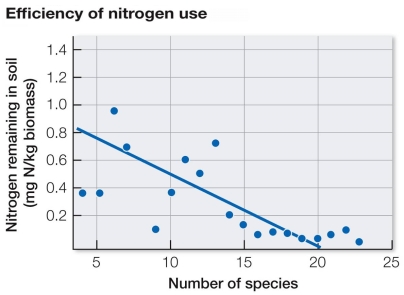 Based on the graph, one can conclude that as species richness increases,
 (Multiple Choice)
4.7/5 (84)
(84) Wolves in Yellowstone National Park feed on elk, bison, and coyotes.When wolves were absent from the park, elk populations increased and browsed young aspen trees so much that they could not become established.The elk also browsed willows, which beavers required, and beavers disappeared from the area.When wolves were reintroduced into the park after many years of absence, elk declined, and aspen, willows, and beavers returned.This suggests that wolves in Yellowstone were responsible for
(Multiple Choice)
4.9/5 (78)
(78) In what way is an invasive species most likely to harm the community it invades?
(Multiple Choice)
4.9/5 (72)
(72) 
Filters
- Essay(0)
- Multiple Choice(0)
- Short Answer(0)
- True False(0)
- Matching(0)