



 Chat with AI
Exam 56: Communities

Exam 1: Studying Life246 Questions
Exam 2: Small Molecules and the Chemistry of Life246 Questions
Exam 3: Proteins, Carbohydrates, and Lipids246 Questions
Exam 4: Nucleic Acids and the Origin of Life246 Questions
Exam 5: Cells: the Working Units of Life248 Questions
Exam 6: Cell Membranes246 Questions
Exam 7: Cell Communication and Multicellularity246 Questions
Exam 8: Energy, Enzymes, and Metabolism246 Questions
Exam 9: Pathways That Harvest Chemical Energy246 Questions
Exam 10: Photosynthesis: Energy From Sunlight242 Questions
Exam 11: The Cell Cycle and Cell Division260 Questions
Exam 12: Inheritance, Genes, and Chromosomes250 Questions
Exam 13: Dna and Its Role in Heredity257 Questions
Exam 14: From Dna to Protein: Gene Expression252 Questions
Exam 15: Gene Mutation and Molecular Medicine251 Questions
Exam 16: Regulation of Gene Expression245 Questions
Exam 17: Genomes249 Questions
Exam 18: Recombinant Dna and Biotechnology243 Questions
Exam 20: Mechanisms of Evolution243 Questions
Exam 21: Reconstructing and Using Phylogenies246 Questions
Exam 22: Speciation247 Questions
Exam 23: Evolution of Genes and Genomes252 Questions
Exam 24: The History of Life on Earth246 Questions
Exam 25: Bacteria, Archaea, and Viruses262 Questions
Exam 26: The Origin and Diversification of Eukaryotes252 Questions
Exam 27: Plants Without Seeds: From Water to Land251 Questions
Exam 28: The Evolution of Seed Plants259 Questions
Exam 29: The Evolution and Diversity of Fungi261 Questions
Exam 30: Animal Origins and the Evolution of Body Plans248 Questions
Exam 31: Protostome Animals244 Questions
Exam 32: Deuterostome Animals246 Questions
Exam 33: The Plant Body243 Questions
Exam 34: Transport in Plants248 Questions
Exam 35: Plant Nutrition247 Questions
Exam 36: Regulation of Plant Growth246 Questions
Exam 37: Reproduction in Flowering Plants247 Questions
Exam 38: Plant Responses to Environmental Challenges246 Questions
Exam 39: Physiology, Homeostasis, and Temperature Regulation258 Questions
Exam 40: Animal Hormones249 Questions
Exam 41: Immunology: Animal Defense Systems265 Questions
Exam 42: Animal Reproduction261 Questions
Exam 43: Animal Development261 Questions
Exam 44: Neurons, Glia, and Nervous Systems250 Questions
Exam 45: Sensory Systems249 Questions
Exam 46: The Mammalian Nervous System: Structure and Higher Functions254 Questions
Exam 47: Musculoskeletal Systems259 Questions
Exam 48: Gas Exchange247 Questions
Exam 49: Circulatory Systems252 Questions
Exam 50: Nutrition, Digestion, and Absorption259 Questions
Exam 51: Salt and Water Balance and Nitrogen Excretion251 Questions
Exam 52: Animal Behavior249 Questions
Exam 53: The Physical Environment and Biogeography of Life248 Questions
Exam 54: Populations259 Questions
Exam 55: Species Interactions254 Questions
Exam 56: Communities247 Questions
Exam 57: Ecosystems238 Questions
Exam 58: A Changing Biosphere222 Questions
Select questions type


A forest is clear-cut and then abandoned.Over the next 100 years, it changes.First, fast-growing weedy annuals move in.These are replaced by perennial grasses and forbs, and eventually by shrubs.At some point, tree seedlings take root, and over time, a forest similar to the original forest appears.This region is undergoing the process of _______.
(Short Answer)
4.7/5  (90)
(90) Refer to the table. 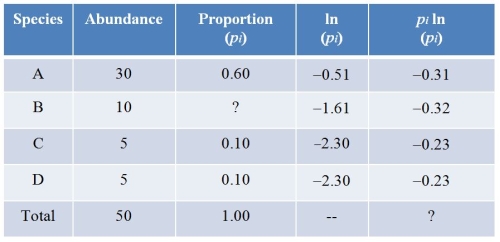 A community contains four species of birds in the following numbers of individuals: 30, 10, 5, 5.The table gives most of the information required to determine the Shannon index of diversity.Complete the table by choosing the correct values: The proportion for species B is _______; the total value for pi ln(pi)is _______.
 (Multiple Choice)
4.9/5 (73)
(73) The ability of species to disperse to a community is determined by which of the "filters" that help determine community membership?
(Multiple Choice)
4.9/5 (87)
(87) In 1963, an oceanic volcanic eruption off the southern coast of Iceland formed the island of Surtsey.If the Surtsey volcano erupted again and a new layer of lava completely covered the island, would the resulting succession be considered primary or secondary succession?
(Multiple Choice)
4.8/5 (75)
(75) A food web is generally used to describe connections or interactions in an ecological community that are related to which factor?
(Multiple Choice)
4.8/5 (73)
(73) After the 1980 eruption of Mount St.Helens, populations of small mammals and other organisms recovered much more quickly in the zones of secondary succession than in the Pumice Plain, where primary succession occurred.This more rapid recovery was aided by all of the following factors except
(Multiple Choice)
4.8/5 (85)
(85) The text shows a large, complex area of desert and a single pitcher plant with water that contains microorganisms as two examples of communities.What do both have that allows them to be defined as communities?
(Multiple Choice)
4.8/5 (86)
(86) Ecologists sometimes have difficulty defining and separating communities in nature because most communities have
(Multiple Choice)
4.9/5 (63)
(63) One reason agricultural communities are often unstable is the practice of planting only a single species, which is called _______.
(Short Answer)
4.7/5 (87)
(87) Bluegills in a pond prefer to feed on large zooplankton, such as copepods.The zooplankton in turn feed on algae.The pond has a few bass, which feed on the bluegills.A farmer introduces a large number of additional bass, which decimate the bluegill population.Quickly, algal blooms threaten to overwhelm the pond.The control of algae in this pond is an illustration of a(n)
(Multiple Choice)
4.8/5 (72)
(72) A new community is forming in a region devastated by a years-long drought.Rain has recently returned to the area; in some cases, the rain has been severe enough to cause flooding and rapid runoff.Seeds from a number of plant species enter from the surrounding region and begin to grow.However, periodic storms erode the soil, and many species have difficulty becoming established.This series of events suggests that which factor is most important in determining membership in the new community?
(Multiple Choice)
4.8/5 (84)
(84) In the Eel River of Northern California, the food web includes the following set of interactions:  Assuming this set of interactions is controlled by a trophic cascade, what changes would be expected if the predatory fish were removed?
 (Multiple Choice)
4.7/5 (78)
(78) Managers sow seeds for a new non-native grass species in a field and allow the grass to become established.Later, they introduce cattle to graze there.The new grass becomes the cattle's favorite food, and the new species is grazed to extinction.This might be considered an example of which process at work?
(Multiple Choice)
5.0/5 (84)
(84) Charles Crisafulli and his colleagues studied populations of small mammals on Mount St.Helens over 20 years following the volcanic eruption.They studied mammals in the Pumice Plain (primary succession) and in the Blowdown Zone and Tephra-fall Zone (secondary succession) and compared them with an unaffected reference area.What was the result of this study?
(Multiple Choice)
4.9/5 (77)
(77) A hurricane devastates a region of the Gulf Coast.Its winds destroy many trees and damage other natural environments.This situation would be described ecologically as a(n)
(Multiple Choice)
4.9/5 (79)
(79) A semiarid ecosystem is dominated by a mixture of shortgrass prairies and chaparral.Prairie primary producers include grasses and other herbaceous flowering plants (forbs).The chaparral is dominated by shrubs, including mesquite and yucca intermixed with grasses and forbs.Herbivores (jackrabbits and cottontails) in turn are eaten by "mesopredators," including badgers, bobcats, skunks, and gray foxes.The top-level predator is the coyote.How many trophic levels are described in this ecosystem?
(Multiple Choice)
4.8/5 (89)
(89) A small fish species is accidentally introduced into a large lake.It adapts easily to the lake environment and reproduces rapidly.However, a large native fish species finds it easy prey, and within a few generations, the introduced fish is essentially wiped out.The species was prevented from remaining in the community by the process of _______.
(Short Answer)
4.9/5 (80)
(80) The establishment of a non-native species in a new community would most likely be considered unsuccessful if
(Multiple Choice)
4.9/5 (78)
(78) The Shannon index of species diversity is calculated using this equation: 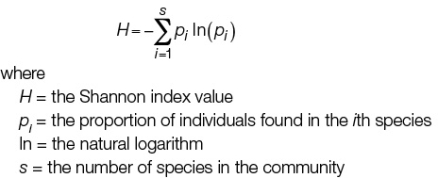 The data for a community of four species is given in the table.Use the table and the equation to determine the diversity value (H) for this community.
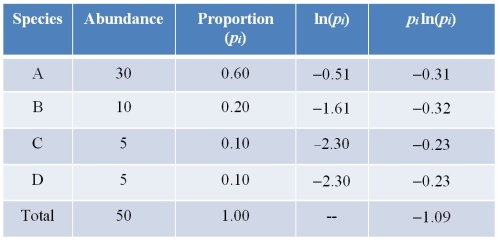
The data for a community of four species is given in the table.Use the table and the equation to determine the diversity value (H) for this community. (Multiple Choice)
4.7/5 (76)
(76) The rocky intertidal zone on the Washington coast supports a community including a bivalve mussel, Mytilus, which is preyed upon by the sea star Pisaster.If sea stars are removed, the mussel becomes dominant and other space-occupying species, including algae, decline.This suggests that the sea star Pisaster in this community serves as a
(Multiple Choice)
4.7/5 (78)
(78) 
Filters
- Essay(0)
- Multiple Choice(0)
- Short Answer(0)
- True False(0)
- Matching(0)