



 Chat with AI
Exam 20: Mechanisms of Evolution

Exam 1: Studying Life246 Questions
Exam 2: Small Molecules and the Chemistry of Life246 Questions
Exam 3: Proteins, Carbohydrates, and Lipids246 Questions
Exam 4: Nucleic Acids and the Origin of Life246 Questions
Exam 5: Cells: the Working Units of Life248 Questions
Exam 6: Cell Membranes246 Questions
Exam 7: Cell Communication and Multicellularity246 Questions
Exam 8: Energy, Enzymes, and Metabolism246 Questions
Exam 9: Pathways That Harvest Chemical Energy246 Questions
Exam 10: Photosynthesis: Energy From Sunlight242 Questions
Exam 11: The Cell Cycle and Cell Division260 Questions
Exam 12: Inheritance, Genes, and Chromosomes250 Questions
Exam 13: Dna and Its Role in Heredity257 Questions
Exam 14: From Dna to Protein: Gene Expression252 Questions
Exam 15: Gene Mutation and Molecular Medicine251 Questions
Exam 16: Regulation of Gene Expression245 Questions
Exam 17: Genomes249 Questions
Exam 18: Recombinant Dna and Biotechnology243 Questions
Exam 20: Mechanisms of Evolution243 Questions
Exam 21: Reconstructing and Using Phylogenies246 Questions
Exam 22: Speciation247 Questions
Exam 23: Evolution of Genes and Genomes252 Questions
Exam 24: The History of Life on Earth246 Questions
Exam 25: Bacteria, Archaea, and Viruses262 Questions
Exam 26: The Origin and Diversification of Eukaryotes252 Questions
Exam 27: Plants Without Seeds: From Water to Land251 Questions
Exam 28: The Evolution of Seed Plants259 Questions
Exam 29: The Evolution and Diversity of Fungi261 Questions
Exam 30: Animal Origins and the Evolution of Body Plans248 Questions
Exam 31: Protostome Animals244 Questions
Exam 32: Deuterostome Animals246 Questions
Exam 33: The Plant Body243 Questions
Exam 34: Transport in Plants248 Questions
Exam 35: Plant Nutrition247 Questions
Exam 36: Regulation of Plant Growth246 Questions
Exam 37: Reproduction in Flowering Plants247 Questions
Exam 38: Plant Responses to Environmental Challenges246 Questions
Exam 39: Physiology, Homeostasis, and Temperature Regulation258 Questions
Exam 40: Animal Hormones249 Questions
Exam 41: Immunology: Animal Defense Systems265 Questions
Exam 42: Animal Reproduction261 Questions
Exam 43: Animal Development261 Questions
Exam 44: Neurons, Glia, and Nervous Systems250 Questions
Exam 45: Sensory Systems249 Questions
Exam 46: The Mammalian Nervous System: Structure and Higher Functions254 Questions
Exam 47: Musculoskeletal Systems259 Questions
Exam 48: Gas Exchange247 Questions
Exam 49: Circulatory Systems252 Questions
Exam 50: Nutrition, Digestion, and Absorption259 Questions
Exam 51: Salt and Water Balance and Nitrogen Excretion251 Questions
Exam 52: Animal Behavior249 Questions
Exam 53: The Physical Environment and Biogeography of Life248 Questions
Exam 54: Populations259 Questions
Exam 55: Species Interactions254 Questions
Exam 56: Communities247 Questions
Exam 57: Ecosystems238 Questions
Exam 58: A Changing Biosphere222 Questions
Select questions type


If variation at a given locus has no effect on the phenotypes of individuals, which evolutionary process will still occur at that locus?
(Multiple Choice)
4.7/5  (71)
(71) Suppose that in a group of flies the mutation rate per nucleotide is about 10 per billion, there are 300 million nucleotides in the haploid genome, and the population size is 40 million.In this case, in every generation about _______ new mutations will appear in the population.
(Short Answer)
4.8/5 (69)
(69) Genetically identical roundworms are raised in two different environments.In the warmer environment, the worms are shorter than they are in the cooler one.What can we infer from this observation?
(Multiple Choice)
4.8/5 (83)
(83) Suppose a population of garter snakes that was initially naive to newts with TTX was placed with such newts.Assuming that the population persisted, over the course of many generations, we would expect the snakes to _______ in TTX resistance and _______ in speed.
(Multiple Choice)
4.9/5 (66)
(66) Snapping shrimp have evolved very rapid movements in the structures they use to capture prey.These rapid movements, which evolved through natural selection, can be considered a(n) _______, and the process by which they evolved is called _______.
(Multiple Choice)
4.7/5 (88)
(88) Which statement about garter snakes that are resistant to tetrodotoxin (TTX) is true?
(Multiple Choice)
4.8/5 (87)
(87) In a population of 200 individuals at Hardy-Weinberg equilibrium, 72 were homozygous recessive for the character of eye color (cc).One hundred individuals from this population died from a fatal disease.If 36 of the survivors are homozygous recessive, how many heterozygous individuals are in the new population?
(Multiple Choice)
4.8/5 (79)
(79) In a population of 600 moose, 30 percent of the individuals are homozygous for an allele and 45 percent are heterozygotes.How many copies of the allele are present in the population?
(Multiple Choice)
4.9/5 (81)
(81) Several populations of copepods are sampled for variation at the G locus.Population A is found to be 30 percent GG, 60 percent Gg, and 10 percent gg.Population B is 62 percent GG, 36 percent Gg, and 2 percent gg.Population C is 30 percent GG, 40 percent Gg, and 30 percent gg.Which of these populations shows a heterozygote deficiency?
(Multiple Choice)
4.8/5 (66)
(66) Three different alleles (c1, c2, and c3) at the c locus exist in a hypothetical population of juniper trees.If the frequency of c1 is 0.3, what can be said about the frequency of c2?
(Multiple Choice)
4.8/5 (63)
(63) Refer to the graph showing beak size for a population of a species of Darwin's finches. 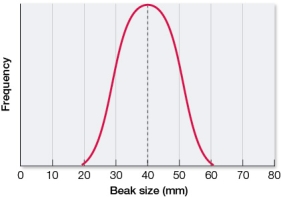 Draw a graph showing what the resulting population would most likely look like after a generation of strong disruptive selection.
 (Essay)
4.9/5 (83)
(83) An allele in a population of mockingbirds has a frequency of 0.3.In a population of 600, how many copies of the allele are present?
(Multiple Choice)
4.9/5 (83)
(83) A population of geese has an allele frequency of 80 percent for one allele of a locus with two alleles.Out of 750 individuals, _______ should be homozygotes for the less common allele if the population is at Hardy-Weinberg equilibrium.
(Short Answer)
4.8/5 (71)
(71) Which statement about genetic drift as an evolutionary factor is true?
(Multiple Choice)
4.8/5 (88)
(88) A population of swallowtail butterflies has an allele frequency of 60 percent for one allele of a locus with two alleles.Out of 1,500 individuals, ______ should be homozygotes for the more common allele if the population is at Hardy-Weinberg equilibrium.
(Short Answer)
4.8/5 (97)
(97) In many bird species, the number of eggs laid is negatively correlated with the survival of the young.At the extreme of very large clutch sizes, hardly any of the young survive.Clutch size variation is largely due to genetic factors.In light of this, which statement is most likely to be true?
(Multiple Choice)
4.9/5 (67)
(67) Individual females within a population of horses are tracked over time to examine their reproductive output.The researchers find that females with the smallest and largest body sizes have fewer offspring than females of average body size.Most likely, _______ selection for size is operating.
(Multiple Choice)
4.9/5 (70)
(70) Selection currently maintains an intermediate body size in a population of salmon.Bears selectively prey on the largest individuals, and smaller individuals produce fewer offspring.Suppose that bears are removed from the area.Most likely, the salmon size will increase because of ______ selection.
(Short Answer)
4.8/5 (84)
(84) The most likely reason that subpopulations often vary genetically from one another is that they
(Multiple Choice)
4.9/5 (76)
(76) The table lists the frequencies of an allele (A) at a locus and the average fitness of carriers of that allele at each frequency in four haploid populations. 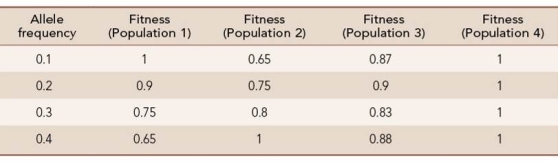 The fitness of the other allele (a) is always 0.9, regardless of the frequency of the alleles.In which population can both alleles be maintained?
 (Multiple Choice)
4.8/5 (84)
(84) 
Filters
- Essay(0)
- Multiple Choice(0)
- Short Answer(0)
- True False(0)
- Matching(0)