



 Chat with AI
Exam 20: Mechanisms of Evolution

Exam 1: Studying Life246 Questions
Exam 2: Small Molecules and the Chemistry of Life246 Questions
Exam 3: Proteins, Carbohydrates, and Lipids246 Questions
Exam 4: Nucleic Acids and the Origin of Life246 Questions
Exam 5: Cells: the Working Units of Life248 Questions
Exam 6: Cell Membranes246 Questions
Exam 7: Cell Communication and Multicellularity246 Questions
Exam 8: Energy, Enzymes, and Metabolism246 Questions
Exam 9: Pathways That Harvest Chemical Energy246 Questions
Exam 10: Photosynthesis: Energy From Sunlight242 Questions
Exam 11: The Cell Cycle and Cell Division260 Questions
Exam 12: Inheritance, Genes, and Chromosomes250 Questions
Exam 13: Dna and Its Role in Heredity257 Questions
Exam 14: From Dna to Protein: Gene Expression252 Questions
Exam 15: Gene Mutation and Molecular Medicine251 Questions
Exam 16: Regulation of Gene Expression245 Questions
Exam 17: Genomes249 Questions
Exam 18: Recombinant Dna and Biotechnology243 Questions
Exam 20: Mechanisms of Evolution243 Questions
Exam 21: Reconstructing and Using Phylogenies246 Questions
Exam 22: Speciation247 Questions
Exam 23: Evolution of Genes and Genomes252 Questions
Exam 24: The History of Life on Earth246 Questions
Exam 25: Bacteria, Archaea, and Viruses262 Questions
Exam 26: The Origin and Diversification of Eukaryotes252 Questions
Exam 27: Plants Without Seeds: From Water to Land251 Questions
Exam 28: The Evolution of Seed Plants259 Questions
Exam 29: The Evolution and Diversity of Fungi261 Questions
Exam 30: Animal Origins and the Evolution of Body Plans248 Questions
Exam 31: Protostome Animals244 Questions
Exam 32: Deuterostome Animals246 Questions
Exam 33: The Plant Body243 Questions
Exam 34: Transport in Plants248 Questions
Exam 35: Plant Nutrition247 Questions
Exam 36: Regulation of Plant Growth246 Questions
Exam 37: Reproduction in Flowering Plants247 Questions
Exam 38: Plant Responses to Environmental Challenges246 Questions
Exam 39: Physiology, Homeostasis, and Temperature Regulation258 Questions
Exam 40: Animal Hormones249 Questions
Exam 41: Immunology: Animal Defense Systems265 Questions
Exam 42: Animal Reproduction261 Questions
Exam 43: Animal Development261 Questions
Exam 44: Neurons, Glia, and Nervous Systems250 Questions
Exam 45: Sensory Systems249 Questions
Exam 46: The Mammalian Nervous System: Structure and Higher Functions254 Questions
Exam 47: Musculoskeletal Systems259 Questions
Exam 48: Gas Exchange247 Questions
Exam 49: Circulatory Systems252 Questions
Exam 50: Nutrition, Digestion, and Absorption259 Questions
Exam 51: Salt and Water Balance and Nitrogen Excretion251 Questions
Exam 52: Animal Behavior249 Questions
Exam 53: The Physical Environment and Biogeography of Life248 Questions
Exam 54: Populations259 Questions
Exam 55: Species Interactions254 Questions
Exam 56: Communities247 Questions
Exam 57: Ecosystems238 Questions
Exam 58: A Changing Biosphere222 Questions
Select questions type


A benefit of sexual reproduction over asexual reproduction is that sexual reproduction
(Multiple Choice)
4.9/5  (92)
(92) The horn sizes in males of a particular beetle have an interesting distribution: the highest frequencies are around 15 millimeters and 30 millimeters, with few individuals in between.Based on this observation, which mode of selection is most likely to be operating on these horns?
(Multiple Choice)
4.9/5 (81)
(81) Which explanation has not been proposed for the existence of sexual reproduction?
(Multiple Choice)
4.9/5 (80)
(80) Whether a fly has white or red eyes is due to alleles at a single locus.It is thus a _______ or _______ trait.
(Multiple Choice)
4.9/5 (84)
(84) Which statement about the neurotoxin tetrodotoxin (TTX) is false?
(Multiple Choice)
4.8/5 (78)
(78) Females preferring male bowerbirds with large bowers is an example of _______ selection.
(Multiple Choice)
4.8/5 (88)
(88) The FY3 gene plays a role in immune responses in flies.In one population, there are two alleles, and the frequency of one allele is 0.8.If the population is at Hardy-Weinberg equilibrium, how many homozygotes for the more common allele should we observe in a sample of 250 individuals?
(Multiple Choice)
4.8/5 (71)
(71) A windstorm transports a gravid fly to an island.Having only a small subset of the genetic variation in the mainland population, the offspring of this fly are somewhat different from the mainland population.This is an example of
(Multiple Choice)
4.7/5 (71)
(71) The artificial selection experiments with bristle numbers in Drosophila illustrated which generality?
(Multiple Choice)
4.8/5 (77)
(77) The average size of downy woodpeckers in North America gradually increases as one moves north.What term best describes this phenomenon?
(Multiple Choice)
4.8/5 (75)
(75) The numbers of fledged young of female swamp sparrows of different sizes were assayed and are presented in the table. 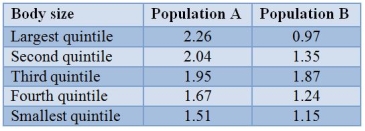 Assume that body size is at least partially heritable.What is the most likely response to selection in population A?
 (Multiple Choice)
4.8/5 (88)
(88) Suppose variants at a single locus affect wing length in a species of crickets, with homozygotes for the L allele having long wings, homozygotes for the l allele having short wings, and heterozygotes having wings of intermediate length.In one population of 600 individuals, 400 have long wings, 160 have intermediate-lengths wings, and 40 have short wings.What is the expected number of individuals with long wings under Hardy-Weinberg equilibrium?
(Multiple Choice)
5.0/5 (73)
(73) The genome of a virus with 9,000 nucleotides has had 18 new mutations.The mutation rate is thus _______ percent.
(Short Answer)
4.8/5 (87)
(87) Draw the relationship between frequency of an allele (from 0.1 to 0.5) and its fitness in cases where frequency-dependent selection maintains genetic variation.
(Essay)
4.9/5 (84)
(84) The haploid human genome contains about 3 billion bp.Given a mutation rate of 5 × 10⁻⁹, how many new mutations would we expect on average in each diploid individual?
(Multiple Choice)
4.8/5 (87)
(87) The table shows the average performance of different genotypes at the A locus for three different populations of lizards in two different environments.The number before the slash is for running speed (in meters per second), and the number after the slash is for relative strength. 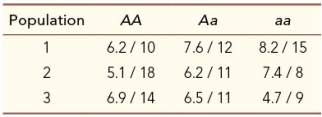 In which population is there evidence of a trade-off between running speed and relative strength?
 (Multiple Choice)
4.8/5 (74)
(74) Refer to the graph showing beak size for a population of a species of Darwin's finches. 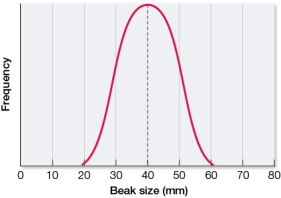 Draw a graph showing what the resulting population would most likely look like after a generation of directional selection for smaller beak size.
 (Essay)
4.9/5 (68)
(68) Male mallards fighting with one another for access to females is an example of _______ selection.
(Multiple Choice)
4.9/5 (91)
(91) 
Filters
- Essay(0)
- Multiple Choice(0)
- Short Answer(0)
- True False(0)
- Matching(0)