



 Chat with AI
Exam 20: Mechanisms of Evolution

Exam 1: Studying Life246 Questions
Exam 2: Small Molecules and the Chemistry of Life246 Questions
Exam 3: Proteins, Carbohydrates, and Lipids246 Questions
Exam 4: Nucleic Acids and the Origin of Life246 Questions
Exam 5: Cells: the Working Units of Life248 Questions
Exam 6: Cell Membranes246 Questions
Exam 7: Cell Communication and Multicellularity246 Questions
Exam 8: Energy, Enzymes, and Metabolism246 Questions
Exam 9: Pathways That Harvest Chemical Energy246 Questions
Exam 10: Photosynthesis: Energy From Sunlight242 Questions
Exam 11: The Cell Cycle and Cell Division260 Questions
Exam 12: Inheritance, Genes, and Chromosomes250 Questions
Exam 13: Dna and Its Role in Heredity257 Questions
Exam 14: From Dna to Protein: Gene Expression252 Questions
Exam 15: Gene Mutation and Molecular Medicine251 Questions
Exam 16: Regulation of Gene Expression245 Questions
Exam 17: Genomes249 Questions
Exam 18: Recombinant Dna and Biotechnology243 Questions
Exam 20: Mechanisms of Evolution243 Questions
Exam 21: Reconstructing and Using Phylogenies246 Questions
Exam 22: Speciation247 Questions
Exam 23: Evolution of Genes and Genomes252 Questions
Exam 24: The History of Life on Earth246 Questions
Exam 25: Bacteria, Archaea, and Viruses262 Questions
Exam 26: The Origin and Diversification of Eukaryotes252 Questions
Exam 27: Plants Without Seeds: From Water to Land251 Questions
Exam 28: The Evolution of Seed Plants259 Questions
Exam 29: The Evolution and Diversity of Fungi261 Questions
Exam 30: Animal Origins and the Evolution of Body Plans248 Questions
Exam 31: Protostome Animals244 Questions
Exam 32: Deuterostome Animals246 Questions
Exam 33: The Plant Body243 Questions
Exam 34: Transport in Plants248 Questions
Exam 35: Plant Nutrition247 Questions
Exam 36: Regulation of Plant Growth246 Questions
Exam 37: Reproduction in Flowering Plants247 Questions
Exam 38: Plant Responses to Environmental Challenges246 Questions
Exam 39: Physiology, Homeostasis, and Temperature Regulation258 Questions
Exam 40: Animal Hormones249 Questions
Exam 41: Immunology: Animal Defense Systems265 Questions
Exam 42: Animal Reproduction261 Questions
Exam 43: Animal Development261 Questions
Exam 44: Neurons, Glia, and Nervous Systems250 Questions
Exam 45: Sensory Systems249 Questions
Exam 46: The Mammalian Nervous System: Structure and Higher Functions254 Questions
Exam 47: Musculoskeletal Systems259 Questions
Exam 48: Gas Exchange247 Questions
Exam 49: Circulatory Systems252 Questions
Exam 50: Nutrition, Digestion, and Absorption259 Questions
Exam 51: Salt and Water Balance and Nitrogen Excretion251 Questions
Exam 52: Animal Behavior249 Questions
Exam 53: The Physical Environment and Biogeography of Life248 Questions
Exam 54: Populations259 Questions
Exam 55: Species Interactions254 Questions
Exam 56: Communities247 Questions
Exam 57: Ecosystems238 Questions
Exam 58: A Changing Biosphere222 Questions
Select questions type


Suppose a population of flour beetles has 1,000 individuals.Normally the beetles are red; however, this population is polymorphic for a mutant autosomal body color, black, designated by bb.Red is dominant to black, so BB and Bb genotypes result in red beetles.Assume the population is at Hardy-Weinberg equilibrium, with equal frequencies of the two alleles.What would be the expected frequencies of the red and black phenotypes?
(Multiple Choice)
4.7/5  (75)
(75) Suppose the mutation rate per nucleotide in a type of fly is about 10 in a billion, that there are 300 million nucleotides in the haploid genome, and that the population size is 40 million.In this case, in every generation about _______ new mutations will appear in each individual on average.
(Short Answer)
4.9/5 (85)
(85) If there are only two alleles at a given locus and the frequency of one allele is 0.6, what is the frequency of the other allele?
(Multiple Choice)
4.9/5 (76)
(76) What is the primary distinction between artificial selection and natural selection?
(Multiple Choice)
4.9/5 (68)
(68) Under Hardy-Weinberg equilibrium, if the frequency of one allele is 0.8, then _______ percent of the population should be heterozygotes.
(Short Answer)
4.9/5 (88)
(88) If a population with two alleles is at Hardy-Weinberg equilibrium and the frequency of one allele is 0.7, what is the heterozygote frequency?
(Multiple Choice)
4.8/5 (63)
(63) In a population of mice, the average survival rates of individuals of varying sizes were assayed and are shown in the table. 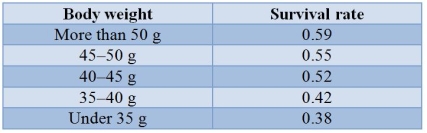 Assume that body size is at least partially heritable.Assuming that all other aspects are independent of size, this population is most likely experiencing ______ selection, and the variation in the population should _______over many generations.
 (Multiple Choice)
4.9/5 (75)
(75) Suppose there are two alleles at a locus and that the locus is at Hardy-Weinberg equilibrium.If the frequency of one allele is r, what is the frequency of the heterozygotes?
(Multiple Choice)
4.9/5 (81)
(81) An allele in a population of oysters has a frequency of 0.21.Out of 600 oysters, _______ copies of the allele are present.
(Short Answer)
4.9/5 (76)
(76) Shown is a table of the results of a study of grasshoppers showing frequencies of different size classes, along with the average number of offspring these individuals produce. 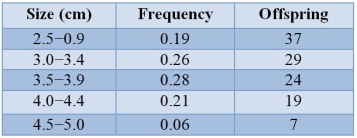 Assuming that size is a heritable trait (and that the number of offspring is a good proxy for the fitness of the phenotype), which type of selection is operating in this population?
 (Multiple Choice)
4.8/5 (71)
(71) Two populations of raccoons are similar in most respects, but the population on the east side of a river is much smaller than that on the west side.There is little gene flow between the populations.Which statement about these populations is most accurate?
(Multiple Choice)
4.8/5 (90)
(90) Which two evolutionary processes would most likely act in opposite ways regarding their effects on the extent of genetic variation in a population?
(Multiple Choice)
4.7/5 (74)
(74) Suppose that in a population of 1,400 individuals, 125 individuals are homozygous for allele A7 and 450 are heterozygous for the same allele.The frequency of the A7 allele is therefore _______.
(Short Answer)
4.8/5 (85)
(85) Which is usually the easiest to examine without specialized equipment?
(Multiple Choice)
4.8/5 (80)
(80) What is the main difference between Darwin and Wallace with respect to their contributions to evolutionary biology?
(Multiple Choice)
4.7/5 (66)
(66) 
Filters
- Essay(0)
- Multiple Choice(0)
- Short Answer(0)
- True False(0)
- Matching(0)