



 Chat with AI
Exam 44: Neurons, Glia, and Nervous Systems

Exam 1: Studying Life246 Questions
Exam 2: Small Molecules and the Chemistry of Life246 Questions
Exam 3: Proteins, Carbohydrates, and Lipids246 Questions
Exam 4: Nucleic Acids and the Origin of Life246 Questions
Exam 5: Cells: the Working Units of Life248 Questions
Exam 6: Cell Membranes246 Questions
Exam 7: Cell Communication and Multicellularity246 Questions
Exam 8: Energy, Enzymes, and Metabolism246 Questions
Exam 9: Pathways That Harvest Chemical Energy246 Questions
Exam 10: Photosynthesis: Energy From Sunlight242 Questions
Exam 11: The Cell Cycle and Cell Division260 Questions
Exam 12: Inheritance, Genes, and Chromosomes250 Questions
Exam 13: Dna and Its Role in Heredity257 Questions
Exam 14: From Dna to Protein: Gene Expression252 Questions
Exam 15: Gene Mutation and Molecular Medicine251 Questions
Exam 16: Regulation of Gene Expression245 Questions
Exam 17: Genomes249 Questions
Exam 18: Recombinant Dna and Biotechnology243 Questions
Exam 20: Mechanisms of Evolution243 Questions
Exam 21: Reconstructing and Using Phylogenies246 Questions
Exam 22: Speciation247 Questions
Exam 23: Evolution of Genes and Genomes252 Questions
Exam 24: The History of Life on Earth246 Questions
Exam 25: Bacteria, Archaea, and Viruses262 Questions
Exam 26: The Origin and Diversification of Eukaryotes252 Questions
Exam 27: Plants Without Seeds: From Water to Land251 Questions
Exam 28: The Evolution of Seed Plants259 Questions
Exam 29: The Evolution and Diversity of Fungi261 Questions
Exam 30: Animal Origins and the Evolution of Body Plans248 Questions
Exam 31: Protostome Animals244 Questions
Exam 32: Deuterostome Animals246 Questions
Exam 33: The Plant Body243 Questions
Exam 34: Transport in Plants248 Questions
Exam 35: Plant Nutrition247 Questions
Exam 36: Regulation of Plant Growth246 Questions
Exam 37: Reproduction in Flowering Plants247 Questions
Exam 38: Plant Responses to Environmental Challenges246 Questions
Exam 39: Physiology, Homeostasis, and Temperature Regulation258 Questions
Exam 40: Animal Hormones249 Questions
Exam 41: Immunology: Animal Defense Systems265 Questions
Exam 42: Animal Reproduction261 Questions
Exam 43: Animal Development261 Questions
Exam 44: Neurons, Glia, and Nervous Systems250 Questions
Exam 45: Sensory Systems249 Questions
Exam 46: The Mammalian Nervous System: Structure and Higher Functions254 Questions
Exam 47: Musculoskeletal Systems259 Questions
Exam 48: Gas Exchange247 Questions
Exam 49: Circulatory Systems252 Questions
Exam 50: Nutrition, Digestion, and Absorption259 Questions
Exam 51: Salt and Water Balance and Nitrogen Excretion251 Questions
Exam 52: Animal Behavior249 Questions
Exam 53: The Physical Environment and Biogeography of Life248 Questions
Exam 54: Populations259 Questions
Exam 55: Species Interactions254 Questions
Exam 56: Communities247 Questions
Exam 57: Ecosystems238 Questions
Exam 58: A Changing Biosphere222 Questions
Select questions type


If the clearance of neurotransmitter from the synaptic cleft is prevented, which of the following will be the most likely result?
(Multiple Choice)
4.9/5  (72)
(72) Refer to the figure showing a neuromuscular junction. 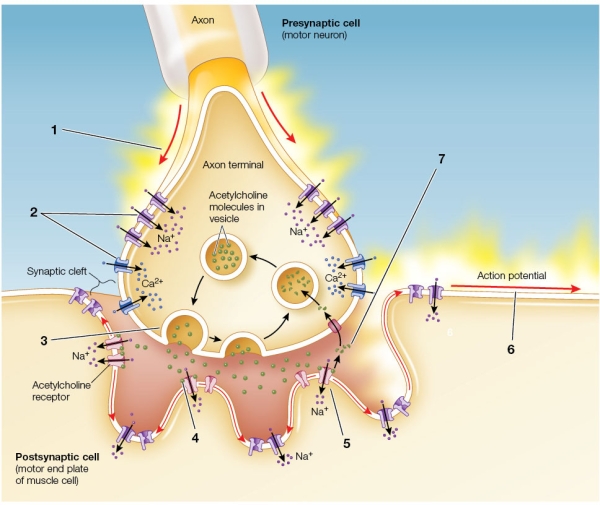 Which cellular event is paired correctly with the location where it occurs?
 (Multiple Choice)
4.7/5 (72)
(72) If the proteins that anchor acetylcholine-containing vesicles to the presynaptic membrane are damaged by botulism toxins, what effect will this have on the neuromuscular junction?
(Multiple Choice)
4.8/5 (73)
(73) Oligodendrocytes have a function in the central nervous system similar to that of Schwann cells in the peripheral nervous system.The main function of oligodendrocytes and Schwann cells is to
(Multiple Choice)
4.7/5 (91)
(91) Which experimental stimulus would most likely produce the greatest response in a postsynaptic neuronal membrane?
(Multiple Choice)
4.8/5 (76)
(76) When an action potential arrives at the axon terminal, the voltage-gated calcium channels at the terminal
(Multiple Choice)
4.8/5 (77)
(77) Disabling the sodium-potassium pump would cause ion concentration differences across the cell membrane to _______.
(Short Answer)
4.8/5 (82)
(82) Jawless vertebrates-hagfishes and lampreys-lack myelin.From this you might deduce that
(Multiple Choice)
4.9/5 (88)
(88) In humans, the region of the brain that is the largest and that is more complex than that of most other vertebrate species is the
(Multiple Choice)
4.9/5 (84)
(84) If a physical or chemical stimulus causes a change in a cell's membrane potential, a direct effect of that change may be
(Multiple Choice)
4.9/5 (71)
(71) Some neurotoxins selectively destroy the axon terminals of neurons.What would be the result of such destruction?
(Short Answer)
4.9/5 (81)
(81) The Nernst and Goldman equations shown are used to predict membrane potentials.  Which equation is more likely to be accurate in predicting the resting membrane potential, and why?
 (Multiple Choice)
4.9/5 (67)
(67) Neurons may vary widely in appearance but are all similar in that they
(Multiple Choice)
4.9/5 (79)
(79) When you read this question and eventually mark an answer, your neurons busily send information to and from your brain and compare it against what you learned in class.Integration of these processes is supplied by
(Multiple Choice)
4.8/5 (70)
(70) When gated channels open or close the membrane potential of the cell changes.When the inside of a neuron becomes less negative because of the influx of Na+ ions, the membrane
(Multiple Choice)
4.8/5 (77)
(77) When you decide to mark a particular answer to this question, your nervous system sends the command to your hand to do so.That command is carried to your hand by
(Multiple Choice)
4.9/5 (79)
(79) In the neuromuscular junction, the response of the motor end plate to the release of acetylcholine is to open cation channels.Cations then enter the muscle cell, resulting in
(Multiple Choice)
4.9/5 (80)
(80) Astrocytes participate in thousands of synapses with neurons.Their presence can influence activity in a postsynaptic neuron by
(Multiple Choice)
4.9/5 (72)
(72) 
Filters
- Essay(0)
- Multiple Choice(0)
- Short Answer(0)
- True False(0)
- Matching(0)