



 Chat with AI
Exam 44: Neurons, Glia, and Nervous Systems

Exam 1: Studying Life246 Questions
Exam 2: Small Molecules and the Chemistry of Life246 Questions
Exam 3: Proteins, Carbohydrates, and Lipids246 Questions
Exam 4: Nucleic Acids and the Origin of Life246 Questions
Exam 5: Cells: the Working Units of Life248 Questions
Exam 6: Cell Membranes246 Questions
Exam 7: Cell Communication and Multicellularity246 Questions
Exam 8: Energy, Enzymes, and Metabolism246 Questions
Exam 9: Pathways That Harvest Chemical Energy246 Questions
Exam 10: Photosynthesis: Energy From Sunlight242 Questions
Exam 11: The Cell Cycle and Cell Division260 Questions
Exam 12: Inheritance, Genes, and Chromosomes250 Questions
Exam 13: Dna and Its Role in Heredity257 Questions
Exam 14: From Dna to Protein: Gene Expression252 Questions
Exam 15: Gene Mutation and Molecular Medicine251 Questions
Exam 16: Regulation of Gene Expression245 Questions
Exam 17: Genomes249 Questions
Exam 18: Recombinant Dna and Biotechnology243 Questions
Exam 20: Mechanisms of Evolution243 Questions
Exam 21: Reconstructing and Using Phylogenies246 Questions
Exam 22: Speciation247 Questions
Exam 23: Evolution of Genes and Genomes252 Questions
Exam 24: The History of Life on Earth246 Questions
Exam 25: Bacteria, Archaea, and Viruses262 Questions
Exam 26: The Origin and Diversification of Eukaryotes252 Questions
Exam 27: Plants Without Seeds: From Water to Land251 Questions
Exam 28: The Evolution of Seed Plants259 Questions
Exam 29: The Evolution and Diversity of Fungi261 Questions
Exam 30: Animal Origins and the Evolution of Body Plans248 Questions
Exam 31: Protostome Animals244 Questions
Exam 32: Deuterostome Animals246 Questions
Exam 33: The Plant Body243 Questions
Exam 34: Transport in Plants248 Questions
Exam 35: Plant Nutrition247 Questions
Exam 36: Regulation of Plant Growth246 Questions
Exam 37: Reproduction in Flowering Plants247 Questions
Exam 38: Plant Responses to Environmental Challenges246 Questions
Exam 39: Physiology, Homeostasis, and Temperature Regulation258 Questions
Exam 40: Animal Hormones249 Questions
Exam 41: Immunology: Animal Defense Systems265 Questions
Exam 42: Animal Reproduction261 Questions
Exam 43: Animal Development261 Questions
Exam 44: Neurons, Glia, and Nervous Systems250 Questions
Exam 45: Sensory Systems249 Questions
Exam 46: The Mammalian Nervous System: Structure and Higher Functions254 Questions
Exam 47: Musculoskeletal Systems259 Questions
Exam 48: Gas Exchange247 Questions
Exam 49: Circulatory Systems252 Questions
Exam 50: Nutrition, Digestion, and Absorption259 Questions
Exam 51: Salt and Water Balance and Nitrogen Excretion251 Questions
Exam 52: Animal Behavior249 Questions
Exam 53: The Physical Environment and Biogeography of Life248 Questions
Exam 54: Populations259 Questions
Exam 55: Species Interactions254 Questions
Exam 56: Communities247 Questions
Exam 57: Ecosystems238 Questions
Exam 58: A Changing Biosphere222 Questions
Select questions type


Choose the correct order in which information moves through the vertebrate nervous system.
(Multiple Choice)
4.9/5  (64)
(64) The specialized chemical synapses between neurons and skeletal muscle cells are called _______.
(Short Answer)
4.9/5 (70)
(70) During an action potential, activation gates in voltage-gated Na+ channels close rapidly, but there is a delay in the reopening of their inactivation gates.This contributes to the
(Multiple Choice)
4.9/5 (63)
(63) In many neurons, a single axon conducts action potentials generated by the _______ to the _______.
(Multiple Choice)
4.8/5 (79)
(79) The resting potential occurs when only leak potassium ion channels are open, whereas the membrane becomes hyperpolarized when chemically-gated _______ ion channels open.
(Short Answer)
4.9/5 (63)
(63) When an action potential arrives at an axon terminal, it causes the opening of _______ channels, increasing the concentration of this ion within the cell, which ultimately triggers fusion of neurotransmitter vesicles with the cell membrane.
(Multiple Choice)
4.9/5 (85)
(85) In the vertebrate neuromuscular junction, acetylcholine is transmitted from the presynaptic neuron to the postsynaptic motor end plate through
(Multiple Choice)
4.8/5 (72)
(72) Evolutionarily, as animals increased in behavioral complexity, the pairs of ganglia in the anterior ends of their bodies fused to form
(Multiple Choice)
5.0/5 (82)
(82) The form of rapid impulse propagation found in axons that are wrapped with myelin and contain nodes of Ranvier is called _______.
(Short Answer)
5.0/5 (72)
(72) In the neuromuscular junction, once the acetylcholine receptor has bound acetylcholine on the postsynaptic muscle fiber, the permeability of the postsynaptic membrane to _______ increases.
(Multiple Choice)
4.9/5 (88)
(88) If a chemical prevents asymmetrical divisions of neuronal stem cells in the neural tube of a fish embryo, then
(Multiple Choice)
4.8/5 (67)
(67) During the withdrawal reflex, sensory neurons transmit action potentials into the dorsal horn of the spinal cord, where they synapse with _______ that send pain information to the brain.
(Short Answer)
4.9/5 (84)
(84) The cells in the nervous system that provide support for neurons and modulate their activity are called _______.
(Short Answer)
4.9/5 (74)
(74) If the motor neuron leaving the _______ root of the spinal cord is damaged, then the extensor muscle of the leg will not contract as it normally would during the knee-jerk reflex.
(Short Answer)
4.9/5 (79)
(79) Disruption of the blood-brain barrier could signal problems with glial cells called _______.
(Short Answer)
4.9/5 (88)
(88) The resting membrane potential provides a means for a neuron to respond to a stimulus.To maintain the resting potential, neurons rely on ion transporters such as
(Multiple Choice)
4.7/5 (80)
(80) Refer to the figure showing the knee-jerk reflex. 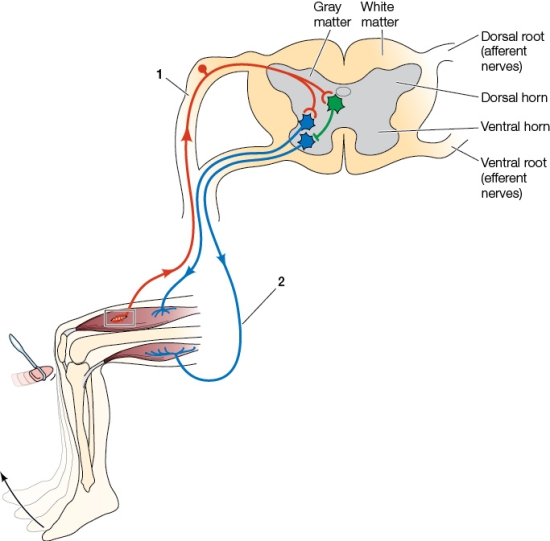 What would be the immediate result of severing the neuron shown at point 2?
 (Short Answer)
4.9/5 (90)
(90) Brain areas vary in size, matched for body mass, among different vertebrates.Choose the pair in which the first area varies the least dramatically and the second area varies the most dramatically.
(Multiple Choice)
4.9/5 (71)
(71) 
Filters
- Essay(0)
- Multiple Choice(0)
- Short Answer(0)
- True False(0)
- Matching(0)