



 Chat with AI
Exam 44: Neurons, Glia, and Nervous Systems

Exam 1: Studying Life246 Questions
Exam 2: Small Molecules and the Chemistry of Life246 Questions
Exam 3: Proteins, Carbohydrates, and Lipids246 Questions
Exam 4: Nucleic Acids and the Origin of Life246 Questions
Exam 5: Cells: the Working Units of Life248 Questions
Exam 6: Cell Membranes246 Questions
Exam 7: Cell Communication and Multicellularity246 Questions
Exam 8: Energy, Enzymes, and Metabolism246 Questions
Exam 9: Pathways That Harvest Chemical Energy246 Questions
Exam 10: Photosynthesis: Energy From Sunlight242 Questions
Exam 11: The Cell Cycle and Cell Division260 Questions
Exam 12: Inheritance, Genes, and Chromosomes250 Questions
Exam 13: Dna and Its Role in Heredity257 Questions
Exam 14: From Dna to Protein: Gene Expression252 Questions
Exam 15: Gene Mutation and Molecular Medicine251 Questions
Exam 16: Regulation of Gene Expression245 Questions
Exam 17: Genomes249 Questions
Exam 18: Recombinant Dna and Biotechnology243 Questions
Exam 20: Mechanisms of Evolution243 Questions
Exam 21: Reconstructing and Using Phylogenies246 Questions
Exam 22: Speciation247 Questions
Exam 23: Evolution of Genes and Genomes252 Questions
Exam 24: The History of Life on Earth246 Questions
Exam 25: Bacteria, Archaea, and Viruses262 Questions
Exam 26: The Origin and Diversification of Eukaryotes252 Questions
Exam 27: Plants Without Seeds: From Water to Land251 Questions
Exam 28: The Evolution of Seed Plants259 Questions
Exam 29: The Evolution and Diversity of Fungi261 Questions
Exam 30: Animal Origins and the Evolution of Body Plans248 Questions
Exam 31: Protostome Animals244 Questions
Exam 32: Deuterostome Animals246 Questions
Exam 33: The Plant Body243 Questions
Exam 34: Transport in Plants248 Questions
Exam 35: Plant Nutrition247 Questions
Exam 36: Regulation of Plant Growth246 Questions
Exam 37: Reproduction in Flowering Plants247 Questions
Exam 38: Plant Responses to Environmental Challenges246 Questions
Exam 39: Physiology, Homeostasis, and Temperature Regulation258 Questions
Exam 40: Animal Hormones249 Questions
Exam 41: Immunology: Animal Defense Systems265 Questions
Exam 42: Animal Reproduction261 Questions
Exam 43: Animal Development261 Questions
Exam 44: Neurons, Glia, and Nervous Systems250 Questions
Exam 45: Sensory Systems249 Questions
Exam 46: The Mammalian Nervous System: Structure and Higher Functions254 Questions
Exam 47: Musculoskeletal Systems259 Questions
Exam 48: Gas Exchange247 Questions
Exam 49: Circulatory Systems252 Questions
Exam 50: Nutrition, Digestion, and Absorption259 Questions
Exam 51: Salt and Water Balance and Nitrogen Excretion251 Questions
Exam 52: Animal Behavior249 Questions
Exam 53: The Physical Environment and Biogeography of Life248 Questions
Exam 54: Populations259 Questions
Exam 55: Species Interactions254 Questions
Exam 56: Communities247 Questions
Exam 57: Ecosystems238 Questions
Exam 58: A Changing Biosphere222 Questions
Select questions type


An axon terminal of one neuron comes very close to the membrane of its target cell.The gap between the neuron and the target cell is called a
(Multiple Choice)
4.8/5  (69)
(69) Which of the following does not characterize an electrochemical gradient across a membrane?
(Multiple Choice)
4.9/5 (75)
(75) If you were looking through a microscope at a thin cross section of the neural tube from a very young vertebrate embryo, which cells might you see?
(Multiple Choice)
4.9/5 (83)
(83) Refer to the graph showing the tracing of membrane potential change during the course of an action potential. 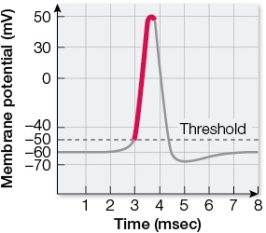 Which event is occurring in the section of the tracing highlighted in red?
 (Multiple Choice)
4.8/5 (79)
(79) The acetylcholine receptor is restored to its normal closed position by
(Multiple Choice)
4.8/5 (76)
(76) Which statement about the withdrawal response to stepping on a piece of broken glass is false?
(Multiple Choice)
5.0/5 (87)
(87) Morphine reduces pain because it is an _______ that potentiates the effects of _______.
(Multiple Choice)
4.9/5 (82)
(82) If you step on a sharp tack, sensory receptors in your foot will stimulate action potentials to be sent via sensory neurons into the spinal cord.The sensory neurons will synapse with several different interneurons there to
(Multiple Choice)
4.9/5 (86)
(86) The tripartite synapse model is the idea that the synapse includes presynaptic neurons, postsynaptic neurons, and _______.
(Short Answer)
4.7/5 (82)
(82) Which event would make it less likely for a postsynaptic muscle cell to fire an action potential?
(Multiple Choice)
4.8/5 (102)
(102) In vertebrates, most synapses are chemical, which means that information is transferred from one neuron to the next via
(Multiple Choice)
4.9/5 (71)
(71) Because birds have forelimbs specialized for flight, most rely on their beaks to build nests.Controlling for body size, you might expect bird species that build nests requiring complex beak movements and fine motor control to have a larger _______ than bird species that build nests requiring only simple movements.
(Multiple Choice)
4.8/5 (61)
(61) One way to prevent a sensory stimulus, such as pressure, from being received by the nervous system is to chemically block
(Multiple Choice)
4.9/5 (74)
(74) Which statement about the ganglia of invertebrates is true?
(Multiple Choice)
4.9/5 (96)
(96) As part of the peripheral nervous system, efferent neurons transmit information to
(Multiple Choice)
4.8/5 (78)
(78) Refer to the graph showing the course of an action potential. 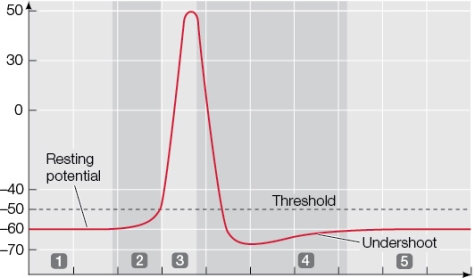 At which of the numbered points along the graph do voltage-gated sodium channels first open, and what is the result?
 (Short Answer)
4.9/5 (87)
(87) Neurons have different shapes and sizes depending on their roles.A bipolar cell in the retina of the eye collects information from a few inputs and transmits it a short distance to one or more closely spaced neurons.What shape would you predict it to have?
(Multiple Choice)
4.8/5 (72)
(72) The area where a neuron comes extremely close to a target cell and transmits information to the target cell is
(Multiple Choice)
5.0/5 (75)
(75) 
Filters
- Essay(0)
- Multiple Choice(0)
- Short Answer(0)
- True False(0)
- Matching(0)