



 Chat with AI
Exam 44: Neurons, Glia, and Nervous Systems

Exam 1: Studying Life246 Questions
Exam 2: Small Molecules and the Chemistry of Life246 Questions
Exam 3: Proteins, Carbohydrates, and Lipids246 Questions
Exam 4: Nucleic Acids and the Origin of Life246 Questions
Exam 5: Cells: the Working Units of Life248 Questions
Exam 6: Cell Membranes246 Questions
Exam 7: Cell Communication and Multicellularity246 Questions
Exam 8: Energy, Enzymes, and Metabolism246 Questions
Exam 9: Pathways That Harvest Chemical Energy246 Questions
Exam 10: Photosynthesis: Energy From Sunlight242 Questions
Exam 11: The Cell Cycle and Cell Division260 Questions
Exam 12: Inheritance, Genes, and Chromosomes250 Questions
Exam 13: Dna and Its Role in Heredity257 Questions
Exam 14: From Dna to Protein: Gene Expression252 Questions
Exam 15: Gene Mutation and Molecular Medicine251 Questions
Exam 16: Regulation of Gene Expression245 Questions
Exam 17: Genomes249 Questions
Exam 18: Recombinant Dna and Biotechnology243 Questions
Exam 20: Mechanisms of Evolution243 Questions
Exam 21: Reconstructing and Using Phylogenies246 Questions
Exam 22: Speciation247 Questions
Exam 23: Evolution of Genes and Genomes252 Questions
Exam 24: The History of Life on Earth246 Questions
Exam 25: Bacteria, Archaea, and Viruses262 Questions
Exam 26: The Origin and Diversification of Eukaryotes252 Questions
Exam 27: Plants Without Seeds: From Water to Land251 Questions
Exam 28: The Evolution of Seed Plants259 Questions
Exam 29: The Evolution and Diversity of Fungi261 Questions
Exam 30: Animal Origins and the Evolution of Body Plans248 Questions
Exam 31: Protostome Animals244 Questions
Exam 32: Deuterostome Animals246 Questions
Exam 33: The Plant Body243 Questions
Exam 34: Transport in Plants248 Questions
Exam 35: Plant Nutrition247 Questions
Exam 36: Regulation of Plant Growth246 Questions
Exam 37: Reproduction in Flowering Plants247 Questions
Exam 38: Plant Responses to Environmental Challenges246 Questions
Exam 39: Physiology, Homeostasis, and Temperature Regulation258 Questions
Exam 40: Animal Hormones249 Questions
Exam 41: Immunology: Animal Defense Systems265 Questions
Exam 42: Animal Reproduction261 Questions
Exam 43: Animal Development261 Questions
Exam 44: Neurons, Glia, and Nervous Systems250 Questions
Exam 45: Sensory Systems249 Questions
Exam 46: The Mammalian Nervous System: Structure and Higher Functions254 Questions
Exam 47: Musculoskeletal Systems259 Questions
Exam 48: Gas Exchange247 Questions
Exam 49: Circulatory Systems252 Questions
Exam 50: Nutrition, Digestion, and Absorption259 Questions
Exam 51: Salt and Water Balance and Nitrogen Excretion251 Questions
Exam 52: Animal Behavior249 Questions
Exam 53: The Physical Environment and Biogeography of Life248 Questions
Exam 54: Populations259 Questions
Exam 55: Species Interactions254 Questions
Exam 56: Communities247 Questions
Exam 57: Ecosystems238 Questions
Exam 58: A Changing Biosphere222 Questions
Select questions type


If you were to design an axon with low resistance to ionic current flow, you would make
(Multiple Choice)
5.0/5  (84)
(84) Sea stars are marine animals that have the simplest form of nervous system, a _______, located in each arm.
(Multiple Choice)
4.9/5 (85)
(85) Refer to the figure showing the conduction of an action potential traveling from left to right in a myelinated axon.Note the action potential at node 2. 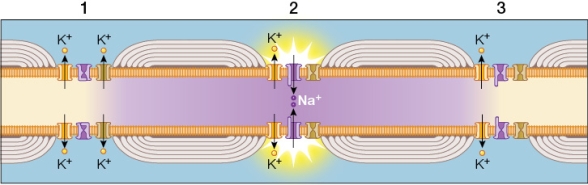 Which statement about section 2 of the axon is true?
 (Multiple Choice)
4.9/5 (78)
(78) Neural networks contain functional categories of neurons involved with input, output, and integration.The types of neurons that carry information that has been transduced by specialized sensory cells to the central nervous system are
(Multiple Choice)
4.9/5 (80)
(80) A disease that destroys astrocytes would cause all of the following except
(Multiple Choice)
4.9/5 (83)
(83) A postsynaptic neuron receives both excitatory and inhibitory input on its dendrites or cell body.For the neuron to respond appropriately to the stimuli received at all of these sites, _______ summation must occur.
(Short Answer)
4.8/5 (79)
(79) The potassium equilibrium potential is reached when the diffusion of K+ out of the cell due to the concentration gradient is balanced by the movement of K+ into the cell due to the negative electric potential.This potassium equilibrium potential
(Multiple Choice)
4.8/5 (81)
(81) You are looking at neural tissue that has been treated with calcium-sensitive dyes and you notice calcium ion waves traveling through the tissue.These waves represent
(Multiple Choice)
5.0/5 (75)
(75) Refer to the figure showing the knee-jerk reflex. 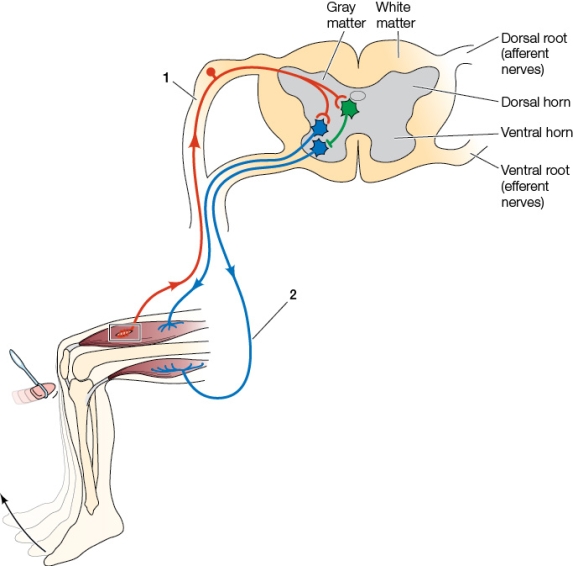 What is happening at point 2?
 (Multiple Choice)
4.8/5 (77)
(77) Action potentials are all-or-none and self-regenerating events.These two properties contribute to which characteristic of action potentials?
(Multiple Choice)
4.8/5 (81)
(81) Dendrites are projections that extend from the cell body of a neuron.A large array of dendrites would allow the neuron to
(Multiple Choice)
4.8/5 (86)
(86) Which of the following has the components of the knee-jerk reflex in the correct sequence?
(Multiple Choice)
4.8/5 (83)
(83) All of the following are events in an action potential except
(Multiple Choice)
4.9/5 (72)
(72) A challenge to modern medicine is to design drugs that target the brain.Existing knowledge about the ability of _______ to cross the blood‒brain barrier seems to be the best starting point in the design of new treatments.
(Multiple Choice)
4.7/5 (83)
(83) Consider the following statement: Voltage is to the flow of electrically charged particles as pressure is to the flow of water.This statement indicates that voltage is the
(Multiple Choice)
4.7/5 (77)
(77) The motor end plate in a neuromuscular junction is part of the
(Multiple Choice)
4.9/5 (81)
(81) The binding of acetylcholine results in a(n) _______ in the motor end plate membrane.
(Multiple Choice)
4.7/5 (89)
(89) Myasthenia gravis is a chronic autoimmune disease that causes weakness in skeletal muscle.It develops when a person's antibodies block or destroy _______ nicotinic receptors.
(Multiple Choice)
4.9/5 (73)
(73) When K+ ions diffuse out of a resting neuron through open potassium leak channels and leave behind unbalanced negative charges that create a negative membrane potential, that pulls K+ back into the neuron.The membrane potential at which the diffusion of K+ out of the cell is balanced by the pull of K+ into the cell is called the potassium
(Multiple Choice)
4.8/5 (88)
(88) Refer to the figure showing two electrodes, one placed within the cytoplasm of a nerve cell and the other placed outside the cell membrane. 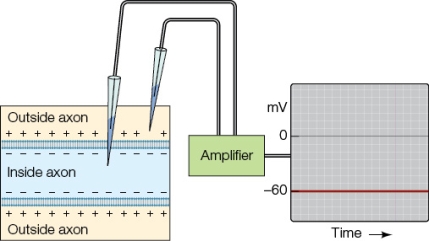 What are the two electrodes measuring, and what does the red line represent?
 (Short Answer)
4.8/5 (90)
(90) 
Filters
- Essay(0)
- Multiple Choice(0)
- Short Answer(0)
- True False(0)
- Matching(0)