



 Chat with AI
Exam 44: Neurons, Glia, and Nervous Systems

Exam 1: Studying Life246 Questions
Exam 2: Small Molecules and the Chemistry of Life246 Questions
Exam 3: Proteins, Carbohydrates, and Lipids246 Questions
Exam 4: Nucleic Acids and the Origin of Life246 Questions
Exam 5: Cells: the Working Units of Life248 Questions
Exam 6: Cell Membranes246 Questions
Exam 7: Cell Communication and Multicellularity246 Questions
Exam 8: Energy, Enzymes, and Metabolism246 Questions
Exam 9: Pathways That Harvest Chemical Energy246 Questions
Exam 10: Photosynthesis: Energy From Sunlight242 Questions
Exam 11: The Cell Cycle and Cell Division260 Questions
Exam 12: Inheritance, Genes, and Chromosomes250 Questions
Exam 13: Dna and Its Role in Heredity257 Questions
Exam 14: From Dna to Protein: Gene Expression252 Questions
Exam 15: Gene Mutation and Molecular Medicine251 Questions
Exam 16: Regulation of Gene Expression245 Questions
Exam 17: Genomes249 Questions
Exam 18: Recombinant Dna and Biotechnology243 Questions
Exam 20: Mechanisms of Evolution243 Questions
Exam 21: Reconstructing and Using Phylogenies246 Questions
Exam 22: Speciation247 Questions
Exam 23: Evolution of Genes and Genomes252 Questions
Exam 24: The History of Life on Earth246 Questions
Exam 25: Bacteria, Archaea, and Viruses262 Questions
Exam 26: The Origin and Diversification of Eukaryotes252 Questions
Exam 27: Plants Without Seeds: From Water to Land251 Questions
Exam 28: The Evolution of Seed Plants259 Questions
Exam 29: The Evolution and Diversity of Fungi261 Questions
Exam 30: Animal Origins and the Evolution of Body Plans248 Questions
Exam 31: Protostome Animals244 Questions
Exam 32: Deuterostome Animals246 Questions
Exam 33: The Plant Body243 Questions
Exam 34: Transport in Plants248 Questions
Exam 35: Plant Nutrition247 Questions
Exam 36: Regulation of Plant Growth246 Questions
Exam 37: Reproduction in Flowering Plants247 Questions
Exam 38: Plant Responses to Environmental Challenges246 Questions
Exam 39: Physiology, Homeostasis, and Temperature Regulation258 Questions
Exam 40: Animal Hormones249 Questions
Exam 41: Immunology: Animal Defense Systems265 Questions
Exam 42: Animal Reproduction261 Questions
Exam 43: Animal Development261 Questions
Exam 44: Neurons, Glia, and Nervous Systems250 Questions
Exam 45: Sensory Systems249 Questions
Exam 46: The Mammalian Nervous System: Structure and Higher Functions254 Questions
Exam 47: Musculoskeletal Systems259 Questions
Exam 48: Gas Exchange247 Questions
Exam 49: Circulatory Systems252 Questions
Exam 50: Nutrition, Digestion, and Absorption259 Questions
Exam 51: Salt and Water Balance and Nitrogen Excretion251 Questions
Exam 52: Animal Behavior249 Questions
Exam 53: The Physical Environment and Biogeography of Life248 Questions
Exam 54: Populations259 Questions
Exam 55: Species Interactions254 Questions
Exam 56: Communities247 Questions
Exam 57: Ecosystems238 Questions
Exam 58: A Changing Biosphere222 Questions
Select questions type


If divisions of neuronal stem cells in the neural tube of a vertebrate embryo are symmetrical rather than asymmetrical, then which of the following will result?
(Multiple Choice)
4.8/5  (92)
(92) When an action potential reaches an axon terminal, it can cause the release of neurotransmitters into the synaptic cleft.Which of the following is a possible sequence of events that could follow?
(Multiple Choice)
4.9/5 (87)
(87) In most vertebrate neurons, an action potential arrives at the axon terminal and causes the release of chemical messenger molecules.These molecules are
(Multiple Choice)
4.9/5 (75)
(75) Refer to the figure showing brains of various sizes and complexities.Keep in mind that the species shown can have similar body masses as adults. 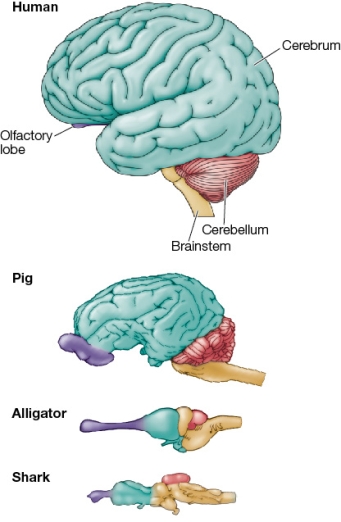 Which statement is false?
 (Multiple Choice)
4.9/5 (80)
(80) Evaluate the following statement: Water-soluble drugs cross the blood-brain barrier, allowing treatment of infections of the central nervous system.
(Essay)
4.9/5 (91)
(91) In the nervous system of vertebrates, the afferent (sensory) axons in a spinal nerve enter the spinal cord via the _______ root, while the efferent (motor) axons leave through the ventral root.
(Short Answer)
4.9/5 (74)
(74) Which of the following is most likely to cause the opening of a voltage-gated channel in a cell membrane?
(Multiple Choice)
4.9/5 (78)
(78) Refer to the graphs showing action potentials occurring in response to multiple excitatory postsynaptic potentials (EPSPs). 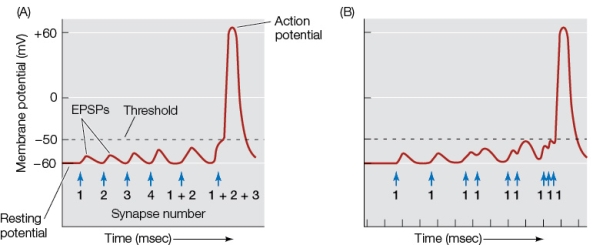 In graph B, the action potential is due to
 (Multiple Choice)
4.7/5 (83)
(83) The direction and amount of movement of ions through an ion channel depends on the concentration gradient of the ion as well as on the voltage difference across the membrane.These two forces acting on an ion are called the
(Multiple Choice)
5.0/5 (93)
(93) If a neuron records several postsynaptic potentials in rapid succession at the same synapse, _______ summation must occur for the neuron to fire an action potential.
(Short Answer)
4.8/5 (82)
(82) A disease in which antibodies destroy myelin produced by oligodendrocytes would most likely cause which of the following?
(Multiple Choice)
4.8/5 (79)
(79) Antibodies produced by the human immune system are typically prevented from getting to the brain by the blood‒brain barrier.Does this mean that the brain has no immune defenses?
(Multiple Choice)
4.8/5 (72)
(72) When acetylcholine binds to its receptors on the motor end plate, it triggers a(n) _______ in the postsynaptic membrane.
(Multiple Choice)
4.8/5 (84)
(84) Nervous systems are able to encode, process, and store information because of the properties of two classes of cells: _______ cells and _______ cells.
(Multiple Choice)
4.9/5 (76)
(76) In the neural tube of a developing vertebrate embryo, neuronal stem cells eventually divide asymmetrically, forming one daughter cell that is a neuronal stem cell and another that is either a neuroblast or a _______.
(Short Answer)
4.7/5 (66)
(66) The frequency at which a single neuron can "fire" action potentials is limited by the
(Multiple Choice)
4.8/5 (65)
(65) Briefly explain how an action potential travels more quickly down an axon wrapped in myelin than it does down an unmyelinated axon.
(Essay)
4.8/5 (75)
(75) Glial cells are estimated to be more numerous in the brain than are neurons, yet much less is known about them.What makes glial cells so difficult to study?
(Multiple Choice)
4.9/5 (77)
(77) Which of the following is not one of the major ions that carry electrical charges across the cell membranes of neurons?
(Multiple Choice)
4.9/5 (87)
(87) 
Filters
- Essay(0)
- Multiple Choice(0)
- Short Answer(0)
- True False(0)
- Matching(0)