



 Chat with AI
Exam 41: Immunology: Animal Defense Systems

Exam 1: Studying Life246 Questions
Exam 2: Small Molecules and the Chemistry of Life246 Questions
Exam 3: Proteins, Carbohydrates, and Lipids246 Questions
Exam 4: Nucleic Acids and the Origin of Life246 Questions
Exam 5: Cells: the Working Units of Life248 Questions
Exam 6: Cell Membranes246 Questions
Exam 7: Cell Communication and Multicellularity246 Questions
Exam 8: Energy, Enzymes, and Metabolism246 Questions
Exam 9: Pathways That Harvest Chemical Energy246 Questions
Exam 10: Photosynthesis: Energy From Sunlight242 Questions
Exam 11: The Cell Cycle and Cell Division260 Questions
Exam 12: Inheritance, Genes, and Chromosomes250 Questions
Exam 13: Dna and Its Role in Heredity257 Questions
Exam 14: From Dna to Protein: Gene Expression252 Questions
Exam 15: Gene Mutation and Molecular Medicine251 Questions
Exam 16: Regulation of Gene Expression245 Questions
Exam 17: Genomes249 Questions
Exam 18: Recombinant Dna and Biotechnology243 Questions
Exam 20: Mechanisms of Evolution243 Questions
Exam 21: Reconstructing and Using Phylogenies246 Questions
Exam 22: Speciation247 Questions
Exam 23: Evolution of Genes and Genomes252 Questions
Exam 24: The History of Life on Earth246 Questions
Exam 25: Bacteria, Archaea, and Viruses262 Questions
Exam 26: The Origin and Diversification of Eukaryotes252 Questions
Exam 27: Plants Without Seeds: From Water to Land251 Questions
Exam 28: The Evolution of Seed Plants259 Questions
Exam 29: The Evolution and Diversity of Fungi261 Questions
Exam 30: Animal Origins and the Evolution of Body Plans248 Questions
Exam 31: Protostome Animals244 Questions
Exam 32: Deuterostome Animals246 Questions
Exam 33: The Plant Body243 Questions
Exam 34: Transport in Plants248 Questions
Exam 35: Plant Nutrition247 Questions
Exam 36: Regulation of Plant Growth246 Questions
Exam 37: Reproduction in Flowering Plants247 Questions
Exam 38: Plant Responses to Environmental Challenges246 Questions
Exam 39: Physiology, Homeostasis, and Temperature Regulation258 Questions
Exam 40: Animal Hormones249 Questions
Exam 41: Immunology: Animal Defense Systems265 Questions
Exam 42: Animal Reproduction261 Questions
Exam 43: Animal Development261 Questions
Exam 44: Neurons, Glia, and Nervous Systems250 Questions
Exam 45: Sensory Systems249 Questions
Exam 46: The Mammalian Nervous System: Structure and Higher Functions254 Questions
Exam 47: Musculoskeletal Systems259 Questions
Exam 48: Gas Exchange247 Questions
Exam 49: Circulatory Systems252 Questions
Exam 50: Nutrition, Digestion, and Absorption259 Questions
Exam 51: Salt and Water Balance and Nitrogen Excretion251 Questions
Exam 52: Animal Behavior249 Questions
Exam 53: The Physical Environment and Biogeography of Life248 Questions
Exam 54: Populations259 Questions
Exam 55: Species Interactions254 Questions
Exam 56: Communities247 Questions
Exam 57: Ecosystems238 Questions
Exam 58: A Changing Biosphere222 Questions
Select questions type


Harmful organisms and viruses that can cause disease are collectively known as _______.
(Short Answer)
4.7/5  (76)
(76) Refer to the figure. 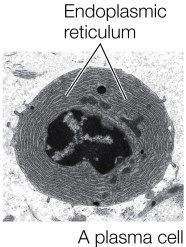 This plasma cell has a large amount of rough endoplasmic reticulum.This is necessary in order for the cell to _______.
 (Short Answer)
4.8/5 (72)
(72) A researcher is investigating which time of year birds are exposed to the West Nile Virus (WNV), so she places a cage full of lab-reared (and therefore unexposed) birds near a marsh full of mosquitoes suspected of carrying WNV.Her lab technician tests the birds' blood for anti-WNV antibodies three times per year.Eventually they find a large amount of IgG but almost no IgM.Which is the best conclusion the researcher can reach from these data?
(Multiple Choice)
4.9/5 (84)
(84) If an individual has inappropriately low levels of activity of Tregs, it is likely that the individual will develop a(n) _______ disease.
(Short Answer)
4.8/5 (67)
(67) Which defense mechanism would a pathogen on your skin encounter?
(Multiple Choice)
4.7/5 (92)
(92) The process by which immature B or T cells with the potential to respond strongly to self antigens undergo apoptosis is called
(Multiple Choice)
4.8/5 (95)
(95) Also known as antigenic determinants, _______ are specific sites on the antigen that are recognized by the immune system.
(Short Answer)
5.0/5 (79)
(79) Immature T cells migrate from the bone marrow to the _______, where they complete maturation.
(Short Answer)
4.7/5 (80)
(80) Which statement about antibodies in the class IgE is true?
(Multiple Choice)
4.9/5 (82)
(82) Refer to the graph showing a person's immune response, first to a vaccination, and later to exposure to the pathogen that the vaccine targeted.Time is represented on the x-axis, but the scale is different for each subdivision. 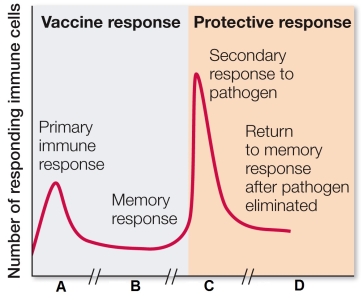 What amount of time does each period typically represent?
 (Short Answer)
4.9/5 (77)
(77) Which component play(s) a role in the activation phase of the cellular immune response that is analogous to the role played by class II MHC proteins in the activation phase of the humoral immune response?
(Multiple Choice)
4.9/5 (74)
(74) 
Filters
- Essay(0)
- Multiple Choice(0)
- Short Answer(0)
- True False(0)
- Matching(0)