



 Chat with AI
Exam 41: Immunology: Animal Defense Systems

Exam 1: Studying Life246 Questions
Exam 2: Small Molecules and the Chemistry of Life246 Questions
Exam 3: Proteins, Carbohydrates, and Lipids246 Questions
Exam 4: Nucleic Acids and the Origin of Life246 Questions
Exam 5: Cells: the Working Units of Life248 Questions
Exam 6: Cell Membranes246 Questions
Exam 7: Cell Communication and Multicellularity246 Questions
Exam 8: Energy, Enzymes, and Metabolism246 Questions
Exam 9: Pathways That Harvest Chemical Energy246 Questions
Exam 10: Photosynthesis: Energy From Sunlight242 Questions
Exam 11: The Cell Cycle and Cell Division260 Questions
Exam 12: Inheritance, Genes, and Chromosomes250 Questions
Exam 13: Dna and Its Role in Heredity257 Questions
Exam 14: From Dna to Protein: Gene Expression252 Questions
Exam 15: Gene Mutation and Molecular Medicine251 Questions
Exam 16: Regulation of Gene Expression245 Questions
Exam 17: Genomes249 Questions
Exam 18: Recombinant Dna and Biotechnology243 Questions
Exam 20: Mechanisms of Evolution243 Questions
Exam 21: Reconstructing and Using Phylogenies246 Questions
Exam 22: Speciation247 Questions
Exam 23: Evolution of Genes and Genomes252 Questions
Exam 24: The History of Life on Earth246 Questions
Exam 25: Bacteria, Archaea, and Viruses262 Questions
Exam 26: The Origin and Diversification of Eukaryotes252 Questions
Exam 27: Plants Without Seeds: From Water to Land251 Questions
Exam 28: The Evolution of Seed Plants259 Questions
Exam 29: The Evolution and Diversity of Fungi261 Questions
Exam 30: Animal Origins and the Evolution of Body Plans248 Questions
Exam 31: Protostome Animals244 Questions
Exam 32: Deuterostome Animals246 Questions
Exam 33: The Plant Body243 Questions
Exam 34: Transport in Plants248 Questions
Exam 35: Plant Nutrition247 Questions
Exam 36: Regulation of Plant Growth246 Questions
Exam 37: Reproduction in Flowering Plants247 Questions
Exam 38: Plant Responses to Environmental Challenges246 Questions
Exam 39: Physiology, Homeostasis, and Temperature Regulation258 Questions
Exam 40: Animal Hormones249 Questions
Exam 41: Immunology: Animal Defense Systems265 Questions
Exam 42: Animal Reproduction261 Questions
Exam 43: Animal Development261 Questions
Exam 44: Neurons, Glia, and Nervous Systems250 Questions
Exam 45: Sensory Systems249 Questions
Exam 46: The Mammalian Nervous System: Structure and Higher Functions254 Questions
Exam 47: Musculoskeletal Systems259 Questions
Exam 48: Gas Exchange247 Questions
Exam 49: Circulatory Systems252 Questions
Exam 50: Nutrition, Digestion, and Absorption259 Questions
Exam 51: Salt and Water Balance and Nitrogen Excretion251 Questions
Exam 52: Animal Behavior249 Questions
Exam 53: The Physical Environment and Biogeography of Life248 Questions
Exam 54: Populations259 Questions
Exam 55: Species Interactions254 Questions
Exam 56: Communities247 Questions
Exam 57: Ecosystems238 Questions
Exam 58: A Changing Biosphere222 Questions
Select questions type


If you come down with the flu, your body will launch an adaptive immune attack against the flu virus.During the recognition phase,
(Multiple Choice)
4.8/5  (81)
(81) Which event would most likely occur after an ingested virus is degraded within a macrophage?
(Multiple Choice)
5.0/5 (72)
(72) Which event must take place for a B cell to become an antibody-secreting plasma cell?
(Multiple Choice)
4.9/5 (83)
(83) When would a B cell present an antigen on an MHC I protein?
(Multiple Choice)
4.9/5 (73)
(73) The drug cyclosporine is commonly given to patients after a tissue transplant to prevent rejection.A likely mechanism for cyclosporine action is that it
(Multiple Choice)
4.7/5 (85)
(85) Refer to the figure below. 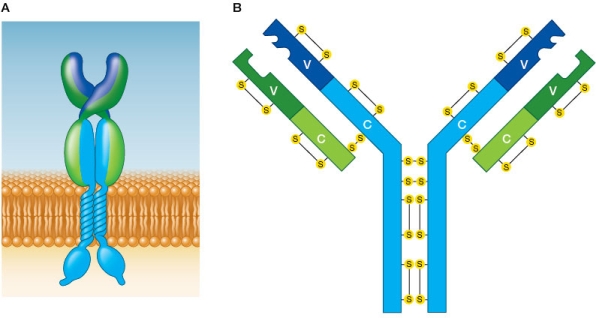 You would find the receptor labeled "B" on a _______ cell
 (Short Answer)
4.9/5 (74)
(74) Refer to the figure showing the adaptive immune system. 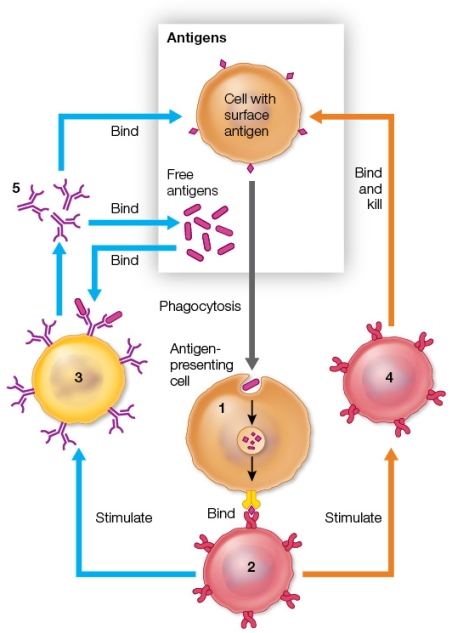 Components involved in the humoral response include
 (Multiple Choice)
4.9/5 (84)
(84) If a person is deficient in Tregs that recognize antigen-MHC complexes specific for insulin-secreting cells, a likely outcome is that the person will
(Multiple Choice)
4.8/5 (81)
(81) The amino acid sequences of the _______ regions are different for each specific immunoglobulin.
(Short Answer)
4.8/5 (79)
(79) A B cell produces IgM molecules that recognize an antigenic determinant on an influenza virus.After several days, the cell begins to produce IgG molecules that recognize the same antigenic determinant.This process is called
(Multiple Choice)
4.9/5 (73)
(73) Refer to the figure showing an immune response to an antigen. 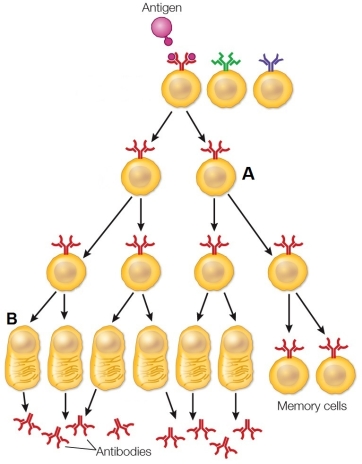 The cell labeled "B" is a(n) _______ cell, which _______.
 (Multiple Choice)
5.0/5 (67)
(67) There are two major kinds of white blood cells: _______ engulf pathogens, while _______ are involved in adaptive immunity.
(Multiple Choice)
5.0/5 (68)
(68) Binding of a molecule from a pathogen to a receptor initiates a signal transduction pathway.Which represents the correct order of events in this pathway?
(Multiple Choice)
4.8/5 (75)
(75) Refer to the figure showing an immunology experiment. 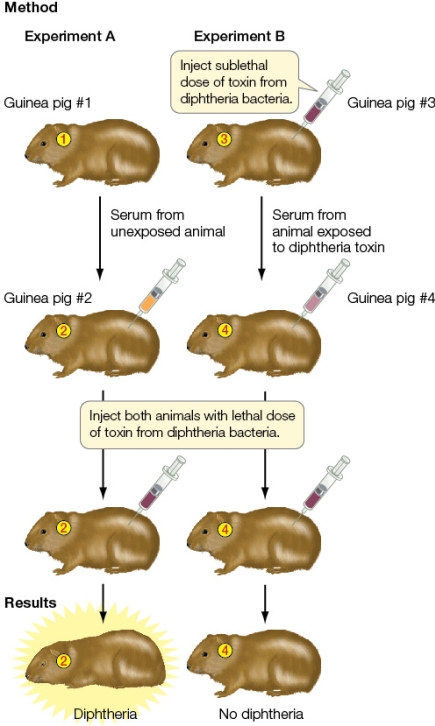 Guinea pig number 2 did not survive exposure to diphtheria toxin most likely because it _______ from the injection of blood serum from guinea pig number 1.
 (Short Answer)
5.0/5 (81)
(81) A child is born with a genetic disorder that impairs her ability to produce B and T lymphocytes.With this diagnosis, the symptom would you most likely see would be
(Multiple Choice)
4.8/5 (79)
(79) 
Filters
- Essay(0)
- Multiple Choice(0)
- Short Answer(0)
- True False(0)
- Matching(0)