



 Chat with AI
Exam 41: Immunology: Animal Defense Systems

Exam 1: Studying Life246 Questions
Exam 2: Small Molecules and the Chemistry of Life246 Questions
Exam 3: Proteins, Carbohydrates, and Lipids246 Questions
Exam 4: Nucleic Acids and the Origin of Life246 Questions
Exam 5: Cells: the Working Units of Life248 Questions
Exam 6: Cell Membranes246 Questions
Exam 7: Cell Communication and Multicellularity246 Questions
Exam 8: Energy, Enzymes, and Metabolism246 Questions
Exam 9: Pathways That Harvest Chemical Energy246 Questions
Exam 10: Photosynthesis: Energy From Sunlight242 Questions
Exam 11: The Cell Cycle and Cell Division260 Questions
Exam 12: Inheritance, Genes, and Chromosomes250 Questions
Exam 13: Dna and Its Role in Heredity257 Questions
Exam 14: From Dna to Protein: Gene Expression252 Questions
Exam 15: Gene Mutation and Molecular Medicine251 Questions
Exam 16: Regulation of Gene Expression245 Questions
Exam 17: Genomes249 Questions
Exam 18: Recombinant Dna and Biotechnology243 Questions
Exam 20: Mechanisms of Evolution243 Questions
Exam 21: Reconstructing and Using Phylogenies246 Questions
Exam 22: Speciation247 Questions
Exam 23: Evolution of Genes and Genomes252 Questions
Exam 24: The History of Life on Earth246 Questions
Exam 25: Bacteria, Archaea, and Viruses262 Questions
Exam 26: The Origin and Diversification of Eukaryotes252 Questions
Exam 27: Plants Without Seeds: From Water to Land251 Questions
Exam 28: The Evolution of Seed Plants259 Questions
Exam 29: The Evolution and Diversity of Fungi261 Questions
Exam 30: Animal Origins and the Evolution of Body Plans248 Questions
Exam 31: Protostome Animals244 Questions
Exam 32: Deuterostome Animals246 Questions
Exam 33: The Plant Body243 Questions
Exam 34: Transport in Plants248 Questions
Exam 35: Plant Nutrition247 Questions
Exam 36: Regulation of Plant Growth246 Questions
Exam 37: Reproduction in Flowering Plants247 Questions
Exam 38: Plant Responses to Environmental Challenges246 Questions
Exam 39: Physiology, Homeostasis, and Temperature Regulation258 Questions
Exam 40: Animal Hormones249 Questions
Exam 41: Immunology: Animal Defense Systems265 Questions
Exam 42: Animal Reproduction261 Questions
Exam 43: Animal Development261 Questions
Exam 44: Neurons, Glia, and Nervous Systems250 Questions
Exam 45: Sensory Systems249 Questions
Exam 46: The Mammalian Nervous System: Structure and Higher Functions254 Questions
Exam 47: Musculoskeletal Systems259 Questions
Exam 48: Gas Exchange247 Questions
Exam 49: Circulatory Systems252 Questions
Exam 50: Nutrition, Digestion, and Absorption259 Questions
Exam 51: Salt and Water Balance and Nitrogen Excretion251 Questions
Exam 52: Animal Behavior249 Questions
Exam 53: The Physical Environment and Biogeography of Life248 Questions
Exam 54: Populations259 Questions
Exam 55: Species Interactions254 Questions
Exam 56: Communities247 Questions
Exam 57: Ecosystems238 Questions
Exam 58: A Changing Biosphere222 Questions
Select questions type


When a patient is given a heart transplant, the patient may be treated with cyclosporine A, which suppresses T-helper cells.What do you predict the effects of this drug might be?
(Multiple Choice)
4.9/5  (73)
(73) Refer to the figure showing an immunology experiment. 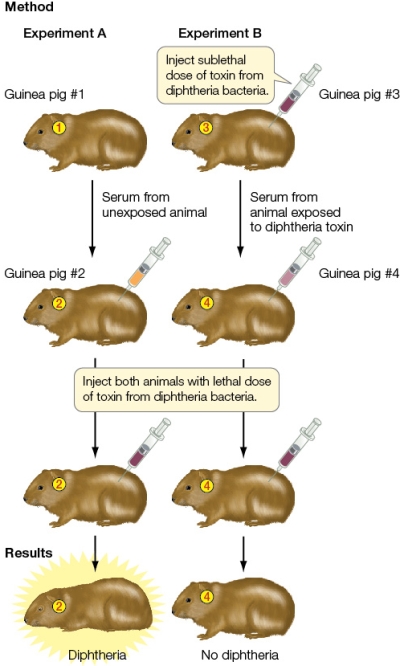 From the results of the experiment shown, what is your hypothesis about what the serum injected into guinea pig #4 contained that was not in the serum injected into guinea pig #2?
 (Short Answer)
4.7/5 (96)
(96) Which statement about antibodies in the class IgG is true?
(Multiple Choice)
4.8/5 (65)
(65) What typically prompts a naïve B cell to develop into a plasma cell that secretes antibodies?
(Multiple Choice)
4.8/5 (82)
(82) NASA astronauts returning from the moon were placed in strict quarantine because scientists feared exposure to pathogens with which humans had no prior experience.Had there been any life forms on the moon, initially we would have had to rely on our _______ (innate/adaptive) immunity for protection.
(Short Answer)
5.0/5 (98)
(98) Inoculation with antigenic proteins in a form that does not cause disease is known as _______.
(Short Answer)
4.9/5 (91)
(91) Which immunoglobulin is involved with the inflammatory response and is found bound to mast cells?
(Multiple Choice)
4.8/5 (75)
(75) Which is not considered one of the mechanisms that generates diversity in the human immune response?
(Multiple Choice)
4.8/5 (83)
(83) A treatment that can desensitize a person to a dust mite allergy involves
(Multiple Choice)
4.9/5 (81)
(81) Refer to the figure showing an immunology experiment. 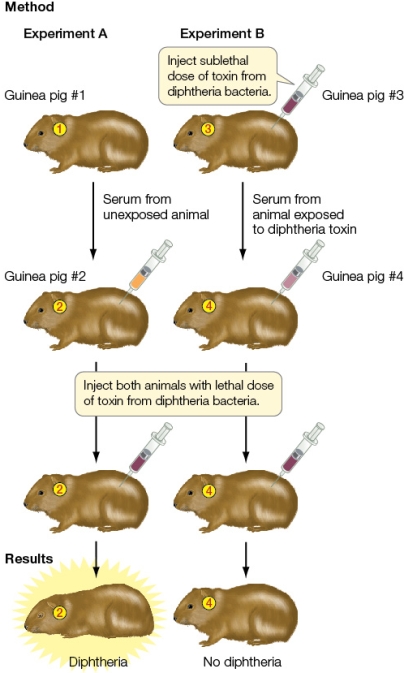 What can you conclude from the results of the experiments shown?
 (Short Answer)
4.9/5 (77)
(77) In the cellular immune response, a cytotoxic T cell recognizes a foreign antigen presented in an antigen-class I MHC complex on the surface of an infected cell.In the next step of this process, the cytotoxic T cell will produce
(Multiple Choice)
4.9/5 (78)
(78) Which antibody class is most likely to trigger a large release of histamines?
(Multiple Choice)
4.8/5 (75)
(75) Among different immunoglobulin G molecules, the amino acid sequences of the _______ regions are similar, and the amino acid sequences of the _______ regions are different.
(Multiple Choice)
4.9/5 (100)
(100) If a person has had an immediate hypersensitive allergic reaction to gluten, that person
(Multiple Choice)
4.7/5 (86)
(86) 
Filters
- Essay(0)
- Multiple Choice(0)
- Short Answer(0)
- True False(0)
- Matching(0)