



 Chat with AI
Exam 41: Immunology: Animal Defense Systems

Exam 1: Studying Life246 Questions
Exam 2: Small Molecules and the Chemistry of Life246 Questions
Exam 3: Proteins, Carbohydrates, and Lipids246 Questions
Exam 4: Nucleic Acids and the Origin of Life246 Questions
Exam 5: Cells: the Working Units of Life248 Questions
Exam 6: Cell Membranes246 Questions
Exam 7: Cell Communication and Multicellularity246 Questions
Exam 8: Energy, Enzymes, and Metabolism246 Questions
Exam 9: Pathways That Harvest Chemical Energy246 Questions
Exam 10: Photosynthesis: Energy From Sunlight242 Questions
Exam 11: The Cell Cycle and Cell Division260 Questions
Exam 12: Inheritance, Genes, and Chromosomes250 Questions
Exam 13: Dna and Its Role in Heredity257 Questions
Exam 14: From Dna to Protein: Gene Expression252 Questions
Exam 15: Gene Mutation and Molecular Medicine251 Questions
Exam 16: Regulation of Gene Expression245 Questions
Exam 17: Genomes249 Questions
Exam 18: Recombinant Dna and Biotechnology243 Questions
Exam 20: Mechanisms of Evolution243 Questions
Exam 21: Reconstructing and Using Phylogenies246 Questions
Exam 22: Speciation247 Questions
Exam 23: Evolution of Genes and Genomes252 Questions
Exam 24: The History of Life on Earth246 Questions
Exam 25: Bacteria, Archaea, and Viruses262 Questions
Exam 26: The Origin and Diversification of Eukaryotes252 Questions
Exam 27: Plants Without Seeds: From Water to Land251 Questions
Exam 28: The Evolution of Seed Plants259 Questions
Exam 29: The Evolution and Diversity of Fungi261 Questions
Exam 30: Animal Origins and the Evolution of Body Plans248 Questions
Exam 31: Protostome Animals244 Questions
Exam 32: Deuterostome Animals246 Questions
Exam 33: The Plant Body243 Questions
Exam 34: Transport in Plants248 Questions
Exam 35: Plant Nutrition247 Questions
Exam 36: Regulation of Plant Growth246 Questions
Exam 37: Reproduction in Flowering Plants247 Questions
Exam 38: Plant Responses to Environmental Challenges246 Questions
Exam 39: Physiology, Homeostasis, and Temperature Regulation258 Questions
Exam 40: Animal Hormones249 Questions
Exam 41: Immunology: Animal Defense Systems265 Questions
Exam 42: Animal Reproduction261 Questions
Exam 43: Animal Development261 Questions
Exam 44: Neurons, Glia, and Nervous Systems250 Questions
Exam 45: Sensory Systems249 Questions
Exam 46: The Mammalian Nervous System: Structure and Higher Functions254 Questions
Exam 47: Musculoskeletal Systems259 Questions
Exam 48: Gas Exchange247 Questions
Exam 49: Circulatory Systems252 Questions
Exam 50: Nutrition, Digestion, and Absorption259 Questions
Exam 51: Salt and Water Balance and Nitrogen Excretion251 Questions
Exam 52: Animal Behavior249 Questions
Exam 53: The Physical Environment and Biogeography of Life248 Questions
Exam 54: Populations259 Questions
Exam 55: Species Interactions254 Questions
Exam 56: Communities247 Questions
Exam 57: Ecosystems238 Questions
Exam 58: A Changing Biosphere222 Questions
Select questions type


Which reaction is the most likely to be a delayed hypersensitivity reaction to an allergen?
(Multiple Choice)
4.9/5  (78)
(78) If you were vaccinated against measles as a child, you still have immunity to the disease decades later because
(Multiple Choice)
4.8/5 (90)
(90) Which substance is most likely responsible for fever during inflammation?
(Multiple Choice)
4.8/5 (71)
(71) Refer to the figure showing different types of hammer. 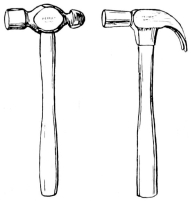 If you compare the hammers to T cell receptors, the heads of the hammers are most analogous to the
 (Multiple Choice)
4.9/5 (87)
(87) Refer to the figure illustrating an immune response to an antigen. 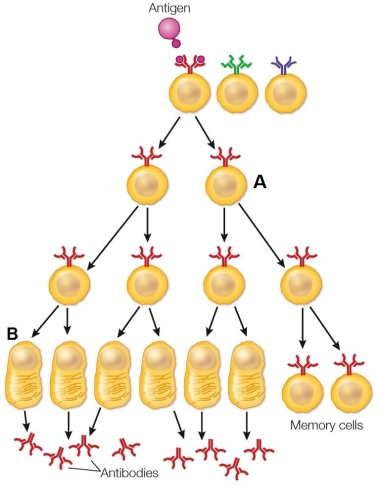 The cell labeled "A" is a B lymphocyte and the cell labeled "B" is a(n) _______.These cells are involved in a humoral immune response.
 (Short Answer)
4.9/5 (71)
(71) If you come down with a streptococcal bacterial infection that results in your getting strep throat, you are likely to suffer from a fever, sore throat, headache, nausea, and even vomiting.At least one of these symptoms may be useful to your recovery because
(Multiple Choice)
4.7/5 (77)
(77) Cruise ship passengers find themselves with flu-like symptoms for the first 4-5 days of their trip, but eventually recover and enjoy their trip.Which defense listed is last to be involved in their recovery?
(Multiple Choice)
4.8/5 (79)
(79) Interferons are a class of _______ that increase the resistance of neighboring cells to infection.
(Short Answer)
4.9/5 (90)
(90) If a person suffers from hay fever due to an allergy to grass pollen, that person can be treated to reduce the allergic response by injections of small amounts of the allergen, a process called _______.
(Short Answer)
4.8/5 (82)
(82) Refer to the figure showing the body's reaction to a splinter.Once the substance labeled A is released, which will be the next event in the inflammatory response? 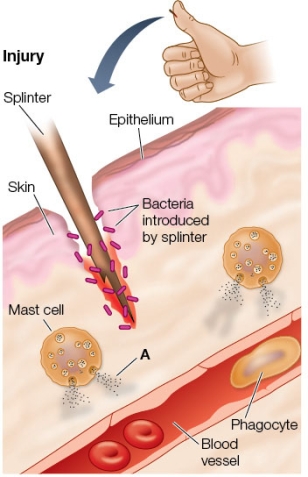
(Multiple Choice)
4.8/5 (75)
(75) Also known as white blood cells, _______ play key roles in both innate and adaptive immunity.
(Short Answer)
4.9/5 (79)
(79) If the vaccination rate for hepatitis B virus in a given country is at 60 percent of the population, it is reasonable to conclude that
(Multiple Choice)
4.8/5 (91)
(91) In the humoral immune response, a T-helper cell recognizes a foreign antigen presented in an antigen-class II MHC complex on the surface of a macrophage.In the next step of this process, the T-helper cell will produce
(Multiple Choice)
4.9/5 (84)
(84) 
Filters
- Essay(0)
- Multiple Choice(0)
- Short Answer(0)
- True False(0)
- Matching(0)