



 Chat with AI
Exam 41: Immunology: Animal Defense Systems

Exam 1: Studying Life246 Questions
Exam 2: Small Molecules and the Chemistry of Life246 Questions
Exam 3: Proteins, Carbohydrates, and Lipids246 Questions
Exam 4: Nucleic Acids and the Origin of Life246 Questions
Exam 5: Cells: the Working Units of Life248 Questions
Exam 6: Cell Membranes246 Questions
Exam 7: Cell Communication and Multicellularity246 Questions
Exam 8: Energy, Enzymes, and Metabolism246 Questions
Exam 9: Pathways That Harvest Chemical Energy246 Questions
Exam 10: Photosynthesis: Energy From Sunlight242 Questions
Exam 11: The Cell Cycle and Cell Division260 Questions
Exam 12: Inheritance, Genes, and Chromosomes250 Questions
Exam 13: Dna and Its Role in Heredity257 Questions
Exam 14: From Dna to Protein: Gene Expression252 Questions
Exam 15: Gene Mutation and Molecular Medicine251 Questions
Exam 16: Regulation of Gene Expression245 Questions
Exam 17: Genomes249 Questions
Exam 18: Recombinant Dna and Biotechnology243 Questions
Exam 20: Mechanisms of Evolution243 Questions
Exam 21: Reconstructing and Using Phylogenies246 Questions
Exam 22: Speciation247 Questions
Exam 23: Evolution of Genes and Genomes252 Questions
Exam 24: The History of Life on Earth246 Questions
Exam 25: Bacteria, Archaea, and Viruses262 Questions
Exam 26: The Origin and Diversification of Eukaryotes252 Questions
Exam 27: Plants Without Seeds: From Water to Land251 Questions
Exam 28: The Evolution of Seed Plants259 Questions
Exam 29: The Evolution and Diversity of Fungi261 Questions
Exam 30: Animal Origins and the Evolution of Body Plans248 Questions
Exam 31: Protostome Animals244 Questions
Exam 32: Deuterostome Animals246 Questions
Exam 33: The Plant Body243 Questions
Exam 34: Transport in Plants248 Questions
Exam 35: Plant Nutrition247 Questions
Exam 36: Regulation of Plant Growth246 Questions
Exam 37: Reproduction in Flowering Plants247 Questions
Exam 38: Plant Responses to Environmental Challenges246 Questions
Exam 39: Physiology, Homeostasis, and Temperature Regulation258 Questions
Exam 40: Animal Hormones249 Questions
Exam 41: Immunology: Animal Defense Systems265 Questions
Exam 42: Animal Reproduction261 Questions
Exam 43: Animal Development261 Questions
Exam 44: Neurons, Glia, and Nervous Systems250 Questions
Exam 45: Sensory Systems249 Questions
Exam 46: The Mammalian Nervous System: Structure and Higher Functions254 Questions
Exam 47: Musculoskeletal Systems259 Questions
Exam 48: Gas Exchange247 Questions
Exam 49: Circulatory Systems252 Questions
Exam 50: Nutrition, Digestion, and Absorption259 Questions
Exam 51: Salt and Water Balance and Nitrogen Excretion251 Questions
Exam 52: Animal Behavior249 Questions
Exam 53: The Physical Environment and Biogeography of Life248 Questions
Exam 54: Populations259 Questions
Exam 55: Species Interactions254 Questions
Exam 56: Communities247 Questions
Exam 57: Ecosystems238 Questions
Exam 58: A Changing Biosphere222 Questions
Select questions type


During the activation phase of the _______ immune response, T-helper cells release cytokines, which stimulate the production of a clone of T-helper cells with the same specificity.
(Short Answer)
4.7/5  (91)
(91) In immediate hypersensitivity, individuals exposed to an allergen produce too much of the immunoglobulin IgE, which causes a rapid release of a large amount of _______, the chemical responsible for many allergic symptoms.
(Short Answer)
4.8/5 (93)
(93) If you scrape your knee falling on asphalt, of the events listed, which is the first in the sequence of inflammatory responses at the wound site?
(Multiple Choice)
4.9/5 (75)
(75) Which list shows the correct components in the correct order for initiation of the inflammatory response?
(Multiple Choice)
5.0/5 (72)
(72) Refer to the figure showing the adaptive immune system. 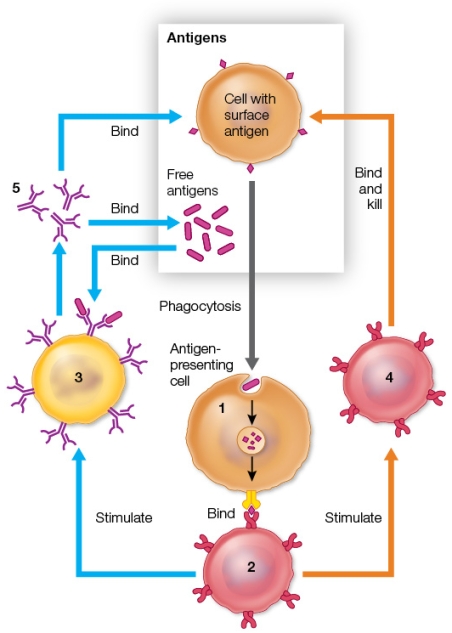 When a patient receives a kidney transplant, the patient will likely be given a drug to prevent rejection of the transplanted organ.The effect of the drug will have to result in an interruption in the action of which component to achieve this effect?
 (Multiple Choice)
4.8/5 (92)
(92) Refer to the figure showing two different types of hammer. 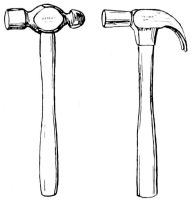 If you compare the hammers to T cell receptors, the handles of the hammers are most analogous to the
 (Multiple Choice)
4.9/5 (82)
(82) A college student taking a 24-hour bus trip to her summer internship is surrounded by people sniffling and sneezing.She cannot escape the pathogen involved, but she does not share the others' symptoms during her trip.Which of the following is not involved in her resistance to the illness?
(Multiple Choice)
4.8/5 (90)
(90) For every white blood cell in a given volume of human blood, there are about _______ red blood cells.
(Multiple Choice)
4.9/5 (67)
(67) The retrovirus HIV specifically destroys T-helper cells and thus disrupts the
(Multiple Choice)
4.8/5 (67)
(67) T cells are stimulated by the binding of antigen‒MHC complex to the T cells' receptors.The outcome of this interaction (i.e., whether it leads to formation of antibodies or to the death of the cell with the antigen‒MHC complex) depends on
(Multiple Choice)
4.9/5 (79)
(79) Which is an opportunistic infection often associated with AIDS?
(Multiple Choice)
4.9/5 (85)
(85) In certain liver cancers, patients show an overexpression of Tregs.The result of this is most likely to
(Multiple Choice)
4.8/5 (76)
(76) A fruit fly has an immune system that most likely shares which feature with that of humans?
(Multiple Choice)
4.8/5 (93)
(93) 
Filters
- Essay(0)
- Multiple Choice(0)
- Short Answer(0)
- True False(0)
- Matching(0)