



 Chat with AI
Exam 36: Regulation of Plant Growth

Exam 1: Studying Life246 Questions
Exam 2: Small Molecules and the Chemistry of Life246 Questions
Exam 3: Proteins, Carbohydrates, and Lipids246 Questions
Exam 4: Nucleic Acids and the Origin of Life246 Questions
Exam 5: Cells: the Working Units of Life248 Questions
Exam 6: Cell Membranes246 Questions
Exam 7: Cell Communication and Multicellularity246 Questions
Exam 8: Energy, Enzymes, and Metabolism246 Questions
Exam 9: Pathways That Harvest Chemical Energy246 Questions
Exam 10: Photosynthesis: Energy From Sunlight242 Questions
Exam 11: The Cell Cycle and Cell Division260 Questions
Exam 12: Inheritance, Genes, and Chromosomes250 Questions
Exam 13: Dna and Its Role in Heredity257 Questions
Exam 14: From Dna to Protein: Gene Expression252 Questions
Exam 15: Gene Mutation and Molecular Medicine251 Questions
Exam 16: Regulation of Gene Expression245 Questions
Exam 17: Genomes249 Questions
Exam 18: Recombinant Dna and Biotechnology243 Questions
Exam 20: Mechanisms of Evolution243 Questions
Exam 21: Reconstructing and Using Phylogenies246 Questions
Exam 22: Speciation247 Questions
Exam 23: Evolution of Genes and Genomes252 Questions
Exam 24: The History of Life on Earth246 Questions
Exam 25: Bacteria, Archaea, and Viruses262 Questions
Exam 26: The Origin and Diversification of Eukaryotes252 Questions
Exam 27: Plants Without Seeds: From Water to Land251 Questions
Exam 28: The Evolution of Seed Plants259 Questions
Exam 29: The Evolution and Diversity of Fungi261 Questions
Exam 30: Animal Origins and the Evolution of Body Plans248 Questions
Exam 31: Protostome Animals244 Questions
Exam 32: Deuterostome Animals246 Questions
Exam 33: The Plant Body243 Questions
Exam 34: Transport in Plants248 Questions
Exam 35: Plant Nutrition247 Questions
Exam 36: Regulation of Plant Growth246 Questions
Exam 37: Reproduction in Flowering Plants247 Questions
Exam 38: Plant Responses to Environmental Challenges246 Questions
Exam 39: Physiology, Homeostasis, and Temperature Regulation258 Questions
Exam 40: Animal Hormones249 Questions
Exam 41: Immunology: Animal Defense Systems265 Questions
Exam 42: Animal Reproduction261 Questions
Exam 43: Animal Development261 Questions
Exam 44: Neurons, Glia, and Nervous Systems250 Questions
Exam 45: Sensory Systems249 Questions
Exam 46: The Mammalian Nervous System: Structure and Higher Functions254 Questions
Exam 47: Musculoskeletal Systems259 Questions
Exam 48: Gas Exchange247 Questions
Exam 49: Circulatory Systems252 Questions
Exam 50: Nutrition, Digestion, and Absorption259 Questions
Exam 51: Salt and Water Balance and Nitrogen Excretion251 Questions
Exam 52: Animal Behavior249 Questions
Exam 53: The Physical Environment and Biogeography of Life248 Questions
Exam 54: Populations259 Questions
Exam 55: Species Interactions254 Questions
Exam 56: Communities247 Questions
Exam 57: Ecosystems238 Questions
Exam 58: A Changing Biosphere222 Questions
Select questions type


A botanist is studying a newly discovered plant that is native to Norway.Which of the following would be the earliest indication that gibberellins play the same role in this plant that they play in flowering and reproduction in cabbage?
(Multiple Choice)
4.9/5  (74)
(74) Refer to the figure below, illustrating early studies of phototropism. 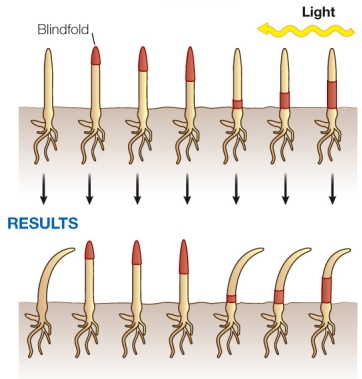 After blindfolding different parts of the seedling and watching the response to a light stimulus, the Darwins concluded that
 (Multiple Choice)
4.9/5 (79)
(79) Application of _______ to leaves can keep them green and delay senescence.
(Short Answer)
4.8/5 (85)
(85) Refer to the diagram below showing cereal grain germination. 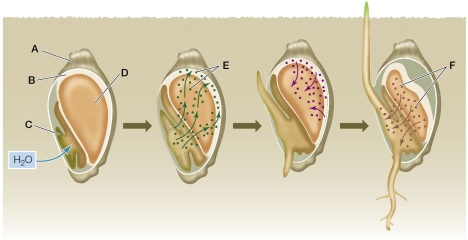 Wheat grains are processed to produce flour before germination occurs.Which part of the seed is used to mill white flour (which is mostly starch)?
 (Multiple Choice)
4.8/5 (70)
(70) A plant part (such as a root) that responds to gravity by growing downward is said to be _______.
(Short Answer)
5.0/5 (91)
(91) Auxin produced by mature leaves prevents the death of cells in the _______ at the base of the petiole.
(Multiple Choice)
4.9/5 (78)
(78) A type of seedless fruit commonly produced using artificially applied gibberellins is _______.
(Short Answer)
4.9/5 (85)
(85) Refer to the diagram below showing cereal grain germination. 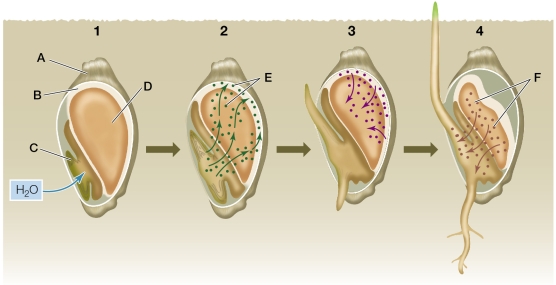 Identify the molecules indicated by F in seed 4.What is their role in relation to structure C?
 (Short Answer)
4.9/5 (76)
(76) Researchers used a genetic screen to identify a blue-light-insensitive mutant Arabidopsis plant strain, then identified the gene for a blue-light receptor protein.Name the photoreceptor involved, and explain its role in plant behavior.
(Essay)
4.9/5 (81)
(81) In an experiment for this course, you are told to remove the shoot apical meristem of a sunflower, and you see that this leads to outgrowth of branch shoots.In order to reestablish apical dominance you would then apply _______.
(Short Answer)
4.8/5 (83)
(83) When germinating grass seeds are stimulated by gibberellins, the stimulation specifically increases enzyme production by the
(Multiple Choice)
4.9/5 (73)
(73) A scientist is studying seeds from a species of sundew native to Western Australia.These seeds need to be treated with smoke before they can imbibe and germinate.This suggests that _______ for the seeds to germinate.
(Multiple Choice)
4.8/5 (67)
(67) Each cocklebur fruit contains two seeds that are kept dormant by two different mechanisms.Why might having two mechanisms of dormancy be advantageous to cockleburs?
(Essay)
4.9/5 (73)
(73) Refer to the figure below. 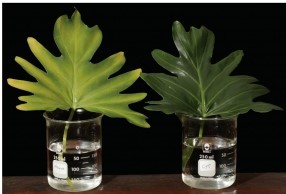 The leaf on the left is turning yellow because it is experiencing a natural process known as
 (Multiple Choice)
4.7/5 (82)
(82) Describe the circumstances under which it would be advantageous for a species to have the dormancy of its seeds broken by fire.
(Essay)
4.9/5 (88)
(88) Molecules that are active at small concentrations and regulate plant development are called _______.
(Short Answer)
4.8/5 (71)
(71) 
Filters
- Essay(0)
- Multiple Choice(0)
- Short Answer(0)
- True False(0)
- Matching(0)