



 Chat with AI
Exam 36: Regulation of Plant Growth

Exam 1: Studying Life246 Questions
Exam 2: Small Molecules and the Chemistry of Life246 Questions
Exam 3: Proteins, Carbohydrates, and Lipids246 Questions
Exam 4: Nucleic Acids and the Origin of Life246 Questions
Exam 5: Cells: the Working Units of Life248 Questions
Exam 6: Cell Membranes246 Questions
Exam 7: Cell Communication and Multicellularity246 Questions
Exam 8: Energy, Enzymes, and Metabolism246 Questions
Exam 9: Pathways That Harvest Chemical Energy246 Questions
Exam 10: Photosynthesis: Energy From Sunlight242 Questions
Exam 11: The Cell Cycle and Cell Division260 Questions
Exam 12: Inheritance, Genes, and Chromosomes250 Questions
Exam 13: Dna and Its Role in Heredity257 Questions
Exam 14: From Dna to Protein: Gene Expression252 Questions
Exam 15: Gene Mutation and Molecular Medicine251 Questions
Exam 16: Regulation of Gene Expression245 Questions
Exam 17: Genomes249 Questions
Exam 18: Recombinant Dna and Biotechnology243 Questions
Exam 20: Mechanisms of Evolution243 Questions
Exam 21: Reconstructing and Using Phylogenies246 Questions
Exam 22: Speciation247 Questions
Exam 23: Evolution of Genes and Genomes252 Questions
Exam 24: The History of Life on Earth246 Questions
Exam 25: Bacteria, Archaea, and Viruses262 Questions
Exam 26: The Origin and Diversification of Eukaryotes252 Questions
Exam 27: Plants Without Seeds: From Water to Land251 Questions
Exam 28: The Evolution of Seed Plants259 Questions
Exam 29: The Evolution and Diversity of Fungi261 Questions
Exam 30: Animal Origins and the Evolution of Body Plans248 Questions
Exam 31: Protostome Animals244 Questions
Exam 32: Deuterostome Animals246 Questions
Exam 33: The Plant Body243 Questions
Exam 34: Transport in Plants248 Questions
Exam 35: Plant Nutrition247 Questions
Exam 36: Regulation of Plant Growth246 Questions
Exam 37: Reproduction in Flowering Plants247 Questions
Exam 38: Plant Responses to Environmental Challenges246 Questions
Exam 39: Physiology, Homeostasis, and Temperature Regulation258 Questions
Exam 40: Animal Hormones249 Questions
Exam 41: Immunology: Animal Defense Systems265 Questions
Exam 42: Animal Reproduction261 Questions
Exam 43: Animal Development261 Questions
Exam 44: Neurons, Glia, and Nervous Systems250 Questions
Exam 45: Sensory Systems249 Questions
Exam 46: The Mammalian Nervous System: Structure and Higher Functions254 Questions
Exam 47: Musculoskeletal Systems259 Questions
Exam 48: Gas Exchange247 Questions
Exam 49: Circulatory Systems252 Questions
Exam 50: Nutrition, Digestion, and Absorption259 Questions
Exam 51: Salt and Water Balance and Nitrogen Excretion251 Questions
Exam 52: Animal Behavior249 Questions
Exam 53: The Physical Environment and Biogeography of Life248 Questions
Exam 54: Populations259 Questions
Exam 55: Species Interactions254 Questions
Exam 56: Communities247 Questions
Exam 57: Ecosystems238 Questions
Exam 58: A Changing Biosphere222 Questions
Select questions type


Refer to the figure below, showing the portion of the visible spectrum detected by a particular plant photoreceptor. 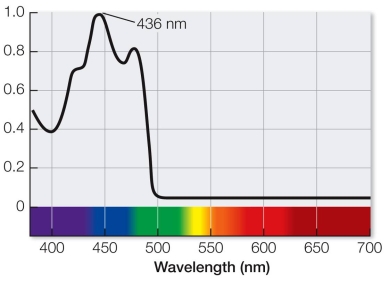 What is the most likely response of a plant to this portion of the visible spectrum (i.e., 436 nm)?
 (Multiple Choice)
4.9/5  (83)
(83) The advantage of crops that produce more grain per plant is obvious, but the disadvantage is that such a plant is likely to bend over unless the properties of the stem are altered to grow in thickness rather than _______.
(Short Answer)
5.0/5 (72)
(72) A biology class studying plant development is observing the germination of orange seeds.What structure are they most likely to observe emerging from the seed coat?
(Multiple Choice)
4.8/5 (74)
(74) _______ causes the triple response in seedlings growing underground.
(Short Answer)
4.8/5 (79)
(79) A plant scientist exposes the seeds of a model organism such as Arabidopsis to mutagenic substances.She then treats the resulting seedlings with a specific hormone and looks for individual plants with a unique physiological response.DNA sequencing of these mutants can reveal the underpinning of signal transduction pathways.This type of study is called a(n)
(Multiple Choice)
4.8/5 (84)
(84) Explain why semi-dwarf varieties of wheat and rice can be more productive than traditional varieties.
(Essay)
4.8/5 (89)
(89) Rapid progress in the elucidation of signal transduction pathways in plant hormone action has been made using the model plant, Arabidopsis thaliana.Genetic screens involve the following steps: 1.Mapping and cloning of a gene
2)Selection of a phenotype
3)Exposure of seeds to a chemical mutagen
"4)Germination of the seeds and identification of mutants
Which of the following shows these steps in their proper sequence?"
(Multiple Choice)
4.9/5 (81)
(81) Which of the following is not involved in the polar transport of auxin?
(Multiple Choice)
4.7/5 (81)
(81) Refer to the figure below. 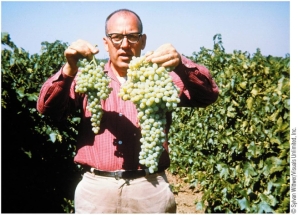 The seedless grapes on the right were most likely treated with _______ to make them grow larger.
 (Short Answer)
4.9/5 (84)
(84) What happens to auxin after it diffuses into a cell, trapping it in the cell until the auxin can be transported out at the base of the cell?
(Multiple Choice)
4.8/5 (75)
(75) Genetic screens found two types of gibberellin-insensitive mutant strains: excessively tall plants and dwarf plants.These mutations affected _______ protein(s), a(n) _______ of a transcription factor.In the excessively tall plants, the growth-promoting genes controlled by gibberellin are always switched _______, whereas in dwarf plants they switched _______.
(Multiple Choice)
5.0/5 (81)
(81) The delicate monocot shoot is protected by a sheath called the
(Multiple Choice)
4.9/5 (74)
(74) Corn stunt spiroplasma (a bacterium) causes a great reduction in the growth rate of infected corn plants.Diseased plants take on a dwarfed form.Because their appearance is reminiscent of genetically dwarfed corn, you suspect that the bacterium may inhibit the synthesis of gibberellins by corn plants.Describe two experiments you might conduct to test this hypothesis, only one of which should require chemical measurement.
(Essay)
4.8/5 (64)
(64) To produce roots on a cutting from a fig tree, you would add
(Multiple Choice)
4.9/5 (83)
(83) You run a genetic screen and find a mutant plant that is dwarf and infertile, with pollen tubes that fail to elongate.You conclude that the mutagen may have altered genes involved in one or more of the _______ hormone pathways.
(Short Answer)
4.9/5 (69)
(69) A botanist compares a wild-type plant to two different mutant plants of the same species.One of the mutants is small and has fewer cells than the wild type.The other has the normal number of cells, though each cell is much smaller than the cells in the wild-type plant.Which hormones are likely to be missing or not functioning properly in these two types of mutants?
(Multiple Choice)
4.8/5 (74)
(74) Which of the following does not occur during the earliest stages of germination?
(Multiple Choice)
4.8/5 (93)
(93) 
Filters
- Essay(0)
- Multiple Choice(0)
- Short Answer(0)
- True False(0)
- Matching(0)