



 Chat with AI
Exam 28: The Evolution of Seed Plants

Exam 1: Studying Life246 Questions
Exam 2: Small Molecules and the Chemistry of Life246 Questions
Exam 3: Proteins, Carbohydrates, and Lipids246 Questions
Exam 4: Nucleic Acids and the Origin of Life246 Questions
Exam 5: Cells: the Working Units of Life248 Questions
Exam 6: Cell Membranes246 Questions
Exam 7: Cell Communication and Multicellularity246 Questions
Exam 8: Energy, Enzymes, and Metabolism246 Questions
Exam 9: Pathways That Harvest Chemical Energy246 Questions
Exam 10: Photosynthesis: Energy From Sunlight242 Questions
Exam 11: The Cell Cycle and Cell Division260 Questions
Exam 12: Inheritance, Genes, and Chromosomes250 Questions
Exam 13: Dna and Its Role in Heredity257 Questions
Exam 14: From Dna to Protein: Gene Expression252 Questions
Exam 15: Gene Mutation and Molecular Medicine251 Questions
Exam 16: Regulation of Gene Expression245 Questions
Exam 17: Genomes249 Questions
Exam 18: Recombinant Dna and Biotechnology243 Questions
Exam 20: Mechanisms of Evolution243 Questions
Exam 21: Reconstructing and Using Phylogenies246 Questions
Exam 22: Speciation247 Questions
Exam 23: Evolution of Genes and Genomes252 Questions
Exam 24: The History of Life on Earth246 Questions
Exam 25: Bacteria, Archaea, and Viruses262 Questions
Exam 26: The Origin and Diversification of Eukaryotes252 Questions
Exam 27: Plants Without Seeds: From Water to Land251 Questions
Exam 28: The Evolution of Seed Plants259 Questions
Exam 29: The Evolution and Diversity of Fungi261 Questions
Exam 30: Animal Origins and the Evolution of Body Plans248 Questions
Exam 31: Protostome Animals244 Questions
Exam 32: Deuterostome Animals246 Questions
Exam 33: The Plant Body243 Questions
Exam 34: Transport in Plants248 Questions
Exam 35: Plant Nutrition247 Questions
Exam 36: Regulation of Plant Growth246 Questions
Exam 37: Reproduction in Flowering Plants247 Questions
Exam 38: Plant Responses to Environmental Challenges246 Questions
Exam 39: Physiology, Homeostasis, and Temperature Regulation258 Questions
Exam 40: Animal Hormones249 Questions
Exam 41: Immunology: Animal Defense Systems265 Questions
Exam 42: Animal Reproduction261 Questions
Exam 43: Animal Development261 Questions
Exam 44: Neurons, Glia, and Nervous Systems250 Questions
Exam 45: Sensory Systems249 Questions
Exam 46: The Mammalian Nervous System: Structure and Higher Functions254 Questions
Exam 47: Musculoskeletal Systems259 Questions
Exam 48: Gas Exchange247 Questions
Exam 49: Circulatory Systems252 Questions
Exam 50: Nutrition, Digestion, and Absorption259 Questions
Exam 51: Salt and Water Balance and Nitrogen Excretion251 Questions
Exam 52: Animal Behavior249 Questions
Exam 53: The Physical Environment and Biogeography of Life248 Questions
Exam 54: Populations259 Questions
Exam 55: Species Interactions254 Questions
Exam 56: Communities247 Questions
Exam 57: Ecosystems238 Questions
Exam 58: A Changing Biosphere222 Questions
Select questions type


A plant that produces seeds in fruits, endosperm in its seeds, and one cotyledon per seedling is most likely a member of the
(Multiple Choice)
5.0/5  (87)
(87) A fossil seed plant that dates to the earliest time that such plants are known to have existed is most likely a member of the
(Multiple Choice)
4.9/5 (72)
(72) Which of the following is not an ecological service provided by plants?
(Multiple Choice)
4.7/5 (68)
(68) Early flowers have individual tepals, carpels that are separate, numerous, and attached at their bases and are
(Multiple Choice)
4.9/5 (77)
(77) Refer to the figure. 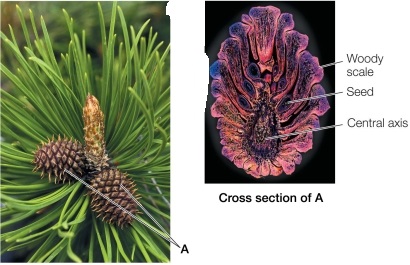 Suppose that a specimen of structure A is given to you as an example of a fruit.Which response would be the most accurate?
 (Multiple Choice)
4.9/5 (79)
(79) Pollen grains develop in the _______ of both gymnosperms and angiosperms.
(Multiple Choice)
4.8/5 (74)
(74) The reproductive structure of angiosperms, which includes several different organs, is the
(Multiple Choice)
4.7/5 (76)
(76) An accessory fruit includes not only the ovary but also, most commonly, the area where floral organs attach, or the
(Multiple Choice)
4.8/5 (63)
(63) A new, non-angiosperm seed plant is found to have modified leaves that evolved convergently with carpels.These modified leaves most likely
(Multiple Choice)
4.8/5 (88)
(88) You are throwing a disco-themed party and decorate with some small white flowers that have a delicate fragrance.During the party you notice the flowers have a striking pattern when the black light (a source of UV light) is on.Based on these observations, the flowers are most likely
(Multiple Choice)
4.8/5 (88)
(88) In a plant that produces large quantities of pollen that disperses over very large areas, _______ is/are most likely to transfer its pollen.
(Multiple Choice)
4.9/5 (89)
(89) A new kind of lemon tree produces megasporangia and microsporangia in separate flowers on the same plant.This plant has _______ flowers and is _______.
(Multiple Choice)
4.8/5 (81)
(81) Which of the following is not a characteristic of gymnosperm reproduction?
(Multiple Choice)
4.9/5 (80)
(80) A structure composed of one carpel or two or more fused carpels is called a(n)
(Multiple Choice)
4.8/5 (74)
(74) In most flowers, the pollen tube grows for the greatest part of its length through the _______ before fertilization can occur.
(Multiple Choice)
5.0/5 (81)
(81) The ovary of a flowering plant develops into a(n) _______, which consists of the mature ovary and its seeds and may also include other parts of the flower.
(Short Answer)
4.8/5 (79)
(79) One reason for the enormous evolutionary success of seed plants as a group is their possession of
(Multiple Choice)
4.8/5 (75)
(75) In seed plants, secondary growth derived from the _______ allowed these plants to grow to great heights to compete for sunlight.
(Short Answer)
4.8/5 (76)
(76) 
Filters
- Essay(0)
- Multiple Choice(0)
- Short Answer(0)
- True False(0)
- Matching(0)