



 Chat with AI
Exam 28: The Evolution of Seed Plants

Exam 1: Studying Life246 Questions
Exam 2: Small Molecules and the Chemistry of Life246 Questions
Exam 3: Proteins, Carbohydrates, and Lipids246 Questions
Exam 4: Nucleic Acids and the Origin of Life246 Questions
Exam 5: Cells: the Working Units of Life248 Questions
Exam 6: Cell Membranes246 Questions
Exam 7: Cell Communication and Multicellularity246 Questions
Exam 8: Energy, Enzymes, and Metabolism246 Questions
Exam 9: Pathways That Harvest Chemical Energy246 Questions
Exam 10: Photosynthesis: Energy From Sunlight242 Questions
Exam 11: The Cell Cycle and Cell Division260 Questions
Exam 12: Inheritance, Genes, and Chromosomes250 Questions
Exam 13: Dna and Its Role in Heredity257 Questions
Exam 14: From Dna to Protein: Gene Expression252 Questions
Exam 15: Gene Mutation and Molecular Medicine251 Questions
Exam 16: Regulation of Gene Expression245 Questions
Exam 17: Genomes249 Questions
Exam 18: Recombinant Dna and Biotechnology243 Questions
Exam 20: Mechanisms of Evolution243 Questions
Exam 21: Reconstructing and Using Phylogenies246 Questions
Exam 22: Speciation247 Questions
Exam 23: Evolution of Genes and Genomes252 Questions
Exam 24: The History of Life on Earth246 Questions
Exam 25: Bacteria, Archaea, and Viruses262 Questions
Exam 26: The Origin and Diversification of Eukaryotes252 Questions
Exam 27: Plants Without Seeds: From Water to Land251 Questions
Exam 28: The Evolution of Seed Plants259 Questions
Exam 29: The Evolution and Diversity of Fungi261 Questions
Exam 30: Animal Origins and the Evolution of Body Plans248 Questions
Exam 31: Protostome Animals244 Questions
Exam 32: Deuterostome Animals246 Questions
Exam 33: The Plant Body243 Questions
Exam 34: Transport in Plants248 Questions
Exam 35: Plant Nutrition247 Questions
Exam 36: Regulation of Plant Growth246 Questions
Exam 37: Reproduction in Flowering Plants247 Questions
Exam 38: Plant Responses to Environmental Challenges246 Questions
Exam 39: Physiology, Homeostasis, and Temperature Regulation258 Questions
Exam 40: Animal Hormones249 Questions
Exam 41: Immunology: Animal Defense Systems265 Questions
Exam 42: Animal Reproduction261 Questions
Exam 43: Animal Development261 Questions
Exam 44: Neurons, Glia, and Nervous Systems250 Questions
Exam 45: Sensory Systems249 Questions
Exam 46: The Mammalian Nervous System: Structure and Higher Functions254 Questions
Exam 47: Musculoskeletal Systems259 Questions
Exam 48: Gas Exchange247 Questions
Exam 49: Circulatory Systems252 Questions
Exam 50: Nutrition, Digestion, and Absorption259 Questions
Exam 51: Salt and Water Balance and Nitrogen Excretion251 Questions
Exam 52: Animal Behavior249 Questions
Exam 53: The Physical Environment and Biogeography of Life248 Questions
Exam 54: Populations259 Questions
Exam 55: Species Interactions254 Questions
Exam 56: Communities247 Questions
Exam 57: Ecosystems238 Questions
Exam 58: A Changing Biosphere222 Questions
Select questions type


Refer to the figure. 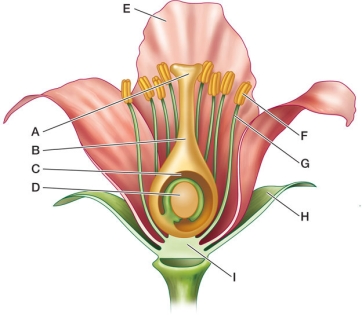 What is the name of the floral parts that collectively make up the calyx? Identify the correct label.
 (Multiple Choice)
4.8/5  (75)
(75) While hiking in South America, a member of your group becomes ill with fever and chills after passing through a swampy area.A resident of the area removes bark from a nearby tree and has the ill person chew on it, which has a beneficial effect.The effective ingredient was likely _______ from the _______ tree.
(Multiple Choice)
4.9/5 (80)
(80) A seed of a flowering plant or gymnosperm may contain tissues from _______ generation(s).
(Multiple Choice)
4.8/5 (73)
(73) Refer to the figure, which shows the evolutionary relationships among the angiosperms. 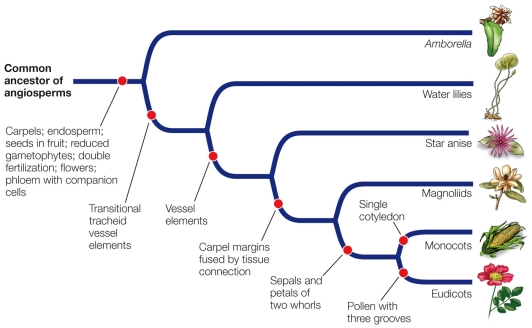 If you discovered a new plant with transitional tracheid vessel elements but no true vessel elements, the plant would belong to which group shown?
 (Multiple Choice)
4.9/5 (67)
(67) Refer to the figure, which shows the evolutionary relationships among the angiosperms. 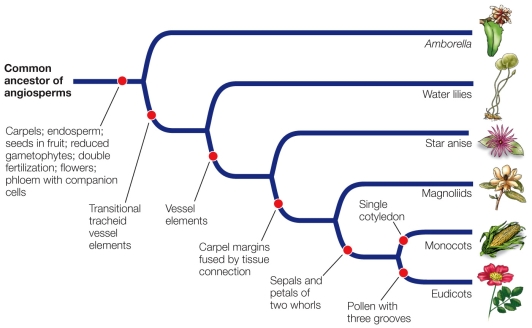 Which group arose first?
 (Multiple Choice)
4.9/5 (76)
(76) For humans, two of the top benefits provided by seed plants are
(Multiple Choice)
4.9/5 (81)
(81) Western medicine uses chemicals from plant sources in a variety of medical applications.Which of the following is an important anticancer drug that comes from extracts of the bark of Pacific yews?
(Multiple Choice)
4.8/5 (75)
(75) In a search for medicines in a relatively unexplored tropical jungle, which approach is most likely to be successful?
(Multiple Choice)
4.9/5 (80)
(80) Draw a perfect flower that embodies traits of the earliest known angiosperms.Be sure to label structures and explain features of your drawing.How have the structures in your drawing changed over the course of angiosperm evolution?
(Essay)
4.8/5 (82)
(82) The pollen of a recently discovered flowering plant is captured at the base of the style.It is likely that there has been a developmental rearrangement placing receptive tissue from the _______ at the base of the style.
(Multiple Choice)
4.8/5 (71)
(71) What is a primary difference between angiosperm and gymnosperm seeds?
(Multiple Choice)
4.8/5 (72)
(72) A plant with a spontaneous mutation occurring in a gene involved in _______ formation would be unable to form proper seed coats, and this defect would ultimately result in seeds unable to cope with desiccation.
(Short Answer)
4.9/5 (83)
(83) Which of the following is not a characteristic of an angiosperm?
(Multiple Choice)
4.9/5 (75)
(75) Which tropical plant group, made up of palmlike plants, is the earliest-diverging clade of gymnosperms?
(Multiple Choice)
4.9/5 (81)
(81) Cycads, ginkgos, gnetophytes, and conifers all fall within the more inclusive group called the _______, of which there are fewer than 1,200 living species.
(Short Answer)
4.9/5 (84)
(84) A scientist takes a survey of a 1,000-acre plot and finds 200 gymnosperm plants.Of these, 180 belong to one group.This group is likely to be the
(Multiple Choice)
4.7/5 (82)
(82) In gymnosperms, a female cone is made up of modified _______, and a male cone is composed of _______ along a central axis.
(Multiple Choice)
4.7/5 (79)
(79) A newly discovered gymnosperm species having typical gymnosperm pollination biology would most likely be pollinated by
(Multiple Choice)
4.8/5 (85)
(85) Research on an island off the coast of Australia turns up an angiosperm even more primitive than Amborella.In fact, it employs the most primitive means of transferring pollen, which is pollination by
(Multiple Choice)
4.9/5 (71)
(71) 
Filters
- Essay(0)
- Multiple Choice(0)
- Short Answer(0)
- True False(0)
- Matching(0)