



 Chat with AI
Exam 28: The Evolution of Seed Plants

Exam 1: Studying Life246 Questions
Exam 2: Small Molecules and the Chemistry of Life246 Questions
Exam 3: Proteins, Carbohydrates, and Lipids246 Questions
Exam 4: Nucleic Acids and the Origin of Life246 Questions
Exam 5: Cells: the Working Units of Life248 Questions
Exam 6: Cell Membranes246 Questions
Exam 7: Cell Communication and Multicellularity246 Questions
Exam 8: Energy, Enzymes, and Metabolism246 Questions
Exam 9: Pathways That Harvest Chemical Energy246 Questions
Exam 10: Photosynthesis: Energy From Sunlight242 Questions
Exam 11: The Cell Cycle and Cell Division260 Questions
Exam 12: Inheritance, Genes, and Chromosomes250 Questions
Exam 13: Dna and Its Role in Heredity257 Questions
Exam 14: From Dna to Protein: Gene Expression252 Questions
Exam 15: Gene Mutation and Molecular Medicine251 Questions
Exam 16: Regulation of Gene Expression245 Questions
Exam 17: Genomes249 Questions
Exam 18: Recombinant Dna and Biotechnology243 Questions
Exam 20: Mechanisms of Evolution243 Questions
Exam 21: Reconstructing and Using Phylogenies246 Questions
Exam 22: Speciation247 Questions
Exam 23: Evolution of Genes and Genomes252 Questions
Exam 24: The History of Life on Earth246 Questions
Exam 25: Bacteria, Archaea, and Viruses262 Questions
Exam 26: The Origin and Diversification of Eukaryotes252 Questions
Exam 27: Plants Without Seeds: From Water to Land251 Questions
Exam 28: The Evolution of Seed Plants259 Questions
Exam 29: The Evolution and Diversity of Fungi261 Questions
Exam 30: Animal Origins and the Evolution of Body Plans248 Questions
Exam 31: Protostome Animals244 Questions
Exam 32: Deuterostome Animals246 Questions
Exam 33: The Plant Body243 Questions
Exam 34: Transport in Plants248 Questions
Exam 35: Plant Nutrition247 Questions
Exam 36: Regulation of Plant Growth246 Questions
Exam 37: Reproduction in Flowering Plants247 Questions
Exam 38: Plant Responses to Environmental Challenges246 Questions
Exam 39: Physiology, Homeostasis, and Temperature Regulation258 Questions
Exam 40: Animal Hormones249 Questions
Exam 41: Immunology: Animal Defense Systems265 Questions
Exam 42: Animal Reproduction261 Questions
Exam 43: Animal Development261 Questions
Exam 44: Neurons, Glia, and Nervous Systems250 Questions
Exam 45: Sensory Systems249 Questions
Exam 46: The Mammalian Nervous System: Structure and Higher Functions254 Questions
Exam 47: Musculoskeletal Systems259 Questions
Exam 48: Gas Exchange247 Questions
Exam 49: Circulatory Systems252 Questions
Exam 50: Nutrition, Digestion, and Absorption259 Questions
Exam 51: Salt and Water Balance and Nitrogen Excretion251 Questions
Exam 52: Animal Behavior249 Questions
Exam 53: The Physical Environment and Biogeography of Life248 Questions
Exam 54: Populations259 Questions
Exam 55: Species Interactions254 Questions
Exam 56: Communities247 Questions
Exam 57: Ecosystems238 Questions
Exam 58: A Changing Biosphere222 Questions
Select questions type


When strolling through a botanical garden, you come upon an area full of plants that have cones and needlelike leaves.This section of the botanical garden is dedicated to the
(Multiple Choice)
4.9/5  (89)
(89) Pollen is found only in seed-producing vascular plants.What role did pollen play in vascular plant evolution? Is pollen a sporophyte or gametophyte?
(Essay)
4.9/5 (84)
(84) The big showy flowers of a hibiscus function to attract pollinators, while the production of _______ is involved in seed dispersal.
(Short Answer)
4.9/5 (87)
(87) A scientist finds a fossil plant that pushes back the origins of a reproductive structure that includes gametophytic tissue, stored macromolecules, and a tiny plant.This scientist has most likely discovered a fossil
(Multiple Choice)
4.7/5 (86)
(86) A popcorn kernel is actually a seed encased in a thin layer of fruit.When you eat popcorn, the majority of what you are eating is _______, the tissue that stores nutrients for the embryo within the seed.
(Short Answer)
4.7/5 (86)
(86) How have gymnosperms surmounted the obstacles that all plants faced when they began to colonize terrestrial environments?
(Essay)
4.8/5 (83)
(83) The two major living groups of seed plants are the _______ and _______.
(Multiple Choice)
4.9/5 (89)
(89) In a previously unknown aquatic, flowering plant that produces typical angiosperm flowers, two male haploid nuclei would be expected to play a role in
(Multiple Choice)
4.7/5 (79)
(79) If a fungus were to kill off all extant seed plants with needlelike or scalelike leaves plus cones, it would eliminate
(Multiple Choice)
4.9/5 (88)
(88) Which group of angiosperms is thought to contain the most primitive living members?
(Multiple Choice)
4.8/5 (83)
(83) Also known as seed leaves, _______ can digest endosperm, become photosynthetic, or do both.
(Short Answer)
4.8/5 (78)
(78) There have been changes in the dominant vegetation since plants first invaded the terrestrial environment 400-500 mya.Which of the following shows groups in the correct order in which they were dominant, from earliest to most recent?
(Multiple Choice)
4.8/5 (80)
(80) Refer to the figure. 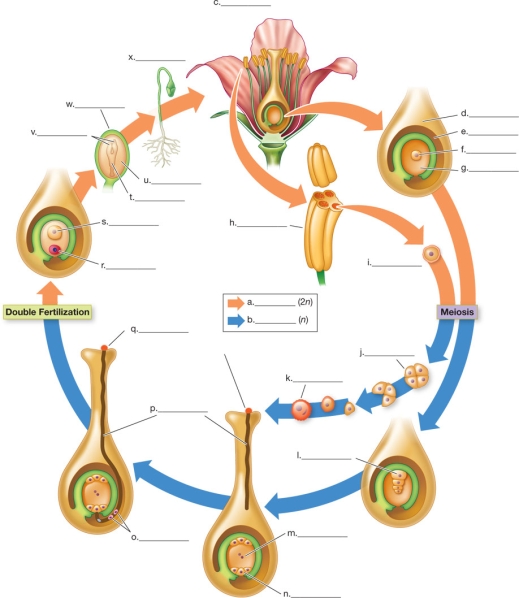 In the angiosperm life cycle shown, label the processes in the boxes, indicate the haploid and diploid generations, and label all of the structures indicated.
 (Short Answer)
4.7/5 (77)
(77) A newly discovered gymnosperm with palm- or fernlike leaves would most likely be a
(Multiple Choice)
4.9/5 (85)
(85) The most primitive living genus of flowering plants known today
(Multiple Choice)
4.8/5 (78)
(78) The vasculature of angiosperms contains more derived cell types, for instance, vessel elements, fibers, and companion cells.Has this specialization resulted in greater success in angiosperms compared with gymnosperms? Justify your answer.
(Essay)
4.9/5 (89)
(89) 
Filters
- Essay(0)
- Multiple Choice(0)
- Short Answer(0)
- True False(0)
- Matching(0)