



 Chat with AI
Exam 28: The Evolution of Seed Plants

Exam 1: Studying Life246 Questions
Exam 2: Small Molecules and the Chemistry of Life246 Questions
Exam 3: Proteins, Carbohydrates, and Lipids246 Questions
Exam 4: Nucleic Acids and the Origin of Life246 Questions
Exam 5: Cells: the Working Units of Life248 Questions
Exam 6: Cell Membranes246 Questions
Exam 7: Cell Communication and Multicellularity246 Questions
Exam 8: Energy, Enzymes, and Metabolism246 Questions
Exam 9: Pathways That Harvest Chemical Energy246 Questions
Exam 10: Photosynthesis: Energy From Sunlight242 Questions
Exam 11: The Cell Cycle and Cell Division260 Questions
Exam 12: Inheritance, Genes, and Chromosomes250 Questions
Exam 13: Dna and Its Role in Heredity257 Questions
Exam 14: From Dna to Protein: Gene Expression252 Questions
Exam 15: Gene Mutation and Molecular Medicine251 Questions
Exam 16: Regulation of Gene Expression245 Questions
Exam 17: Genomes249 Questions
Exam 18: Recombinant Dna and Biotechnology243 Questions
Exam 20: Mechanisms of Evolution243 Questions
Exam 21: Reconstructing and Using Phylogenies246 Questions
Exam 22: Speciation247 Questions
Exam 23: Evolution of Genes and Genomes252 Questions
Exam 24: The History of Life on Earth246 Questions
Exam 25: Bacteria, Archaea, and Viruses262 Questions
Exam 26: The Origin and Diversification of Eukaryotes252 Questions
Exam 27: Plants Without Seeds: From Water to Land251 Questions
Exam 28: The Evolution of Seed Plants259 Questions
Exam 29: The Evolution and Diversity of Fungi261 Questions
Exam 30: Animal Origins and the Evolution of Body Plans248 Questions
Exam 31: Protostome Animals244 Questions
Exam 32: Deuterostome Animals246 Questions
Exam 33: The Plant Body243 Questions
Exam 34: Transport in Plants248 Questions
Exam 35: Plant Nutrition247 Questions
Exam 36: Regulation of Plant Growth246 Questions
Exam 37: Reproduction in Flowering Plants247 Questions
Exam 38: Plant Responses to Environmental Challenges246 Questions
Exam 39: Physiology, Homeostasis, and Temperature Regulation258 Questions
Exam 40: Animal Hormones249 Questions
Exam 41: Immunology: Animal Defense Systems265 Questions
Exam 42: Animal Reproduction261 Questions
Exam 43: Animal Development261 Questions
Exam 44: Neurons, Glia, and Nervous Systems250 Questions
Exam 45: Sensory Systems249 Questions
Exam 46: The Mammalian Nervous System: Structure and Higher Functions254 Questions
Exam 47: Musculoskeletal Systems259 Questions
Exam 48: Gas Exchange247 Questions
Exam 49: Circulatory Systems252 Questions
Exam 50: Nutrition, Digestion, and Absorption259 Questions
Exam 51: Salt and Water Balance and Nitrogen Excretion251 Questions
Exam 52: Animal Behavior249 Questions
Exam 53: The Physical Environment and Biogeography of Life248 Questions
Exam 54: Populations259 Questions
Exam 55: Species Interactions254 Questions
Exam 56: Communities247 Questions
Exam 57: Ecosystems238 Questions
Exam 58: A Changing Biosphere222 Questions
Select questions type


Refer to the figure. 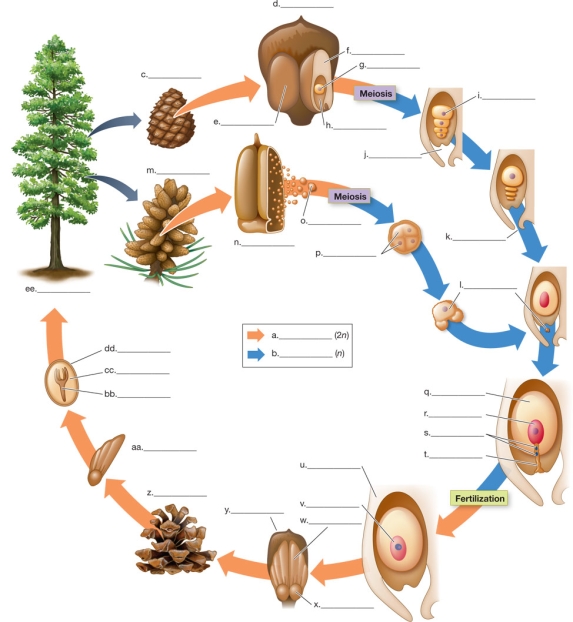 Label the processes in the life cycle of a pine.In the boxes; indicate the haploid, diploid, sporophyte, and gametophyte generations; and label all of the structures indicated.
 (Short Answer)
4.9/5  (83)
(83) All living _______ and many angiosperms show secondary growth.
(Short Answer)
4.9/5 (77)
(77) A student is working with a flowering plant in which nectar is deeply placed in the flowers.When the student discovers the natural pollinator of this plant, it is most likely to have
(Multiple Choice)
4.7/5 (71)
(71) Which characteristic is not a synapomorphy of the angiosperms?
(Multiple Choice)
4.8/5 (62)
(62) An adaptation of the lodgepole pine is that their cones open only after treatment with _______.
(Short Answer)
4.8/5 (71)
(71) You encounter a bush with what looks like bright red berries.Upon closer inspection you notice that the fleshy tissue is an extension of the seed, a structure called a(n) _______, and the bush likely belongs to the conifer group of gymnosperms.
(Short Answer)
4.9/5 (78)
(78) Coniferous gymnosperms, such as pines, depend primarily on _______ for pollination; thus, the plants produce large quantities of pollen that disperse over large areas during the spring.
(Multiple Choice)
4.8/5 (82)
(82) Which of the following is not a danger of relying on only a few domesticated plant species for our food supply?
(Multiple Choice)
5.0/5 (73)
(73) Flower markings that are visible under ultraviolet light and help pollinators locate rewards provided by the flowers are called
(Multiple Choice)
4.9/5 (70)
(70) Magnolia flowers differ from orchid flowers in that magnolia flowers
(Multiple Choice)
4.8/5 (84)
(84) The primary reason that angiosperms are so prevalent on Earth today is that
(Multiple Choice)
4.7/5 (72)
(72) In open agricultural areas, rows of trees or shrubs are often planted to act as windbreaks.The roots of these plants reduce _______ by anchoring the soil and preventing wind or water from washing it away.
(Short Answer)
4.9/5 (81)
(81) Certain features of some angiosperm seeds give them a better chance of dispersal in variable environments.These features include all of the following except
(Multiple Choice)
4.7/5 (80)
(80) Refer to the figure. 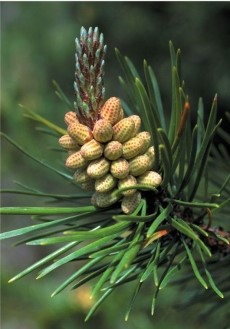 The clusters of structures shown in the figure are
 (Multiple Choice)
4.8/5 (68)
(68) Which seed plant group always has separate male and female plants?
(Multiple Choice)
4.8/5 (86)
(86) A newly-discovered seed plant in which the sequence of reproductive structures is sepal, petal, stamen, carpel is a
(Multiple Choice)
4.7/5 (74)
(74) A scientist discovers a fossil branch having typical conifer leaves and a fruit.What is unusual about this?
(Multiple Choice)
4.9/5 (80)
(80) 
Filters
- Essay(0)
- Multiple Choice(0)
- Short Answer(0)
- True False(0)
- Matching(0)