



 Chat with AI
Exam 45: Sensory Systems

Exam 1: Studying Life246 Questions
Exam 2: Small Molecules and the Chemistry of Life246 Questions
Exam 3: Proteins, Carbohydrates, and Lipids246 Questions
Exam 4: Nucleic Acids and the Origin of Life246 Questions
Exam 5: Cells: the Working Units of Life248 Questions
Exam 6: Cell Membranes246 Questions
Exam 7: Cell Communication and Multicellularity246 Questions
Exam 8: Energy, Enzymes, and Metabolism246 Questions
Exam 9: Pathways That Harvest Chemical Energy246 Questions
Exam 10: Photosynthesis: Energy From Sunlight242 Questions
Exam 11: The Cell Cycle and Cell Division260 Questions
Exam 12: Inheritance, Genes, and Chromosomes250 Questions
Exam 13: Dna and Its Role in Heredity257 Questions
Exam 14: From Dna to Protein: Gene Expression252 Questions
Exam 15: Gene Mutation and Molecular Medicine251 Questions
Exam 16: Regulation of Gene Expression245 Questions
Exam 17: Genomes249 Questions
Exam 18: Recombinant Dna and Biotechnology243 Questions
Exam 20: Mechanisms of Evolution243 Questions
Exam 21: Reconstructing and Using Phylogenies246 Questions
Exam 22: Speciation247 Questions
Exam 23: Evolution of Genes and Genomes252 Questions
Exam 24: The History of Life on Earth246 Questions
Exam 25: Bacteria, Archaea, and Viruses262 Questions
Exam 26: The Origin and Diversification of Eukaryotes252 Questions
Exam 27: Plants Without Seeds: From Water to Land251 Questions
Exam 28: The Evolution of Seed Plants259 Questions
Exam 29: The Evolution and Diversity of Fungi261 Questions
Exam 30: Animal Origins and the Evolution of Body Plans248 Questions
Exam 31: Protostome Animals244 Questions
Exam 32: Deuterostome Animals246 Questions
Exam 33: The Plant Body243 Questions
Exam 34: Transport in Plants248 Questions
Exam 35: Plant Nutrition247 Questions
Exam 36: Regulation of Plant Growth246 Questions
Exam 37: Reproduction in Flowering Plants247 Questions
Exam 38: Plant Responses to Environmental Challenges246 Questions
Exam 39: Physiology, Homeostasis, and Temperature Regulation258 Questions
Exam 40: Animal Hormones249 Questions
Exam 41: Immunology: Animal Defense Systems265 Questions
Exam 42: Animal Reproduction261 Questions
Exam 43: Animal Development261 Questions
Exam 44: Neurons, Glia, and Nervous Systems250 Questions
Exam 45: Sensory Systems249 Questions
Exam 46: The Mammalian Nervous System: Structure and Higher Functions254 Questions
Exam 47: Musculoskeletal Systems259 Questions
Exam 48: Gas Exchange247 Questions
Exam 49: Circulatory Systems252 Questions
Exam 50: Nutrition, Digestion, and Absorption259 Questions
Exam 51: Salt and Water Balance and Nitrogen Excretion251 Questions
Exam 52: Animal Behavior249 Questions
Exam 53: The Physical Environment and Biogeography of Life248 Questions
Exam 54: Populations259 Questions
Exam 55: Species Interactions254 Questions
Exam 56: Communities247 Questions
Exam 57: Ecosystems238 Questions
Exam 58: A Changing Biosphere222 Questions
Select questions type


All sensory systems process information as action potentials, so how are different stimuli recognized as different sensations?
(Multiple Choice)
4.9/5  (70)
(70) As you pull your socks on in the morning, you are aware of the sensation of material touching your skin, but you don't focus on that sensation throughout the day.What is the functional significance of this phenomenon, known as sensory adaptation?
(Short Answer)
4.9/5 (85)
(85) Disruption of G proteins and second messengers would affect _______ and photoreceptors.
(Short Answer)
5.0/5 (71)
(71) In response to bending when the basilar membrane moves, membranes of hair cells
(Multiple Choice)
5.0/5 (76)
(76) In studying the histology of olfactory receptors, you trace several olfactory receptor neurons whose axons terminate in the same glomerulus.A reasonable assumption about these neurons is that they
(Multiple Choice)
4.9/5 (91)
(91) In mammals, the semicircular ducts of the vestibular system participate in responses to changes in position and movement of the head.Which of the following statements about the semicircular ducts is true?
(Multiple Choice)
4.9/5 (80)
(80) Mechanoreceptors and thermoreceptors have transmembrane proteins that are also _______ channels.
(Short Answer)
4.8/5 (78)
(78) You enjoy the smell of fresh bread coming from a bakery as you pass by.What occurs first to eventually allow you to smell the bread?
(Multiple Choice)
4.8/5 (85)
(85) You have a friend who likes to listen to loud music.Which of the following is true about his risks for hearing loss?
(Multiple Choice)
4.8/5 (72)
(72) Female silkworm moths release the pheromone bombykol to attract males.When measuring the rate of firing in the sensory nerves of a male silkworm moth, you discover that the rate is very high.What does this high firing rate tell you about the concentration of bombykol in the air and distance to the female moth?
(Essay)
4.7/5 (84)
(84) Which cell type receives neurotransmitter released from rods and cones?
(Multiple Choice)
4.8/5 (83)
(83) Damage to the accessory olfactory bulb of a mouse would mean that information from the _______ could not be integrated.
(Short Answer)
4.8/5 (82)
(82) Refer to the graph. 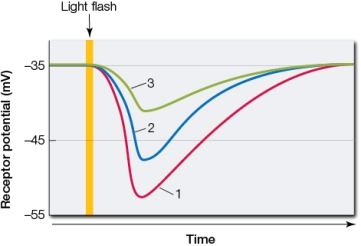 The graph shows the response of rod cells to flashes of light as individual traces.Evaluate the following statement with respect to accuracy: The membrane potential depicted in trace 3 shows the response of rod cells to dim light.
 (Essay)
4.8/5 (74)
(74) Sensory receptor cells transduce specific physical or chemical stimuli
(Multiple Choice)
4.9/5 (77)
(77) In mammals, the shape of the lens in the eye is altered by contraction of the _______.
(Short Answer)
4.9/5 (90)
(90) Which of the following does not characterize the pheromone bombykol, which is emitted by female silkworm moths?
(Multiple Choice)
4.7/5 (82)
(82) 
Filters
- Essay(0)
- Multiple Choice(0)
- Short Answer(0)
- True False(0)
- Matching(0)