



 Chat with AI
Exam 45: Sensory Systems

Exam 1: Studying Life246 Questions
Exam 2: Small Molecules and the Chemistry of Life246 Questions
Exam 3: Proteins, Carbohydrates, and Lipids246 Questions
Exam 4: Nucleic Acids and the Origin of Life246 Questions
Exam 5: Cells: the Working Units of Life248 Questions
Exam 6: Cell Membranes246 Questions
Exam 7: Cell Communication and Multicellularity246 Questions
Exam 8: Energy, Enzymes, and Metabolism246 Questions
Exam 9: Pathways That Harvest Chemical Energy246 Questions
Exam 10: Photosynthesis: Energy From Sunlight242 Questions
Exam 11: The Cell Cycle and Cell Division260 Questions
Exam 12: Inheritance, Genes, and Chromosomes250 Questions
Exam 13: Dna and Its Role in Heredity257 Questions
Exam 14: From Dna to Protein: Gene Expression252 Questions
Exam 15: Gene Mutation and Molecular Medicine251 Questions
Exam 16: Regulation of Gene Expression245 Questions
Exam 17: Genomes249 Questions
Exam 18: Recombinant Dna and Biotechnology243 Questions
Exam 20: Mechanisms of Evolution243 Questions
Exam 21: Reconstructing and Using Phylogenies246 Questions
Exam 22: Speciation247 Questions
Exam 23: Evolution of Genes and Genomes252 Questions
Exam 24: The History of Life on Earth246 Questions
Exam 25: Bacteria, Archaea, and Viruses262 Questions
Exam 26: The Origin and Diversification of Eukaryotes252 Questions
Exam 27: Plants Without Seeds: From Water to Land251 Questions
Exam 28: The Evolution of Seed Plants259 Questions
Exam 29: The Evolution and Diversity of Fungi261 Questions
Exam 30: Animal Origins and the Evolution of Body Plans248 Questions
Exam 31: Protostome Animals244 Questions
Exam 32: Deuterostome Animals246 Questions
Exam 33: The Plant Body243 Questions
Exam 34: Transport in Plants248 Questions
Exam 35: Plant Nutrition247 Questions
Exam 36: Regulation of Plant Growth246 Questions
Exam 37: Reproduction in Flowering Plants247 Questions
Exam 38: Plant Responses to Environmental Challenges246 Questions
Exam 39: Physiology, Homeostasis, and Temperature Regulation258 Questions
Exam 40: Animal Hormones249 Questions
Exam 41: Immunology: Animal Defense Systems265 Questions
Exam 42: Animal Reproduction261 Questions
Exam 43: Animal Development261 Questions
Exam 44: Neurons, Glia, and Nervous Systems250 Questions
Exam 45: Sensory Systems249 Questions
Exam 46: The Mammalian Nervous System: Structure and Higher Functions254 Questions
Exam 47: Musculoskeletal Systems259 Questions
Exam 48: Gas Exchange247 Questions
Exam 49: Circulatory Systems252 Questions
Exam 50: Nutrition, Digestion, and Absorption259 Questions
Exam 51: Salt and Water Balance and Nitrogen Excretion251 Questions
Exam 52: Animal Behavior249 Questions
Exam 53: The Physical Environment and Biogeography of Life248 Questions
Exam 54: Populations259 Questions
Exam 55: Species Interactions254 Questions
Exam 56: Communities247 Questions
Exam 57: Ecosystems238 Questions
Exam 58: A Changing Biosphere222 Questions
Select questions type


As a male silkworm moth nears a female that is releasing pheromone,
(Multiple Choice)
4.9/5  (80)
(80) Refer to the figure. 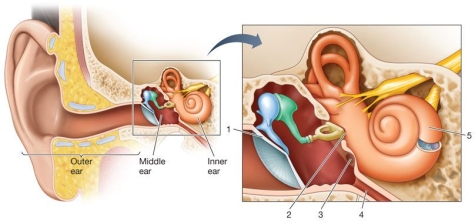 Identify the structures labeled 1, 2, 3, 4, and 5 in the figure, starting with 1 and ending with 5.
 (Multiple Choice)
4.9/5 (81)
(81) In a taste bud sensory cell, molecules bind to receptors on microvilli, which causes the release of neurotransmitter onto _______, which carry information to the central nervous system.
(Short Answer)
4.9/5 (84)
(84) Glaucoma, often caused by increased pressure within the eye, damages the optic nerve and results in loss of vision.The cells damaged in glaucoma are _______ cells.
(Short Answer)
4.7/5 (82)
(82) _______ arriving in the visual cortex of the brain are interpreted as light; in the auditory cortex, as sound; and in the olfactory cortex, as smell.
(Short Answer)
4.9/5 (95)
(95) Just before their transmission to the brain via the optic nerve, visual signals are processed by _______.
(Short Answer)
4.8/5 (89)
(89) In a sensory receptor cell that does not fire action potentials, the intensity of the stimulus influences
(Multiple Choice)
4.9/5 (71)
(71) In the retina of the vertebrate eye, the direct flow of information is from photoreceptor to _______ to ganglion cell
(Short Answer)
4.7/5 (89)
(89) Which statement about the differences between rods and cones is true?
(Multiple Choice)
4.9/5 (89)
(89) Fishes have a lateral line system consisting of canals under the surface of the skin.These canals contain sensory structures consisting of hair cells capped by a cupula.These structures look similar to those found in our semicircular ducts.When a fish swims, a stream of water flows through the lateral line canals.The most likely function of the lateral line sensory system is to sense
(Multiple Choice)
4.8/5 (89)
(89) _______ cells and amacrine cells are interneurons that communicate laterally across the retina.
(Short Answer)
4.8/5 (77)
(77) An ice cube placed on your hand will cause some cells to fire action potentials more frequently and other cells to reduce the number fired.What explains the different responses?
(Multiple Choice)
4.9/5 (91)
(91) Evaluate the following statement with respect to accuracy: A ganglion cell in the fovea receives input from many more photoreceptors than does a ganglion cell in the periphery of the retina.
(Essay)
4.9/5 (63)
(63) Hair cells are not associated with which of the following structures?
(Multiple Choice)
4.8/5 (74)
(74) Which statement about photoreceptors of the human retina is false?
(Multiple Choice)
4.8/5 (85)
(85) The particular sensations we perceive are determined by the
(Multiple Choice)
4.8/5 (68)
(68) 
Filters
- Essay(0)
- Multiple Choice(0)
- Short Answer(0)
- True False(0)
- Matching(0)