



 Chat with AI
Exam 42: Animal Reproduction

Exam 1: Studying Life246 Questions
Exam 2: Small Molecules and the Chemistry of Life246 Questions
Exam 3: Proteins, Carbohydrates, and Lipids246 Questions
Exam 4: Nucleic Acids and the Origin of Life246 Questions
Exam 5: Cells: the Working Units of Life248 Questions
Exam 6: Cell Membranes246 Questions
Exam 7: Cell Communication and Multicellularity246 Questions
Exam 8: Energy, Enzymes, and Metabolism246 Questions
Exam 9: Pathways That Harvest Chemical Energy246 Questions
Exam 10: Photosynthesis: Energy From Sunlight242 Questions
Exam 11: The Cell Cycle and Cell Division260 Questions
Exam 12: Inheritance, Genes, and Chromosomes250 Questions
Exam 13: Dna and Its Role in Heredity257 Questions
Exam 14: From Dna to Protein: Gene Expression252 Questions
Exam 15: Gene Mutation and Molecular Medicine251 Questions
Exam 16: Regulation of Gene Expression245 Questions
Exam 17: Genomes249 Questions
Exam 18: Recombinant Dna and Biotechnology243 Questions
Exam 20: Mechanisms of Evolution243 Questions
Exam 21: Reconstructing and Using Phylogenies246 Questions
Exam 22: Speciation247 Questions
Exam 23: Evolution of Genes and Genomes252 Questions
Exam 24: The History of Life on Earth246 Questions
Exam 25: Bacteria, Archaea, and Viruses262 Questions
Exam 26: The Origin and Diversification of Eukaryotes252 Questions
Exam 27: Plants Without Seeds: From Water to Land251 Questions
Exam 28: The Evolution of Seed Plants259 Questions
Exam 29: The Evolution and Diversity of Fungi261 Questions
Exam 30: Animal Origins and the Evolution of Body Plans248 Questions
Exam 31: Protostome Animals244 Questions
Exam 32: Deuterostome Animals246 Questions
Exam 33: The Plant Body243 Questions
Exam 34: Transport in Plants248 Questions
Exam 35: Plant Nutrition247 Questions
Exam 36: Regulation of Plant Growth246 Questions
Exam 37: Reproduction in Flowering Plants247 Questions
Exam 38: Plant Responses to Environmental Challenges246 Questions
Exam 39: Physiology, Homeostasis, and Temperature Regulation258 Questions
Exam 40: Animal Hormones249 Questions
Exam 41: Immunology: Animal Defense Systems265 Questions
Exam 42: Animal Reproduction261 Questions
Exam 43: Animal Development261 Questions
Exam 44: Neurons, Glia, and Nervous Systems250 Questions
Exam 45: Sensory Systems249 Questions
Exam 46: The Mammalian Nervous System: Structure and Higher Functions254 Questions
Exam 47: Musculoskeletal Systems259 Questions
Exam 48: Gas Exchange247 Questions
Exam 49: Circulatory Systems252 Questions
Exam 50: Nutrition, Digestion, and Absorption259 Questions
Exam 51: Salt and Water Balance and Nitrogen Excretion251 Questions
Exam 52: Animal Behavior249 Questions
Exam 53: The Physical Environment and Biogeography of Life248 Questions
Exam 54: Populations259 Questions
Exam 55: Species Interactions254 Questions
Exam 56: Communities247 Questions
Exam 57: Ecosystems238 Questions
Exam 58: A Changing Biosphere222 Questions
Select questions type


In most ant colonies, females are diploid, but males are haploid and develop from unfertilized eggs.This mode of asexual reproduction is more advantageous than regeneration when
(Multiple Choice)
4.8/5  (97)
(97) Which feature characterizes secretions of the prostate gland?
(Multiple Choice)
4.8/5 (82)
(82) In which animals is external fertilization relatively common?
(Multiple Choice)
4.8/5 (79)
(79) Birth control pills containing synthetic estrogen and progesterone inhibit the ovarian cycle.A similar situation occurs during pregnancy, when levels of estrogen and progesterone are high.During pregnancy, progesterone is produced first by the _______ and then by the _______.
(Multiple Choice)
4.9/5 (90)
(90) Refer to the figure showing a sea urchin sperm and egg. 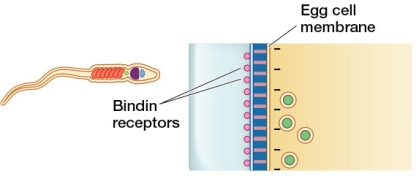 Suppose the sperm is from a different species than the egg.Will the sperm be attracted to the egg, and what will happen if it contacts the jelly of the egg? Explain your answer.
 (Essay)
4.8/5 (77)
(77) Suppose three female sharks are housed without males in a large tank for many years.One morning the caretakers find a single pup swimming with one of the females.They test the pup's DNA and find that it is the same as that of the adult female.The pup likely resulted from
(Multiple Choice)
5.0/5 (85)
(85) Refer to the figure showing the male reproductive tract. 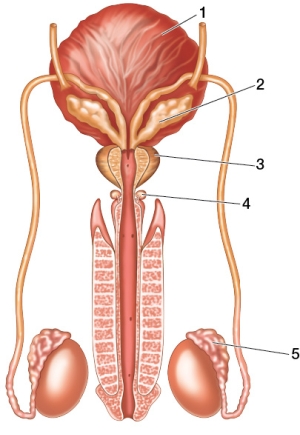 A man who is having trouble conceiving a child consults a fertility clinic and is told that he has prostatitis.It is a low-grade infection, but it appears to be causing less alkaline semen and is likely the cause of his infertility.The physician points to the structure(s) labeled _______ to indicate where the infection is located.
 (Multiple Choice)
4.9/5 (90)
(90) In honeybees, males are produced from unfertilized eggs and are haploid.This mode of asexual reproduction has advantages over budding or regeneration because
(Multiple Choice)
4.7/5 (82)
(82) An infertile couple has come into a clinic to determine what form of assisted reproductive technique would be the best for them to try.The physician examining them determines that the woman has functional ovaries and her oviducts are not blocked.The man's sperm count, however, is low.The physician explains that under these circumstances, the simplest procedure to try is _______, which will allow the sperm a shorter trip to get to an ovulated egg.
(Short Answer)
4.7/5 (64)
(64) The ovaries produce estrogen and progesterone.How might removal of the ovaries influence sexual behavior of female parthenogenetic whiptail lizards? What would you predict about their behavior if you then gave these females injections of either estrogen or progesterone?
(Essay)
4.9/5 (91)
(91) Tay-Sachs disease is an autosomal recessive genetic disorder that causes deterioration of nerves during the early months of life and usually death by the age of 4 years.A man and woman who are both carriers of the Tay-Sachs allele want to have a child that is unaffected by the disease.To assure this outcome, their best approach would be to use _______ combined with genetic analysis of the embryos, which are two assisted reproductive technologies available in medical clinics.
(Short Answer)
4.8/5 (67)
(67) Refer to the figure showing male reproductive hormones. 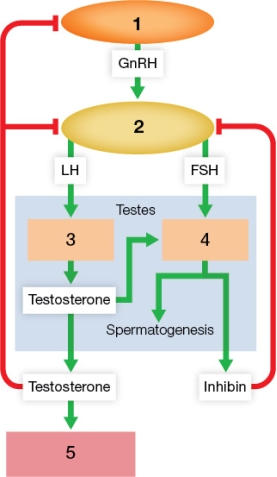 In analyzing a 16-year old male patient with delayed puberty, it is found that the patient has low levels of serum LH, FSH and testosterone.Based on the figure, it is likely that the source of the problem is
 (Multiple Choice)
5.0/5 (65)
(65) 
Filters
- Essay(0)
- Multiple Choice(0)
- Short Answer(0)
- True False(0)
- Matching(0)