



 Chat with AI
Exam 42: Animal Reproduction

Exam 1: Studying Life246 Questions
Exam 2: Small Molecules and the Chemistry of Life246 Questions
Exam 3: Proteins, Carbohydrates, and Lipids246 Questions
Exam 4: Nucleic Acids and the Origin of Life246 Questions
Exam 5: Cells: the Working Units of Life248 Questions
Exam 6: Cell Membranes246 Questions
Exam 7: Cell Communication and Multicellularity246 Questions
Exam 8: Energy, Enzymes, and Metabolism246 Questions
Exam 9: Pathways That Harvest Chemical Energy246 Questions
Exam 10: Photosynthesis: Energy From Sunlight242 Questions
Exam 11: The Cell Cycle and Cell Division260 Questions
Exam 12: Inheritance, Genes, and Chromosomes250 Questions
Exam 13: Dna and Its Role in Heredity257 Questions
Exam 14: From Dna to Protein: Gene Expression252 Questions
Exam 15: Gene Mutation and Molecular Medicine251 Questions
Exam 16: Regulation of Gene Expression245 Questions
Exam 17: Genomes249 Questions
Exam 18: Recombinant Dna and Biotechnology243 Questions
Exam 20: Mechanisms of Evolution243 Questions
Exam 21: Reconstructing and Using Phylogenies246 Questions
Exam 22: Speciation247 Questions
Exam 23: Evolution of Genes and Genomes252 Questions
Exam 24: The History of Life on Earth246 Questions
Exam 25: Bacteria, Archaea, and Viruses262 Questions
Exam 26: The Origin and Diversification of Eukaryotes252 Questions
Exam 27: Plants Without Seeds: From Water to Land251 Questions
Exam 28: The Evolution of Seed Plants259 Questions
Exam 29: The Evolution and Diversity of Fungi261 Questions
Exam 30: Animal Origins and the Evolution of Body Plans248 Questions
Exam 31: Protostome Animals244 Questions
Exam 32: Deuterostome Animals246 Questions
Exam 33: The Plant Body243 Questions
Exam 34: Transport in Plants248 Questions
Exam 35: Plant Nutrition247 Questions
Exam 36: Regulation of Plant Growth246 Questions
Exam 37: Reproduction in Flowering Plants247 Questions
Exam 38: Plant Responses to Environmental Challenges246 Questions
Exam 39: Physiology, Homeostasis, and Temperature Regulation258 Questions
Exam 40: Animal Hormones249 Questions
Exam 41: Immunology: Animal Defense Systems265 Questions
Exam 42: Animal Reproduction261 Questions
Exam 43: Animal Development261 Questions
Exam 44: Neurons, Glia, and Nervous Systems250 Questions
Exam 45: Sensory Systems249 Questions
Exam 46: The Mammalian Nervous System: Structure and Higher Functions254 Questions
Exam 47: Musculoskeletal Systems259 Questions
Exam 48: Gas Exchange247 Questions
Exam 49: Circulatory Systems252 Questions
Exam 50: Nutrition, Digestion, and Absorption259 Questions
Exam 51: Salt and Water Balance and Nitrogen Excretion251 Questions
Exam 52: Animal Behavior249 Questions
Exam 53: The Physical Environment and Biogeography of Life248 Questions
Exam 54: Populations259 Questions
Exam 55: Species Interactions254 Questions
Exam 56: Communities247 Questions
Exam 57: Ecosystems238 Questions
Exam 58: A Changing Biosphere222 Questions
Select questions type


In mammals, the rise in cytosolic calcium caused by sperm entry into the egg
(Multiple Choice)
4.9/5  (89)
(89) An intrauterine device is a means of birth control that prevents
(Multiple Choice)
4.9/5 (93)
(93) In some female mammals, the corpus luteum does not degenerate completely, but turns into a small spot of scar tissue.If researchers were to count these scar tissue spots, they would be able to determine a female's total number of
(Multiple Choice)
4.8/5 (85)
(85) If you examined histological sections of adult human gonads under the microscope, you would conclude that
(Multiple Choice)
4.8/5 (85)
(85) Of the contraceptive methods listed, which has a success rate greater than 95 percent?
(Multiple Choice)
4.8/5 (79)
(79) Choose the correct pairing between organ(s) and classification.
(Multiple Choice)
4.8/5 (86)
(86) Which statement characterizes the slow block to polyspermy in sea urchins?
(Multiple Choice)
4.9/5 (72)
(72) In a mammalian ovary, a _______ consists of one primary oocyte surrounded by ovarian cells.
(Short Answer)
4.9/5 (76)
(76) Which event occurs during the process of fertilization in sea urchins?
(Multiple Choice)
4.7/5 (82)
(82) You observe two species of amphibians mating in a stream.Species A is engaging in external fertilization and species B is engaging in internal fertilization.In which species would recognition molecules on gametes be more critical?
(Multiple Choice)
4.9/5 (83)
(83) Which event occurs before all the others, leading to the delivery of a human baby?
(Multiple Choice)
4.9/5 (87)
(87) When a female Komodo dragon in the London Zoo laid a clutch of eggs after many years in captivity, caretakers were surprised.Even more surprising was that some of the eggs produced baby dragons.Researchers verified that there had been no males around, and the babies were diploid.What is a likely explanation for how this Komodo dragon was able to create a viable embryo?
(Multiple Choice)
4.8/5 (80)
(80) Ovaries produce estrogen and progesterone.Removal of the ovaries in the parthenogenetic whiptail lizard Cnemidophorus uniparens would result in
(Multiple Choice)
4.9/5 (74)
(74) In mammals, the egg is propelled through the oviduct by means of
(Multiple Choice)
4.8/5 (89)
(89) Which product of oogenesis acquires the energy, raw materials, and RNA needed for the first cell divisions after fertilization?
(Multiple Choice)
4.7/5 (91)
(91) At birth, a female has about one million primary oocytes in each ovary.During a woman's fertile years, about _______ of these oocytes will mature and be released at ovulation.
(Multiple Choice)
4.9/5 (75)
(75) Refer to the figure showing the male reproductive tract. 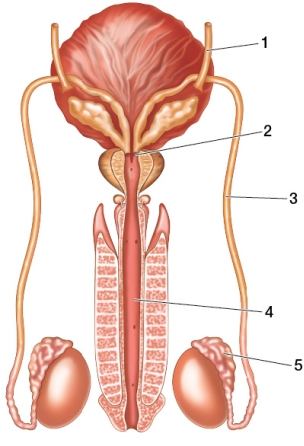 If a man elects to have a vasectomy as a form of contraception, which duct(s) will be cut and tied off in the procedure?
 (Multiple Choice)
4.8/5 (80)
(80) A woman has learned that her fetus has a major birth defect that will lead to death shortly after birth.Medical termination of her pregnancy is called
(Multiple Choice)
4.7/5 (71)
(71) 
Filters
- Essay(0)
- Multiple Choice(0)
- Short Answer(0)
- True False(0)
- Matching(0)