



 Chat with AI
Exam 42: Animal Reproduction

Exam 1: Studying Life246 Questions
Exam 2: Small Molecules and the Chemistry of Life246 Questions
Exam 3: Proteins, Carbohydrates, and Lipids246 Questions
Exam 4: Nucleic Acids and the Origin of Life246 Questions
Exam 5: Cells: the Working Units of Life248 Questions
Exam 6: Cell Membranes246 Questions
Exam 7: Cell Communication and Multicellularity246 Questions
Exam 8: Energy, Enzymes, and Metabolism246 Questions
Exam 9: Pathways That Harvest Chemical Energy246 Questions
Exam 10: Photosynthesis: Energy From Sunlight242 Questions
Exam 11: The Cell Cycle and Cell Division260 Questions
Exam 12: Inheritance, Genes, and Chromosomes250 Questions
Exam 13: Dna and Its Role in Heredity257 Questions
Exam 14: From Dna to Protein: Gene Expression252 Questions
Exam 15: Gene Mutation and Molecular Medicine251 Questions
Exam 16: Regulation of Gene Expression245 Questions
Exam 17: Genomes249 Questions
Exam 18: Recombinant Dna and Biotechnology243 Questions
Exam 20: Mechanisms of Evolution243 Questions
Exam 21: Reconstructing and Using Phylogenies246 Questions
Exam 22: Speciation247 Questions
Exam 23: Evolution of Genes and Genomes252 Questions
Exam 24: The History of Life on Earth246 Questions
Exam 25: Bacteria, Archaea, and Viruses262 Questions
Exam 26: The Origin and Diversification of Eukaryotes252 Questions
Exam 27: Plants Without Seeds: From Water to Land251 Questions
Exam 28: The Evolution of Seed Plants259 Questions
Exam 29: The Evolution and Diversity of Fungi261 Questions
Exam 30: Animal Origins and the Evolution of Body Plans248 Questions
Exam 31: Protostome Animals244 Questions
Exam 32: Deuterostome Animals246 Questions
Exam 33: The Plant Body243 Questions
Exam 34: Transport in Plants248 Questions
Exam 35: Plant Nutrition247 Questions
Exam 36: Regulation of Plant Growth246 Questions
Exam 37: Reproduction in Flowering Plants247 Questions
Exam 38: Plant Responses to Environmental Challenges246 Questions
Exam 39: Physiology, Homeostasis, and Temperature Regulation258 Questions
Exam 40: Animal Hormones249 Questions
Exam 41: Immunology: Animal Defense Systems265 Questions
Exam 42: Animal Reproduction261 Questions
Exam 43: Animal Development261 Questions
Exam 44: Neurons, Glia, and Nervous Systems250 Questions
Exam 45: Sensory Systems249 Questions
Exam 46: The Mammalian Nervous System: Structure and Higher Functions254 Questions
Exam 47: Musculoskeletal Systems259 Questions
Exam 48: Gas Exchange247 Questions
Exam 49: Circulatory Systems252 Questions
Exam 50: Nutrition, Digestion, and Absorption259 Questions
Exam 51: Salt and Water Balance and Nitrogen Excretion251 Questions
Exam 52: Animal Behavior249 Questions
Exam 53: The Physical Environment and Biogeography of Life248 Questions
Exam 54: Populations259 Questions
Exam 55: Species Interactions254 Questions
Exam 56: Communities247 Questions
Exam 57: Ecosystems238 Questions
Exam 58: A Changing Biosphere222 Questions
Select questions type


_______ involves a physician placing sperm in the female reproductive tract.
(Short Answer)
4.9/5  (92)
(92) Some animals can reproduce both sexually and asexually.Why might these animals switch between sexual and asexual reproduction?
(Essay)
4.9/5 (84)
(84) The contragestational pill Mifepristone (RU-486) blocks _______ receptors.
(Multiple Choice)
4.9/5 (56)
(56) You are a physician, and one of your male patients is considering a vasectomy.He is concerned, however, with the possibility of decreased testosterone production and its effects on sexual function.What should you tell your patient?
(Essay)
4.9/5 (80)
(80) Refer to the figure showing the human female reproductive tract. 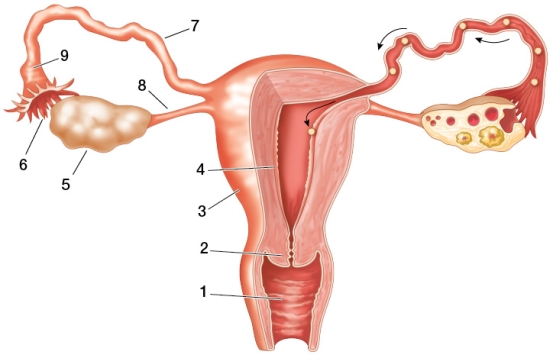 Using the figure, trace the path of a sperm to the point at which it can fertilize an egg.Indicate both the number and name of each structure it passes through on its journey.
 (Short Answer)
4.8/5 (68)
(68) Researchers wishing to perform experiments on organisms that are as genetically similar as possible would use offspring from an organism that reproduces _______.
(Short Answer)
4.9/5 (72)
(72) If a couple combines both male and female barrier methods of contraception, such as a condom for males and a diaphragm (or cervical cap) combined with _______ for females, the couple will significantly reduce their failure rate over any of these three methods used alone, and also protect against sexually transmitted diseases.
(Short Answer)
4.8/5 (81)
(81) Refer to the graph showing changes in three female reproductive hormones during pregnancy. 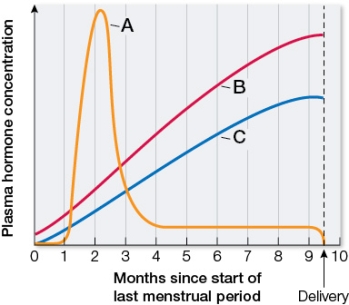 Based on the graph, which statement is true?
 (Multiple Choice)
4.9/5 (91)
(91) A woman who is still lactating and nursing her 9-month old child finds out that she is once again pregnant, which is unusual because lactation normally delays the ovarian and menstrual cycles.In this woman's situation, the release of prolactin stimulated by the infant suckling was sufficient to cause the release of milk but was not sufficient to inhibit the release of _______ from the mother's hypothalamus.
(Short Answer)
4.7/5 (79)
(79) Which cells result from the second meiotic division of spermatogenesis?
(Multiple Choice)
4.9/5 (85)
(85) Refer to the figure showing the marine worm Bonellia viridis. 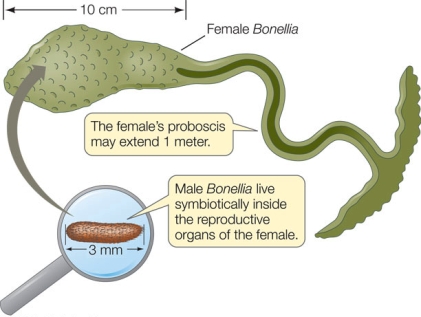 Females of this marine worm release fertilized eggs into the water.The eggs hatch into larvae that swim and then settle on a substrate.If the larvae land on sand, they burrow in and develop into females with large bodies and a proboscis that extends into the water above to collect food.If a larva lands on a female proboscis, it burrows into the female body and becomes a tiny male whose only function is to produce sperm to fertilize the female's eggs.What selection pressures could contribute to this extreme sexual dimorphism?
 (Essay)
4.8/5 (90)
(90) Species with separate male and female members are described as _______.
(Short Answer)
4.7/5 (70)
(70) Which hormone might be given to a woman who has experienced recurrent miscarriages?
(Multiple Choice)
4.8/5 (85)
(85) A carrier is a person who carries the gene for a particular disease but does not have the disease.Suppose that a man and woman who want to have a child together know they are both carriers for a disease.What reproductive technologies might their physician recommend?
(Short Answer)
4.9/5 (77)
(77) A genetic carrier is defined as a person who carries a specific gene for a particular disease but does not have the disease.Suppose both members of a couple know they are carriers for a disease that could be fatal for any child they produced.They would like to have children but are worried about the risk.Which procedure(s) might a physician recommend?
(Multiple Choice)
4.8/5 (71)
(71) Honeybees and parthenogenetic whiptail lizards have which feature in common?
(Multiple Choice)
4.8/5 (90)
(90) Women are encouraged to nurse their babies as soon as possible after giving birth because
(Multiple Choice)
4.9/5 (84)
(84) 
Filters
- Essay(0)
- Multiple Choice(0)
- Short Answer(0)
- True False(0)
- Matching(0)