



 Chat with AI
Exam 42: Animal Reproduction

Exam 1: Studying Life246 Questions
Exam 2: Small Molecules and the Chemistry of Life246 Questions
Exam 3: Proteins, Carbohydrates, and Lipids246 Questions
Exam 4: Nucleic Acids and the Origin of Life246 Questions
Exam 5: Cells: the Working Units of Life248 Questions
Exam 6: Cell Membranes246 Questions
Exam 7: Cell Communication and Multicellularity246 Questions
Exam 8: Energy, Enzymes, and Metabolism246 Questions
Exam 9: Pathways That Harvest Chemical Energy246 Questions
Exam 10: Photosynthesis: Energy From Sunlight242 Questions
Exam 11: The Cell Cycle and Cell Division260 Questions
Exam 12: Inheritance, Genes, and Chromosomes250 Questions
Exam 13: Dna and Its Role in Heredity257 Questions
Exam 14: From Dna to Protein: Gene Expression252 Questions
Exam 15: Gene Mutation and Molecular Medicine251 Questions
Exam 16: Regulation of Gene Expression245 Questions
Exam 17: Genomes249 Questions
Exam 18: Recombinant Dna and Biotechnology243 Questions
Exam 20: Mechanisms of Evolution243 Questions
Exam 21: Reconstructing and Using Phylogenies246 Questions
Exam 22: Speciation247 Questions
Exam 23: Evolution of Genes and Genomes252 Questions
Exam 24: The History of Life on Earth246 Questions
Exam 25: Bacteria, Archaea, and Viruses262 Questions
Exam 26: The Origin and Diversification of Eukaryotes252 Questions
Exam 27: Plants Without Seeds: From Water to Land251 Questions
Exam 28: The Evolution of Seed Plants259 Questions
Exam 29: The Evolution and Diversity of Fungi261 Questions
Exam 30: Animal Origins and the Evolution of Body Plans248 Questions
Exam 31: Protostome Animals244 Questions
Exam 32: Deuterostome Animals246 Questions
Exam 33: The Plant Body243 Questions
Exam 34: Transport in Plants248 Questions
Exam 35: Plant Nutrition247 Questions
Exam 36: Regulation of Plant Growth246 Questions
Exam 37: Reproduction in Flowering Plants247 Questions
Exam 38: Plant Responses to Environmental Challenges246 Questions
Exam 39: Physiology, Homeostasis, and Temperature Regulation258 Questions
Exam 40: Animal Hormones249 Questions
Exam 41: Immunology: Animal Defense Systems265 Questions
Exam 42: Animal Reproduction261 Questions
Exam 43: Animal Development261 Questions
Exam 44: Neurons, Glia, and Nervous Systems250 Questions
Exam 45: Sensory Systems249 Questions
Exam 46: The Mammalian Nervous System: Structure and Higher Functions254 Questions
Exam 47: Musculoskeletal Systems259 Questions
Exam 48: Gas Exchange247 Questions
Exam 49: Circulatory Systems252 Questions
Exam 50: Nutrition, Digestion, and Absorption259 Questions
Exam 51: Salt and Water Balance and Nitrogen Excretion251 Questions
Exam 52: Animal Behavior249 Questions
Exam 53: The Physical Environment and Biogeography of Life248 Questions
Exam 54: Populations259 Questions
Exam 55: Species Interactions254 Questions
Exam 56: Communities247 Questions
Exam 57: Ecosystems238 Questions
Exam 58: A Changing Biosphere222 Questions
Select questions type


In many species of birds, males lack a penis.Which statement about the reproductive process of these birds is true?
(Multiple Choice)
4.7/5  (83)
(83) Which statement describes a characteristic of a 28-day human uterine cycle?
(Multiple Choice)
4.8/5 (76)
(76) In the mammalian ovary, granulosa cells of the follicle are stimulated by follicle-stimulating hormone (FSH) to grow and mature.Granulosa cells are therefore similar to
(Multiple Choice)
4.9/5 (83)
(83) A fertility specialist advises her male patient to switch from wearing tight briefs to loose-fitting boxers because _______ occurs optimally at temperatures lower than normal body temperature.
(Short Answer)
5.0/5 (91)
(91) Which sequence represents the route by which sperm travel through the male reproductive tract?
(Multiple Choice)
4.7/5 (75)
(75) Refer to the figure showing the human male reproductive system. 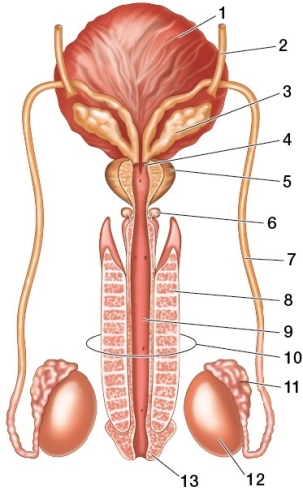 Based on the figure, which statement is true?
 (Multiple Choice)
4.8/5 (66)
(66) Refer to the figure showing the human male reproductive system. 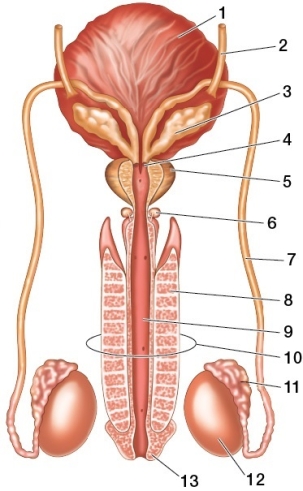 Based on the figure, which statement is true?
 (Multiple Choice)
4.8/5 (91)
(91) Most mammalian females (though not humans) have a period of sexual receptivity called _______.
(Short Answer)
4.9/5 (70)
(70) Refer to the figure showing oogenesis. 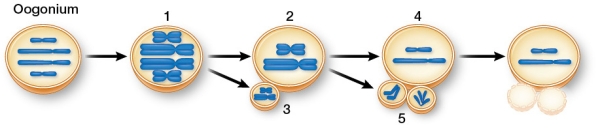 In the figure, the first haploid cell(s) is/are labeled _______.
 (Short Answer)
4.8/5 (81)
(81) The _______ cycles of most mammals, other than humans, do not include _______.
(Multiple Choice)
5.0/5 (80)
(80) You discover a mutation in sea urchins that causes females to produce eggs lacking bindin receptors on the vitelline envelope.What would you expect to see if you exposed these eggs to normal sea urchin sperm?
(Multiple Choice)
4.9/5 (77)
(77) Pregnancy tests that can be done at home detect the presence of
(Multiple Choice)
4.8/5 (73)
(73) For women, the earliest stage in the reproductive process targeted by most methods of birth control is _______ and the latest targeted stage is _______.
(Multiple Choice)
4.8/5 (78)
(78) Whereas luteinizing hormone (LH) and follicle-stimulating hormone (FSH) are produced by the _______ and act on the _______, estrogen and progesterone are produced by _______ and act on the _______.
(Multiple Choice)
5.0/5 (63)
(63) In the early 1900s, oyster fishermen cut sea stars (starfish), which are predators of oysters, into pieces and threw them back into the sea.This practice led to an explosion in the sea star population because
(Multiple Choice)
4.8/5 (77)
(77) In human males and females, a tumor on the anterior pituitary would most immediately affect secretion of _______ and _______.
(Multiple Choice)
4.9/5 (68)
(68) Some patients with breast cancer receive aromatase inhibitors as part of their medical treatment.Such an inhibitor causes
(Multiple Choice)
4.9/5 (69)
(69) 
Filters
- Essay(0)
- Multiple Choice(0)
- Short Answer(0)
- True False(0)
- Matching(0)