



 Chat with AI
Exam 42: Animal Reproduction

Exam 1: Studying Life246 Questions
Exam 2: Small Molecules and the Chemistry of Life246 Questions
Exam 3: Proteins, Carbohydrates, and Lipids246 Questions
Exam 4: Nucleic Acids and the Origin of Life246 Questions
Exam 5: Cells: the Working Units of Life248 Questions
Exam 6: Cell Membranes246 Questions
Exam 7: Cell Communication and Multicellularity246 Questions
Exam 8: Energy, Enzymes, and Metabolism246 Questions
Exam 9: Pathways That Harvest Chemical Energy246 Questions
Exam 10: Photosynthesis: Energy From Sunlight242 Questions
Exam 11: The Cell Cycle and Cell Division260 Questions
Exam 12: Inheritance, Genes, and Chromosomes250 Questions
Exam 13: Dna and Its Role in Heredity257 Questions
Exam 14: From Dna to Protein: Gene Expression252 Questions
Exam 15: Gene Mutation and Molecular Medicine251 Questions
Exam 16: Regulation of Gene Expression245 Questions
Exam 17: Genomes249 Questions
Exam 18: Recombinant Dna and Biotechnology243 Questions
Exam 20: Mechanisms of Evolution243 Questions
Exam 21: Reconstructing and Using Phylogenies246 Questions
Exam 22: Speciation247 Questions
Exam 23: Evolution of Genes and Genomes252 Questions
Exam 24: The History of Life on Earth246 Questions
Exam 25: Bacteria, Archaea, and Viruses262 Questions
Exam 26: The Origin and Diversification of Eukaryotes252 Questions
Exam 27: Plants Without Seeds: From Water to Land251 Questions
Exam 28: The Evolution of Seed Plants259 Questions
Exam 29: The Evolution and Diversity of Fungi261 Questions
Exam 30: Animal Origins and the Evolution of Body Plans248 Questions
Exam 31: Protostome Animals244 Questions
Exam 32: Deuterostome Animals246 Questions
Exam 33: The Plant Body243 Questions
Exam 34: Transport in Plants248 Questions
Exam 35: Plant Nutrition247 Questions
Exam 36: Regulation of Plant Growth246 Questions
Exam 37: Reproduction in Flowering Plants247 Questions
Exam 38: Plant Responses to Environmental Challenges246 Questions
Exam 39: Physiology, Homeostasis, and Temperature Regulation258 Questions
Exam 40: Animal Hormones249 Questions
Exam 41: Immunology: Animal Defense Systems265 Questions
Exam 42: Animal Reproduction261 Questions
Exam 43: Animal Development261 Questions
Exam 44: Neurons, Glia, and Nervous Systems250 Questions
Exam 45: Sensory Systems249 Questions
Exam 46: The Mammalian Nervous System: Structure and Higher Functions254 Questions
Exam 47: Musculoskeletal Systems259 Questions
Exam 48: Gas Exchange247 Questions
Exam 49: Circulatory Systems252 Questions
Exam 50: Nutrition, Digestion, and Absorption259 Questions
Exam 51: Salt and Water Balance and Nitrogen Excretion251 Questions
Exam 52: Animal Behavior249 Questions
Exam 53: The Physical Environment and Biogeography of Life248 Questions
Exam 54: Populations259 Questions
Exam 55: Species Interactions254 Questions
Exam 56: Communities247 Questions
Exam 57: Ecosystems238 Questions
Exam 58: A Changing Biosphere222 Questions
Select questions type


If a woman has scar tissue completely blocking both of her oviducts about halfway down their length, which event would be impossible without medical intervention?
(Multiple Choice)
4.9/5  (62)
(62) Which hormone would decline immediately after a bilateral oophorectomy (surgical removal of both ovaries)?
(Multiple Choice)
4.9/5 (87)
(87) Choose the correct pairing between cell type and function.
(Multiple Choice)
4.9/5 (74)
(74) There is great variety in how animals reproduce sexually.Of the events listed, which is essential for creating diploid offspring that are genetically different from the parents?
(Multiple Choice)
4.8/5 (74)
(74) If the seminal vesicles in a human male are defective, the
(Multiple Choice)
5.0/5 (84)
(84) A physician is discussing methods of contraception with a married couple.The husband and wife are both 35 years old, they have two children, and they have decided that their family is complete.The woman also had two difficult pregnancies and has learned that a third pregnancy could pose a risk to her health.Which method would the physician be likely to recommend to this couple?
(Multiple Choice)
4.9/5 (75)
(75) Which are the first haploid germ cells produced in spermatogenesis?
(Multiple Choice)
4.9/5 (73)
(73) Of the methods listed, which is the most effective form of birth control?
(Multiple Choice)
4.8/5 (96)
(96) Refer to the figure showing ICSI. 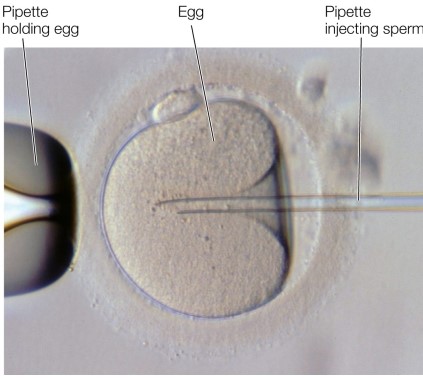 Under which condition would this form of assisted reproductive technology be used?
 (Multiple Choice)
5.0/5 (82)
(82) One of the first indications that a woman is pregnant is that she misses her monthly menstrual period.This is the result of
(Multiple Choice)
4.9/5 (67)
(67) Which statement about the male reproductive system in humans is true?
(Multiple Choice)
4.8/5 (76)
(76) Choose the correct order of events in sea urchin fertilization.
(Multiple Choice)
4.8/5 (83)
(83) Of the contraceptive methods listed, which has the lowest failure rate?
(Multiple Choice)
4.9/5 (80)
(80) Which statement represents the principal difference between the uterine cycle of humans and the cycles of other mammals?
(Multiple Choice)
4.8/5 (79)
(79) If a person develops an estrogen-secreting Leydig cell tumor, that person most likely will
(Multiple Choice)
4.8/5 (84)
(84) Following implantation, human chorionic gonadotropin secreted by the _______ keeps the corpus luteum functional.
(Short Answer)
4.8/5 (93)
(93) At which stage does the secondary oocyte resume meiosis in humans?
(Multiple Choice)
4.8/5 (73)
(73) 
Filters
- Essay(0)
- Multiple Choice(0)
- Short Answer(0)
- True False(0)
- Matching(0)